

Payments & AR
Cardiology AR Management Software
Work open cardiology claims by value, deadline and cause, from cath lab reads to device clinic periods and imaging approvals.
Cardiology AR Management Software tracks every unpaid cardiology claim and sorts follow-up by dollar value, payer deadline and cause. Cath and device implant claims, imaging denied for missing approval, and many small remote monitoring claims each land in their own worklist, with claim status pulled electronically before a collector calls.



 6,500+ specialty providers

AR Management in a Cardiology Practice
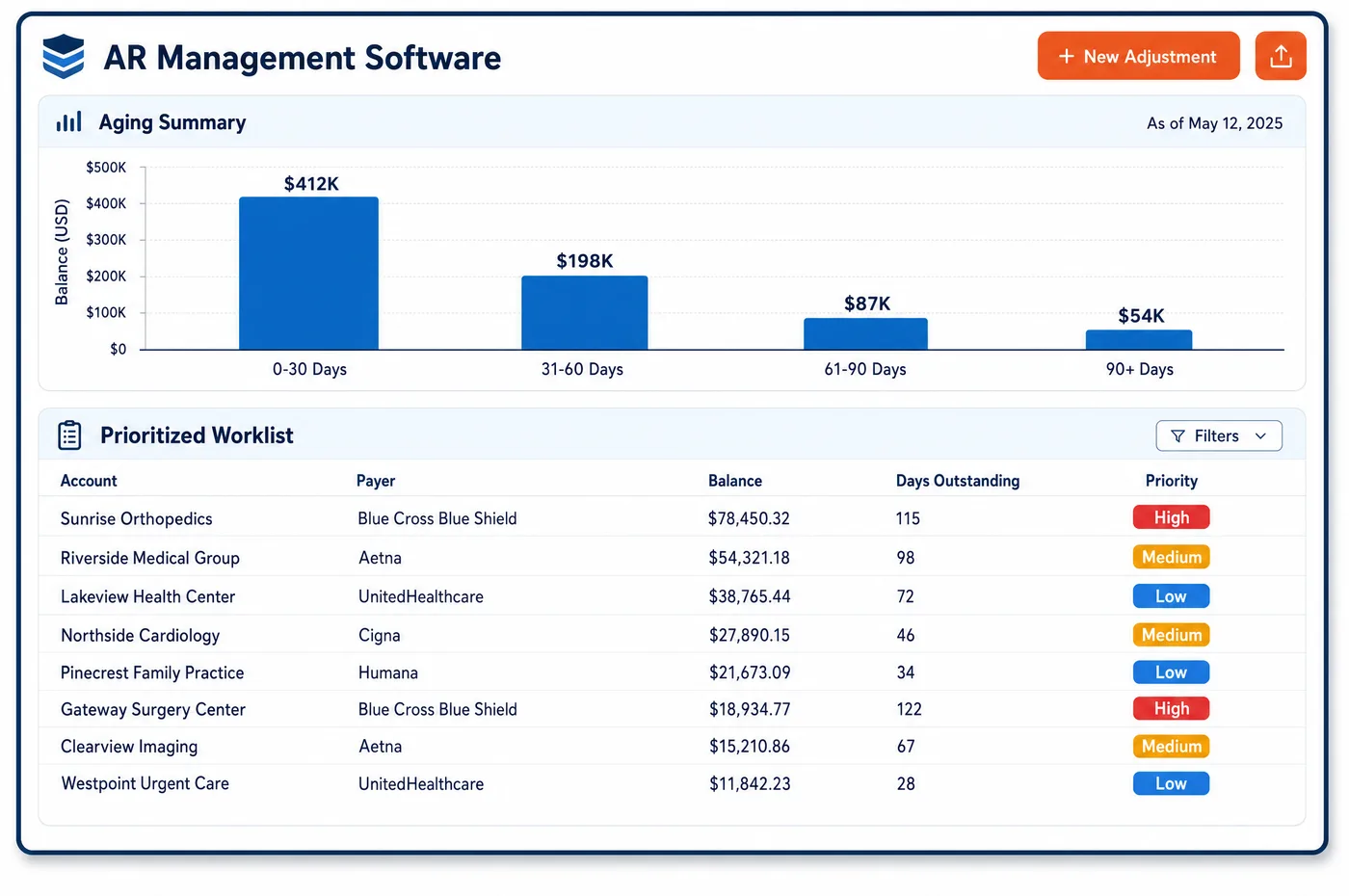
Open AR in a cardiology group comes from many sources at once. Interventional cases and device implants are often billed as professional claims from the hospital, and each carries a high value. Echo, nuclear and cardiac CT claims are often denied when a plan or its benefit manager had no approval on file. Device clinic claims are small but frequent, and they pile up quickly when one payer stops paying them. AR management sorts this mix into worklists by value, aging bucket and filing deadline. Electronic 276 status requests run on open claims first, so collectors only call when the payer has not answered. Denied claims carry their reason code to the worklist, and the appeal deadline is tracked next to the claim. Balances that move to a secondary plan are billed when the primary remit posts. Reports show aging by payer, service line and site, so a backlog in one area is visible early.
Why Is AR Management Different in Cardiology?
Cardiology AR mixes very high and very low claim values. A diagnostic cath with coronary angiography, a PCI or an ICD implant can be worth more than dozens of office visits. A remote pacemaker check is worth little on its own, but a device clinic may bill hundreds of them. If staff work AR oldest-first, high-value procedure claims wait behind small ones. If they work only big claims, a payer that quietly stops paying device checks can run up a large balance before anyone sees it.
Many cardiology denials are about approvals and coverage, not data entry. Many commercial and Medicare Advantage plans require prior authorization for nuclear stress tests, stress echo and cardiac CT or MRI, often through a benefit manager. A test done without approval is denied, and some plans allow a retro review only in narrow cases. Medicare contractors also use coverage policies that tie each test to listed diagnoses. Each of these denials needs a different fix, so AR has to sort them by cause.
Timing is tight. Medicare requires claims within one calendar year of the date of service, and commercial filing limits are often shorter. Hospital-read studies add charge lag, because the interpretation may reach billing well after the test. Appeals have their own windows. Cardiology AR management has to show each claim's deadline next to its balance, and hand off work that needs a coding fix to cardiology charge validation.
What Cardiology AR Management Software Handles
- Medicare filing deadline under 42 CFR 424.44
- Medicare gives a practice one calendar year from the date of service to file. Each open Medicare claim shows the date it ages out, and claims close to it move up the worklist. (42 CFR 424.44: Time limits for filing claims)
- CARC 197: authorization absent
- Imaging and stress test claims denied for missing approval are routed to the staff who handle approvals. The worklist shows whether an approval exists and was missing from the claim, or was never obtained. (X12 Claim Adjustment Reason Codes)
- CARC 50: medical necessity
- Tests denied as not medically necessary go to a queue with the diagnosis codes billed. Staff compare them with the coverage policy and the signed report before deciding to correct or appeal. (X12 Claim Adjustment Reason Codes)
- 276/277 claim status
- Electronic claim status requests run on open claims. Pended, denied and paid answers update the claim, so collectors call only on claims the payer has not answered. (X12 transaction sets, including 276/277 claim status and 835 remittance)
- Remote interrogation periods (93294 to 93296)
- Device clinic claims are tracked by device and period. A Novitas billing article for Medicare says these codes are reported no more than once every ninety days, so a period billed twice is caught in AR, not after a takeback. (CMS Medicare Coverage Database, Billing and Coding Article A56602: Cardiac Rhythm Device Evaluation (Novitas))
How Does Cardiology AR Management Software Work?
1. Build the worklists
Open claims are sorted by value, aging bucket, payer and filing deadline. Procedure claims, imaging denials and device clinic claims each have their own queue and owner.
2. Check status first
Electronic 276 requests run before anyone calls. Claims the payer has paid or denied update on their own and drop off the call list.
3. Sort denials by cause
Authorization, medical necessity, frequency and component denials each go to the team that can fix them. The reason code and the claim history travel with the item.
4. Correct or appeal
Fixable claims are corrected and resent. Appeals are built with the signed report, the approval record or the coverage policy, and their deadlines are tracked.
5. Bill the next payer
When the primary remit posts through cardiology payment posting, the rest of the balance goes to the secondary plan or the patient. Nothing waits for a monthly billing list.
Cardiology AR Management Software vs. Generic Software
| Area | Generic approach | Unlimited Systems |
|---|---|---|
| Work order | Worked in date order, big and small alike. | Value, deadline and cause decide what is worked first. |
| Claim status | Collectors call payers or log in to portals. | Electronic 276 requests run before any call. |
| Authorization denials | Mixed in with all other denials. | Routed to the approval team with the approval history. |
| Device clinic claims | Small balances ignored until they pile up. | Tracked by device and period, with payer trends shown. |
| Deadlines | Filing limits checked from memory. | Each claim shows its filing and appeal dates. |
Who Uses It in a Cardiology Practice
- AR collector: A worklist that puts high-value cath, implant and imaging claims first, with claim status already pulled.
- Billing manager: Aging by payer, service line and site, plus counts of denials by cause, so staffing can follow the work.
- Physician owner: A clear view of what is owed for procedures read or performed at each hospital, and what is at risk of aging out.
Cardiology AR Management Software FAQs
AR management in cardiology handles a wide range of claim values. A cath, PCI or device implant claim may be worth far more than a remote device check, but device clinics bill many more of the small ones. Worklists sort by value, deadline and cause, so procedure claims are worked first and small device claims are still watched for payer trends.
A nuclear, stress echo or cardiac CT claim denied for missing approval goes to the staff who manage approvals. The worklist shows whether an approval was on file and left off the claim, or was never obtained. A missing number is fixed and the claim resent. A test done without approval may need a retro review, if the plan allows one, or an appeal.
Hospital-read echoes, stress tests and caths are billed with modifier 26 and often reach billing late. Each claim shows its filing deadline from the date of service, not the date the charge arrived. Claims near the deadline move up the list. Charge lag is reported by hospital, so a slow feed from one site can be raised with that hospital.
Electronic 276 claim status requests run on open claims, and the 277 answer updates each one. Pended claims show what the payer is waiting for. Denied claims move to the right denial queue with their reason code. Collectors call only on claims the payer has not answered, which keeps phone time for the hard cases.
Remote monitoring claims are tracked by device and monitoring period, not only by amount. If one payer starts denying or pending them, the trend shows up in AR reports before the balance grows. Frequency denials are checked against the periods on file, so a correct denial is closed and a wrong one is appealed.
When the primary remit posts, the remaining balance moves to the secondary plan on file, and the secondary claim is sent. For Medicare patients with a supplement, the crossover is tracked so the claim is not billed twice. Any amount left after the secondary pays moves to the patient balance and its statement cycle.
Related Cardiology Software
Payments & AR
In the revenue cycle
AR Management for related specialties
Sources
GET STARTED
See Unlimited Systems in Action
Whether you're actively evaluating new technology or simply preparing for your next vendor renewal, Unlimited Systems can help you understand where your current workflows may be creating avoidable revenue risk.