

Payments & AR
Cardiology Payment Posting Software
Post every cardiology remit line by component, from global echo payments to stress agents and remote device checks.
Cardiology Payment Posting Software applies 835 remits and patient payments to cardiology claims one service line at a time. It tells global, professional and technical payments apart, checks diagnostic test reductions, posts stress agent units and device monitoring payments, and matches every deposit to the bank so cash and ledger agree.



 6,500+ specialty providers

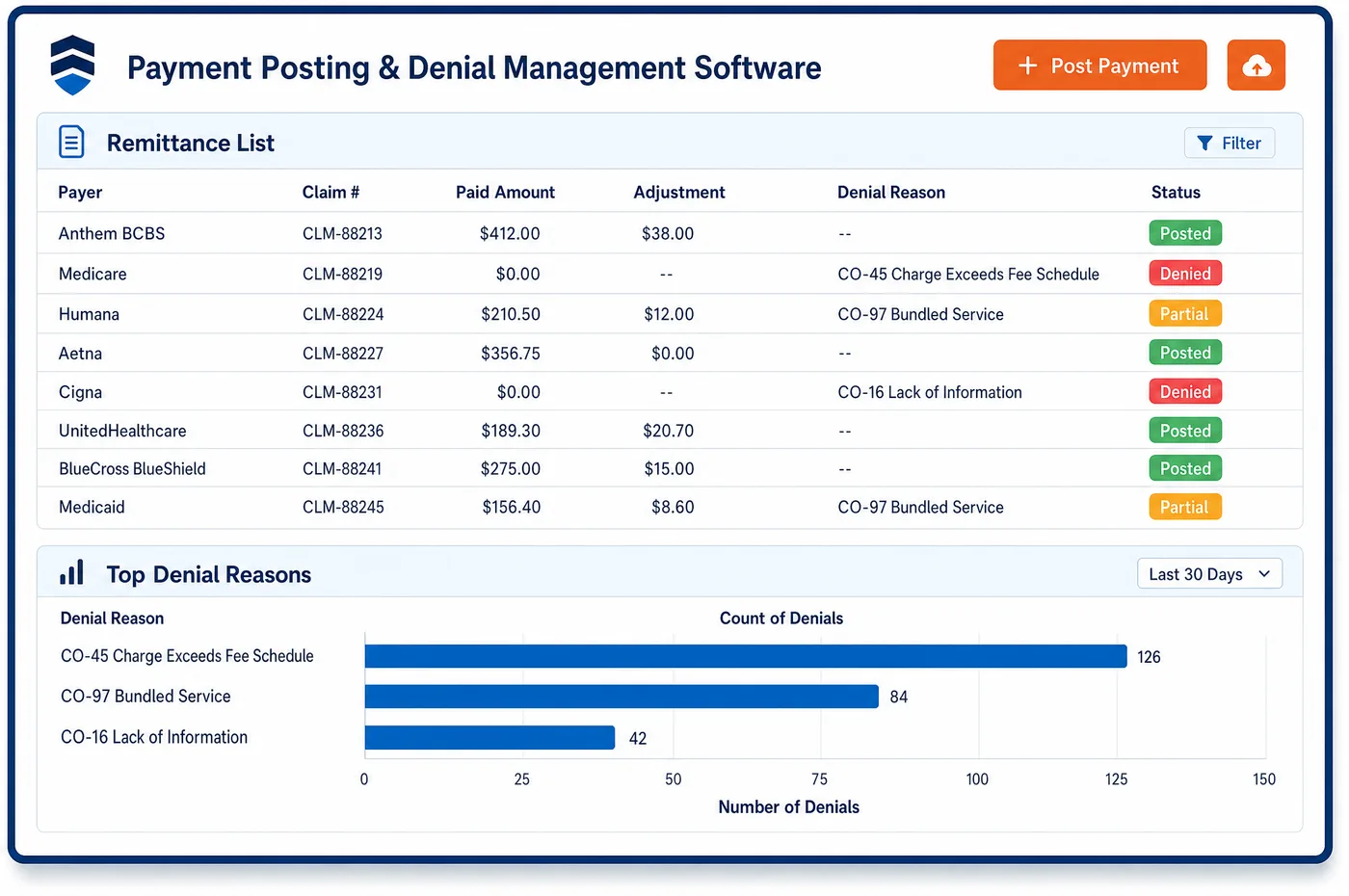
Payment Posting in a Cardiology Practice
A single cardiology 835 can mix very different payments. An office echo (93306) may pay as a global service. A hospital echo read by the same physician pays only the professional component, billed with modifier 26. A nuclear stress test can pay the imaging, the stress test codes and the stress agent on separate lines. Payment posting starts when the file arrives from the clearinghouse and balances to the check or EFT total. Each line is then matched to the charge it pays, with its modifiers and units. Medicare reduces the technical component of later diagnostic cardiovascular tests that one group bills for a patient on the same day, so a CARC 59 adjustment is checked against the line it should hit. Regadenoson (J2785) is paid per 0.1 mg unit, so paid units are compared with billed units. Remote device checks post to the period they cover. Short pays go to an underpayment queue, and zero-pay lines go to denial work.
Why Is Payment Posting Different in Cardiology?
Component billing makes cardiology remits harder to read. Many cardiac tests have a technical and professional split. When the practice owns the equipment and reads the study, it bills the global code. When the test runs in a hospital, the physician bills with modifier 26 and the hospital bills the facility side. One CPT code can pay three different amounts from the same payer. A poster who checks only the check total cannot see that a global claim was paid at the professional rate.
Stress testing adds its own code logic. Codes 93016, 93017 and 93018 split a stress test into supervision, tracing and interpretation, while 93015 covers all three as one global code. The NCCI manual treats the IV start and the injection for a drug-induced stress test as part of the test itself. The stress agent, such as regadenoson, is billed by HCPCS unit. Under Medicare Part B it is a single-dose drug that carries the JZ or JW modifier. Each of those lines pays on its own basis.
Device clinics bring a steady stream of small, recurring payments. Remote checks of pacemakers and ICDs are paid once per monitoring period, and a second claim in that period is often denied. Recoupments for past periods show up as takebacks on new remits. Posting has to tie each payment and each takeback to the right device period. If it does not, a denial looks like a payment error and a payment error looks like a denial. Lines that need an appeal should move straight to cardiology denial management with their reason codes.
What Cardiology Payment Posting Software Handles
- PC/TC indicators and modifiers 26 and TC
- Each paid line is compared with the component that was billed. A global echo paid at the professional rate, or a modifier 26 line paid as global, is flagged before it is accepted. (Medicare Claims Processing Manual, Chapter 12: Physicians/Nonphysician Practitioners (PC/TC indicators))
- CARC 59 on diagnostic cardiovascular tests
- Under Medicare, codes with multiple procedure indicator 6 have the technical component cut on the second and later tests for a patient on the same day. The multiple-procedure adjustment is checked against the lower-valued test, not the highest one. (CMS Recovery Audit Program, Approved Issue 0182: Reduction of Technical Component, Diagnostic Cardiovascular Services)
- Stress test codes 93015 to 93018
- When the practice supervises and reads a hospital stress test, 93016 and 93018 post as two professional lines. A payment on 93017 belongs to the entity that ran the equipment, so it is not expected on a hospital case. (Medicare Claims Processing Manual, Chapter 12: Physicians/Nonphysician Practitioners (PC/TC indicators))
- Regadenoson units (J2785)
- Regadenoson is billed per 0.1 mg, so a 0.4 mg dose is four units. Paid units are compared with billed units. For Medicare Part B the line also needs JZ or JW, because CMS lists J2785 as a single-dose drug. (CMS: Discarded Drugs and Biologicals, JW Modifier and JZ Modifier Policy HCPCS Codes)
- Remote interrogation (93294, 93295, 93296)
- A Novitas billing article for Medicare says these codes are reported no more than once every ninety days. Payments post against the device period they cover, so a frequency denial on a second claim is easy to spot. (CMS Medicare Coverage Database, Billing and Coding Article A56602: Cardiac Rhythm Device Evaluation (Novitas))
- 835 PLB provider-level adjustments
- Provider-level adjustments are split out by the claim they refer to. Staff see which earlier device period or test the money came back from. (X12 transaction sets, including the 835 Health Care Claim Payment/Advice)
How Does Cardiology Payment Posting Software Work?
1. Balance the file
Each 835 is checked against its payment total before anything posts. A file that does not balance stops and goes to the poster with the gap shown.
2. Match by component
Lines are matched to the CPT code, modifier 26 or TC, units and site of service on the charge. A global charge paid as professional only is held for review.
3. Check the expected payment
Allowed amounts are compared with the contract or fee schedule for that payer, setting and component. Short pays go to an underpayment queue with their CARC and RARC codes attached.
4. Move patient and secondary amounts
Deductible, coinsurance and copay amounts move to the patient balance. When a secondary plan is on file, the rest is set up for the secondary claim and tracked by cardiology AR follow-up.
5. Reconcile the deposit
Posted totals are matched to bank deposits using the EFT trace number. An ERA without a deposit, or a deposit without an ERA, shows up on a list the same day.
6. Route the exceptions
Zero-pay lines, frequency denials on device checks and authorization denials on imaging go to the right queue. Each one carries its reason code and the original claim.
Cardiology Payment Posting Software vs. Generic Software
| Area | Generic approach | Unlimited Systems |
|---|---|---|
| Component payments | Accepted when the check total looks close. | Each line checked against the global, 26 or TC rate it should pay. |
| Same-day test reductions | Assumed correct on every multi-test day. | CARC 59 checked against the lower-valued technical line. |
| Stress agent units | Posted as one drug line with no unit check. | Paid units compared with billed units per 0.1 mg. |
| Device monitoring payments | Posted to the patient with no period attached. | Posted to the device period they cover. |
| Deposits | Matched to the bank at month end. | Matched by EFT trace number as remits post. |
Who Uses It in a Cardiology Practice
- Payment poster: A short list of exceptions: files that do not balance, component mismatches, unit short pays and device period conflicts.
- Billing manager: Short-pay trends by payer and component. A plan that keeps paying office echoes at the hospital-read rate is easy to spot and take to contract talks.
- Practice CFO: Cash posted the way the bank reports it, with ERA and EFT matching behind each deposit and adjustments flowing to the general ledger.
Cardiology Payment Posting Software FAQs
Cardiology payment posting reads the modifier on each paid line and compares it with the charge. A global 93306 should pay the full office rate. A 93306 with modifier 26 should pay the professional rate only, and a TC line pays the technical part. If a global claim pays at the professional rate, the line is held as a possible underpayment with its reason code shown.
Medicare cuts the technical component of the second and later diagnostic cardiovascular tests that the same group bills for the same patient on the same day. The highest-paid test is paid in full. The posting check confirms that the cut landed on a lower-valued test. Professional components are not part of this reduction, so a cut on a modifier 26 line is flagged for review.
Stress agents post as drug lines with their HCPCS units. Regadenoson (J2785) is billed per 0.1 mg, so the paid units are compared with the units on the claim. For Medicare Part B, the line carries the JZ modifier when nothing was discarded, or JW on a separate line for any discarded amount. A unit short pay goes to review.
The denial is matched to the device and the monitoring period on file. If the practice already billed that period, the denial is correct and the line is closed. If the earlier claim was for another device or period, the line goes back for correction or appeal. Novitas tells Medicare billers to report 93294 through 93296 no more than once every ninety days.
Recoupments in the 835 PLB segment are split out and linked to the claim they came from. Staff can see whether the payer took money back for a test, a device period or a duplicate payment. That keeps a takeback from lowering an unrelated new payment, and it shows whether the recoupment should be accepted or appealed.
Every posted remit is matched to a bank deposit by the EFT trace number in the 835. Payments with no ERA, and ERAs with no deposit, appear on a reconciliation list. Finance sees cash that agrees with the bank, and the posted payments and adjustments feed the general ledger without being keyed a second time.
Related Cardiology Software
Payments & AR
In the revenue cycle
Payment Posting for related specialties
Sources
- Medicare Claims Processing Manual, Chapter 12: Physicians/Nonphysician Practitioners (PC/TC indicators)
- CMS Recovery Audit Program, Approved Issue 0182: Reduction of Technical Component, Diagnostic Cardiovascular Services
- CMS: Discarded Drugs and Biologicals, JW Modifier and JZ Modifier Policy HCPCS Codes
- CMS Medicare Coverage Database, Billing and Coding Article A56602: Cardiac Rhythm Device Evaluation (Novitas)
- X12 transaction sets, including the 835 Health Care Claim Payment/Advice
- CMS NCCI Policy Manual for Medicare Services, Chapter XI (Medicine), Cardiovascular Services
GET STARTED
See Unlimited Systems in Action
Whether you're actively evaluating new technology or simply preparing for your next vendor renewal, Unlimited Systems can help you understand where your current workflows may be creating avoidable revenue risk.