

Billing & claims
Cardiology Denial Management Software
Prevent, sort, work and appeal cardiology denials, from missing benefit manager approvals and bundled cath lines to device frequency and coverage modifier errors.
Cardiology Denial Management Software stops preventable denials before heart practice claims go out, then sorts and works the ones that still come back. It groups denials by payer, code, provider and reason, routes each to the right person with the next step attached, and sends root causes back to clearance, coding and billing.



 6,500+ specialty providers

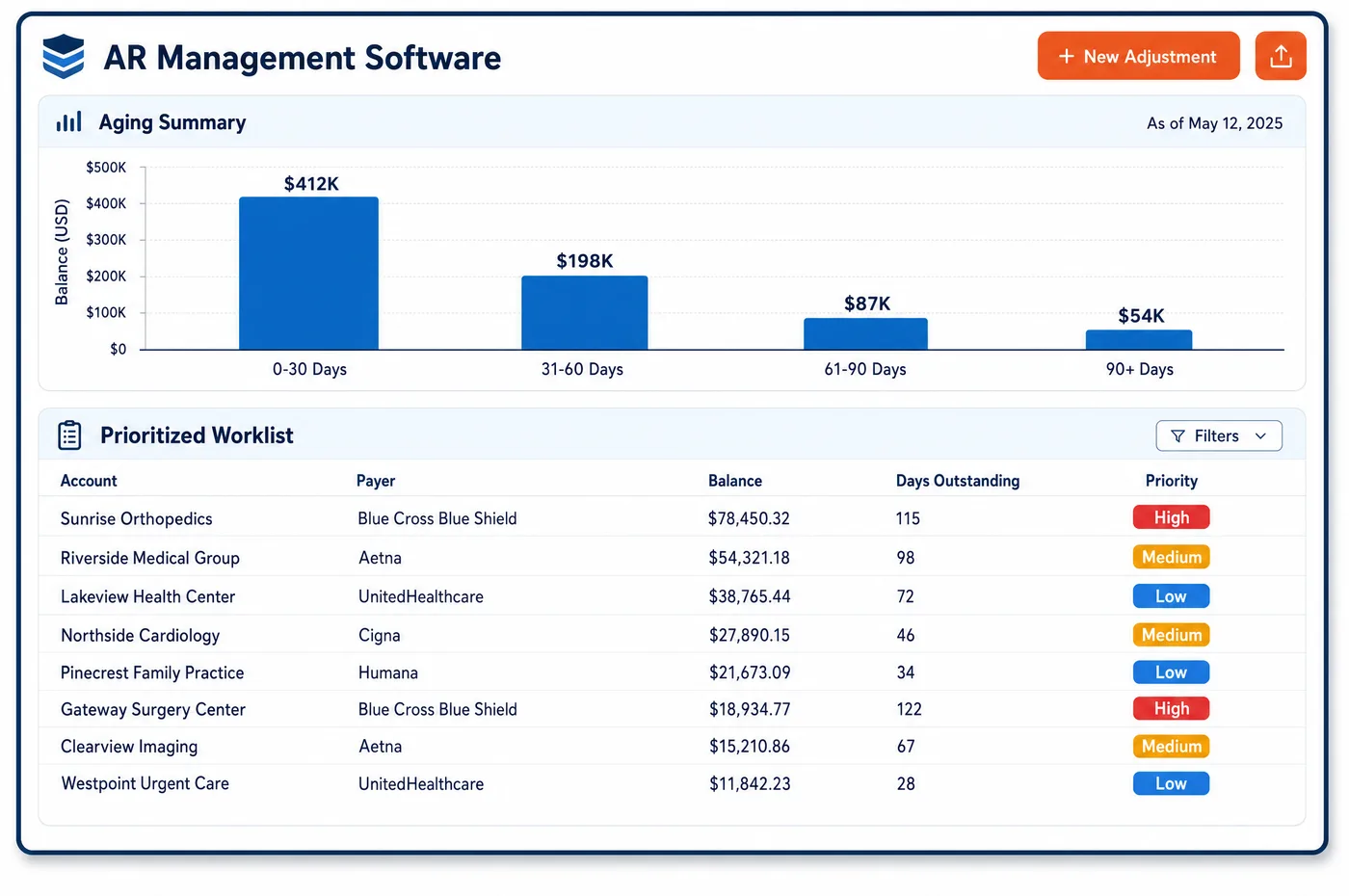
Denial Management in a Cardiology Practice
Cardiology denials tend to cluster. Imaging and cath claims deny when a benefit manager's approval is missing or doesn't match the service. Cath and PCI claims deny when a bundled service is billed as its own line. Device claims deny when a remote check comes too soon or a pacemaker line lacks its coverage modifier. Rehab claims deny past the session cap without KX. Each pattern has a different owner and a different fix. Cardiology denial management software reads the reason codes on each remittance and sorts the denial into one of these groups. Open denials are sorted by value and filing deadline, so the costliest claims at risk are worked first. Each one arrives with the likely cause and the documents that resolve it, such as the order number, the cath report or the signed ABN. Staff correct and resend, or appeal with the record attached. Patterns go back upstream, so the same denial doesn't keep coming back.
Why Is Denial Management Different in Cardiology?
A cardiology denial is often expensive and hard to undo. A nuclear study done without the benefit manager's approval may not be approved after the fact. A device implant without its coverage modifier comes back before it is even processed. Because the claims are large, a few denials can make a big dent in revenue, and preventing them is worth more than appealing them.
Many cardiology denials trace to one step upstream. A missing approval points to clearance. A bundled ultrasound guidance line points to charge capture in the cath lab. A remote check billed early points to the device clinic schedule. Denial management in cardiology works best when each group of denials has an owner who fixes the cause, not just the claim.
Appeals in cardiology lean on clinical detail. A medical necessity appeal for a stress test needs the symptoms and the reason for the test. A frequency appeal for a device check needs the event that prompted it. A global period denial for a return to the cath lab needs the note showing a complication. Having those documents linked to the denial saves time and makes each appeal stronger.
What Cardiology Denial Management Software Handles
- Missing approval (CARC 197)
- A CARC 197 code says the needed precertification or authorization was missing. These denials route to the clearance team with the order history attached, since a missing benefit manager approval is a front-end problem. (X12: Claim Adjustment Reason Codes (CARC) code list)
- TAVR modifier denials (CARC 4)
- Medicare returns TAVR professional claim lines that lack modifier 62 or Q0 with CARC 4, meaning the modifier is inconsistent or a required one is missing. The fix is a corrected line with the right modifiers. (CMS Medicare Claims Processing Manual, Chapter 32, sections 140.2.2.4 (CR sessions beyond 36) and 290 (TAVR))
- Cardiac rehab past 36 sessions (CARC 119)
- Medicare denies cardiac rehab lines past 36 sessions that lack KX with CARC 119, benefit maximum reached. When the record supports more sessions, staff add KX and resend. (CMS Medicare Claims Processing Manual, Chapter 32, sections 140.2.2.4 (CR sessions beyond 36) and 290 (TAVR))
- Frequency denials (CARC 151)
- CARC 151 means the payer finds the claim doesn't support this many services or this frequency. Remote device check denials with this code are compared with the payer's interval and the last billed date. (X12: Claim Adjustment Reason Codes (CARC) code list)
- Bundled cath lab services
- NCCI bundles access, dye injection, fluoroscopy, ECG strips and ultrasound guidance into cath and PCI codes. Denials for those lines are closed as coding errors and sent back to the charge build, not appealed. (CMS NCCI Policy Manual for Medicare Services, Chapter XI, section I: Cardiovascular Services)
- Return to the cath lab in a global period
- For global surgery rules, Medicare counts a cardiac cath suite as an operating room. An unplanned return to it for a related problem is billed with modifier 78, so a global period denial for that case is appealed with the note. (CMS MLN Booklet: Global Surgery (MLN907166))
How Does Cardiology Denial Management Software Work?
1. Stop denials before they start
Claims are checked against payer policy, coding edits and past remit outcomes before they go out. Likely denials are held for a fix in cardiology charge validation.
2. Read and sort what comes back
Remittances post through cardiology payment posting, and each denial's reason code sorts it into a group: approval, bundling, modifier, frequency, coverage or global period.
3. Work the costliest first
The open denial list is ordered by dollar value and filing deadline. Each one lands with the right person, along with the likely cause and the documents needed to resolve it.
4. Correct, resend or appeal
Coding and modifier errors are corrected and resent. Medical necessity and global period denials are appealed with the clinical record, and peer-to-peer reviews are logged when a benefit manager offers one.
5. Fix the cause upstream
Denial patterns by payer, code and provider go back to the team that owns the step. Missing approvals go to financial clearance, and bundling errors go to the charge build.
Cardiology Denial Management Software vs. Generic Software
| Area | Generic approach | Unlimited Systems |
|---|---|---|
| Prevention | Denials found after payment is refused. | Claims checked against policy and remit history before submission. |
| Sorting | One long list of denials. | Groups by reason, payer, code and provider. |
| Priority | Oldest first, or whoever calls loudest. | Worked in order of dollar value and filing deadline. |
| Appeals | Records gathered by hand. | Likely cause and documents attached. |
| Root cause | The same denial over and over. | Patterns sent to the step that caused them. |
Who Uses It in a Cardiology Practice
- Denial specialist: A worklist sorted by value and deadline, with the cause and documents on each denial.
- Prior authorization team: A clear list of missing-approval denials by plan and benefit manager, so their front-end process can change.
- Billing director: Denial trends by service line and payer, showing which upstream fixes are working and where denials are still high.
Cardiology Denial Management Software FAQs
Denial management in cardiology starts before the claim goes out, with checks against payer policy, coding edits and past results. Denials that still come back are sorted by reason, such as missing approvals, bundling, modifiers, frequency or global periods. Each is routed by value and deadline to the person who can fix it, with the documents attached.
Some benefit managers allow a retro request for a short time after the service, but many denials for a missing approval can't be reversed. That is why prevention matters most for cardiac imaging. When a retro path exists, the denial routes to the authorization team at once, with the order and the clinical notes ready to send.
Denials for services bundled into a cath or PCI, such as ultrasound guidance or fluoroscopy, are coding errors. They are closed and adjusted rather than appealed, and the pattern goes back to the charge build so the line isn't added again. Appeals are saved for denials where the record supports a separate service.
A frequency denial on a remote device check is compared with the payer's interval and the last billed check. If the claim went out early, it is corrected under the payer's rules. If the check was needed sooner for a clinical reason, such as a device alert, staff appeal with the note that explains it.
When a patient returns to the cath lab for a related problem during a global period, Medicare treats the cath suite as an operating room. That unplanned return can be billed with modifier 78. A denial for it is appealed with the procedure note showing the problem and the return to the lab.
The most useful reports group denials by reason, payer, code and provider, and show the trend over time. Cardiology practices also gain from viewing denials by service line, such as imaging, cath lab, device clinic and rehab. Those views show where a fix upstream will stop the most denials.
Related Cardiology Software
Billing & claims
In the revenue cycle
Denial Management for related specialties
Sources
- X12: Claim Adjustment Reason Codes (CARC) code list
- Carelon Medical Benefits Management: Radiology and cardiology program FAQ
- CMS Medicare Claims Processing Manual, Chapter 32, sections 140.2.2.4 (CR sessions beyond 36) and 290 (TAVR)
- CMS NCCI Policy Manual for Medicare Services, Chapter XI, section I: Cardiovascular Services
- CMS MLN Booklet: Global Surgery (MLN907166)
GET STARTED
See Unlimited Systems in Action
Whether you're actively evaluating new technology or simply preparing for your next vendor renewal, Unlimited Systems can help you understand where your current workflows may be creating avoidable revenue risk.