

Front office
Cardiology Financial Clearance Software
Check benefits, approvals, Medicare coverage rules and patient cost before a heart test or procedure.
Cardiology Financial Clearance Software confirms that a heart test or procedure is covered and approved before it happens. It checks benefits and tracks approvals for imaging and cath services. It flags Medicare coverage rules for devices and gives the patient a cost estimate. Problems surface while the date can still move.



 6,500+ specialty providers

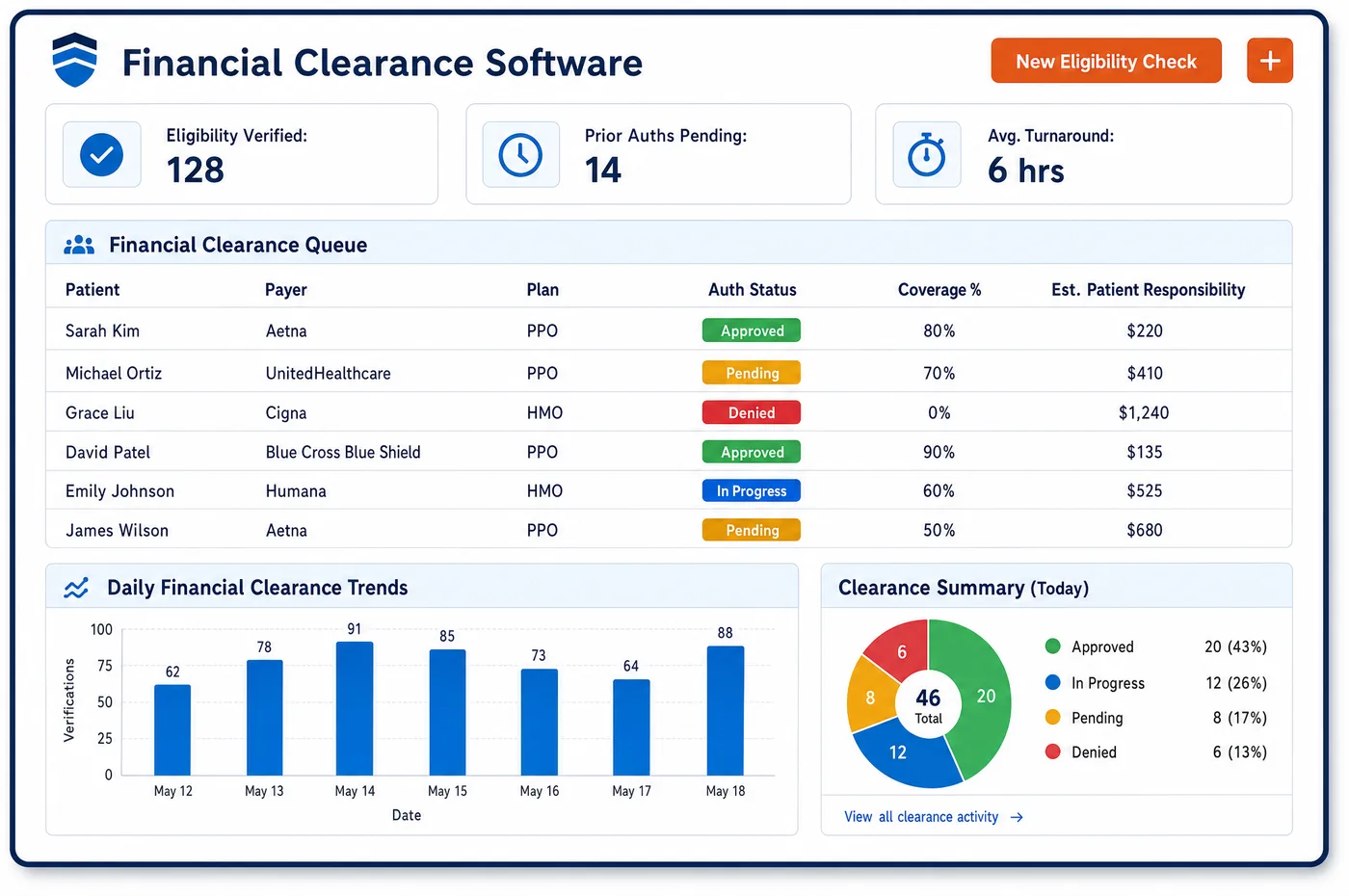
Financial Clearance in a Cardiology Practice
Clearance in cardiology runs on two tracks. For commercial and Medicare Advantage plans, many tests need prior approval, often from a benefit manager that reviews imaging and cardiology for the plan. Staff request an order number before an elective outpatient test, attach the clinical reason and track the answer on the booking. For Original Medicare, prior approval is rarely the issue. Coverage depends instead on national and local coverage rules, such as the criteria for a pacemaker or an ICD. When a service may not meet those rules, the patient signs an advance notice first. Cardiology financial clearance software runs eligibility at booking and shows the deductible and coinsurance left. It holds the test until its approval is in place. It also estimates what the patient will owe. In the hospital, that estimate covers only the practice's professional part, since the hospital bills the technical part. Patients learn their share before the test, not from a statement that arrives later.
Why Is Financial Clearance Different in Cardiology?
Approval rules for cardiac services shift often. A payer may add stress echo to its list one year and drop some nuclear and echo codes the next. Benefit managers set their own clinical criteria and request steps. Clearance in cardiology can't rely on last year's list. It has to check the current rule for the plan on the date of service.
Original Medicare raises a different problem. There is usually no approval to request, but device implants and structural heart procedures must meet national coverage criteria. A pacemaker claim needs a modifier that attests the criteria are met. When they may not be, the patient needs an advance beneficiary notice before the service, or the practice may not be able to bill the patient later.
Cardiac testing is also expensive for patients. Imaging and procedures often fall under the deductible, and a patient may get one bill from the practice and another from the hospital. An estimate at booking that explains which part comes from whom prevents confusion and makes payment at the visit more likely.
What Cardiology Financial Clearance Software Handles
- Benefit manager order numbers
- Carelon asks providers to get an order number before they book or perform elective outpatient imaging and cardiology services. It warns that skipping this step can lead to denial. The booking is held until the order number is on file. (Carelon Medical Benefits Management: Radiology and cardiology program FAQ)
- Added procedures found during a test
- If an added procedure is needed during an approved service, Carelon says to go ahead. The office then calls for an order number for the added procedure. Clearance opens a task so that request isn't missed. (Carelon Medical Benefits Management: Radiology and cardiology program FAQ)
- UnitedHealthcare cardiology program
- UnitedHealthcare requires prior approval for heart rhythm device implants, diagnostic caths and stress echo in the office or outpatient setting. It is not required for inpatient, emergency, urgent care or observation care. Clearance checks the planned setting too. (UnitedHealthcare Provider: Cardiology prior authorization program)
- UnitedHealthcare changes for 2026
- UnitedHealthcare announced that starting Jan. 1, 2026, certain nuclear imaging and echocardiogram procedures no longer need prior authorization on many of its plans. Clearance rules are updated from the payer's current code list rather than carried forward. (UnitedHealthcare Provider News: Removal of prior authorizations for radiology and cardiology procedures)
- Pacemaker coverage modifiers (33206–33208)
- Under WPS policy, modifier KX tells Medicare the chart shows the patient meets the pacemaker coverage rules. Claims that meet neither the KX nor the SC rules take GA or GZ, based on whether an ABN is on file. Those claims are denied. (CMS Medicare Coverage Database, WPS Billing and Coding Article A54958: Single Chamber and Dual Chamber Permanent Cardiac Pacemakers)
- ICD coverage exclusions (NCD 20.4)
- NCD 20.4 excludes some patients soon after a heart attack, bypass surgery or PCI, and requires shared decision-making for many first implants. Clearance checks those criteria against the chart before the implant is confirmed. (CMS National Coverage Determination 20.4: Implantable Cardioverter Defibrillators (ICDs))
How Does Cardiology Financial Clearance Software Work?
1. Run eligibility at booking
An eligibility check runs as soon as a test or procedure is booked. The remaining deductible, coinsurance and plan type come back to the booking record.
2. Check whether approval is needed
The planned code, setting and plan decide whether approval is needed and from whom. Requests start from the booking with the clinical reason attached, using electronic prior authorization where the payer offers it.
3. Apply Medicare coverage rules
For Original Medicare, staff check the national and local coverage rules for the service. When coverage is in doubt, the patient signs an ABN before the service.
4. Estimate the patient's share
The estimate shows what the patient owes the practice and notes when the hospital will bill separately. Uninsured or self-pay patients get a good faith estimate when the visit is booked far enough ahead.
5. Release or hold the booking
Once approval and coverage are confirmed, the booking is cleared. If not, it is held, and cardiology patient scheduling moves the date instead of losing the slot on the day.
Cardiology Financial Clearance Software vs. Generic Software
| Area | Generic approach | Unlimited Systems |
|---|---|---|
| Approval tracking | Spreadsheets of pending requests. | Approval status shown on each booking. |
| Payer lists | Last year's code list reused. | Rules updated from each payer's current list. |
| Medicare coverage | Checked after a denial. | Coverage criteria checked before the service. |
| Added procedures | Found when the claim denies. | Follow-up request opened the same day. |
| Patient estimates | One number that ignores the hospital bill. | Estimate split between practice and hospital. |
Who Uses It in a Cardiology Practice
- Scheduler: A clear signal on each booking: cleared, waiting on approval or held.
- Prior authorization coordinator: One queue of open requests by payer and benefit manager, with each order number tied to the booking and passed to cardiology medical billing.
- Patient: A cost estimate before the test that explains the practice bill and the hospital bill. Balances and payment options carry over to cardiology patient billing.
Cardiology Financial Clearance Software FAQs
Financial clearance for a cardiac test checks the plan, the deductible left and the coinsurance. It asks whether the plan needs prior approval and whether Medicare coverage rules are met. It also builds a cost estimate for the patient. The test is cleared only when those checks are done, so problems are fixed before the patient arrives.
Many health plans hand cardiac imaging and cardiology review to a benefit manager such as Carelon or eviCore. The ordering provider's office requests an order number, and the benefit manager reviews it against its clinical criteria. Which vendor applies depends on the plan, so clearance reads the plan product before starting the request.
Original Medicare generally does not require prior approval for stress tests or echoes. Coverage depends instead on medical necessity under national and local coverage rules, with the diagnosis on the claim supporting the test. When a test may not meet those rules, the patient can be asked to sign an advance notice first.
When a diagnostic cath leads to an intervention in the same session, the cardiologist proceeds as care requires. Some benefit managers then expect a request for the added procedure soon after. Clearance opens a task for that request the same day, so the added service has approval on file before the claim goes out.
For tests done in the hospital, the practice bills the professional part and the hospital bills the technical part. The estimate shows the practice's share and notes that a separate hospital bill will follow. For office tests, the practice bills the whole service, and the estimate reflects that single bill.
An advance beneficiary notice is for Original Medicare patients when a service may not meet coverage rules. The patient signs it before the service and chooses whether to go ahead. With a signed ABN on file, the claim carries modifier GA, and the patient can be billed if Medicare denies.
Related Cardiology Software
Front office
In the revenue cycle
Financial Clearance for related specialties
Sources
- Carelon Medical Benefits Management: Radiology and cardiology program FAQ
- UnitedHealthcare Provider: Cardiology prior authorization program
- UnitedHealthcare Provider News: Removal of prior authorizations for radiology and cardiology procedures
- CMS Medicare Coverage Database, WPS Billing and Coding Article A54958: Single Chamber and Dual Chamber Permanent Cardiac Pacemakers
- CMS National Coverage Determination 20.4: Implantable Cardioverter Defibrillators (ICDs)
- CMS Medical Bill Rights: Good faith estimate guide for patients who are not using insurance
GET STARTED
See Unlimited Systems in Action
Whether you're actively evaluating new technology or simply preparing for your next vendor renewal, Unlimited Systems can help you understand where your current workflows may be creating avoidable revenue risk.