

Front office
Cardiology Patient Scheduling Software
Book consults, stress tests, echoes, device checks and cardiac rehab with the right room, machine, staff and supervising doctor.
Cardiology Patient Scheduling Software books each heart visit and test with the time, room, equipment and staff it needs. Consults, treadmill and nuclear stress tests, echoes, device clinic checks and cardiac rehab sessions each have their own visit type. Tests that need approval are held until it arrives, so the slot isn't lost.



 6,500+ specialty providers

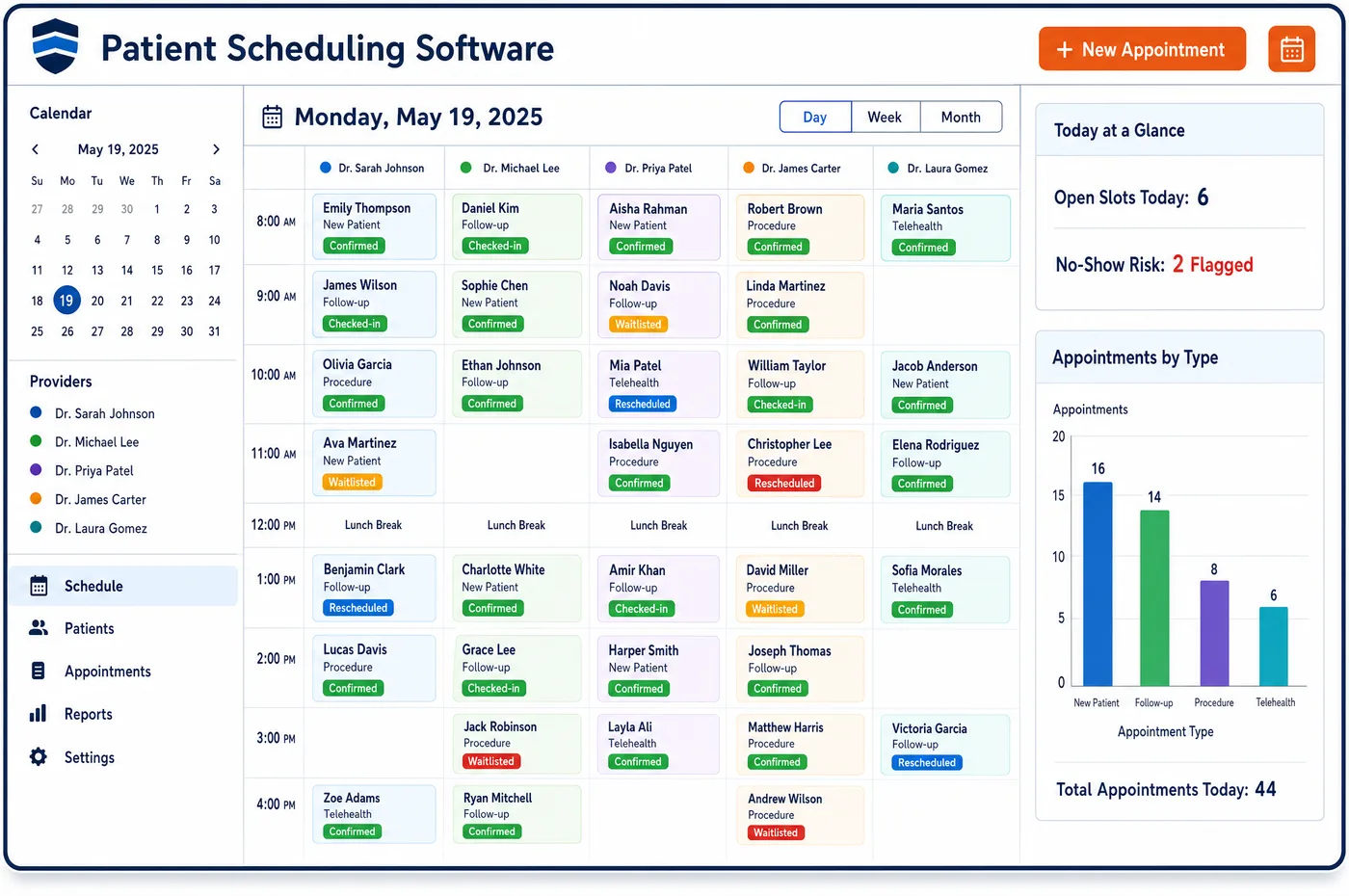
Patient Scheduling in a Cardiology Practice
A cardiology day runs on more than the doctor's calendar. A nuclear stress test ties up a treadmill, a camera, a tech and a supervising provider, and its rest and stress parts may fall hours apart. An echo needs a machine and a sonographer. A device clinic visit needs time with the right programmer for the patient's device. Cardiac rehab runs group sessions with staff and a provider on hand. Cardiology patient scheduling software builds each of these as a visit type with its own length and resources. It books a drug-based stress test when the patient can't exercise. It holds tests that need a benefit manager's approval until the order number is in. Remote device checks are planned on the payer's cycle, so transmissions line up with billable periods. Reminders go out by text, and a waitlist fills open slots when patients cancel. The result is a day where rooms, machines and people are all booked against the same plan.
Why Is Patient Scheduling Different in Cardiology?
Cardiology schedules are built around shared machines. A practice may have one nuclear camera, two treadmills and a few echo machines shared by many doctors. When the schedule only knows provider names, two tests land on one camera, or a tech is booked in two rooms. Booking the equipment and staff along with the doctor keeps the testing area moving.
Supervision rules shape the day too. Stress tests and cardiac rehab need a physician or qualified practitioner available while they run. A day full of stress tests with no supervising provider on site is a day of tests that can't be billed. The schedule has to show who is supervising each block, not just who reads the results.
Many cardiac tests also depend on an approval or a set cycle. A nuclear study booked before the benefit manager grants prior authorization can deny. A remote device check sent too soon after the last one can't be billed. Patient scheduling in a heart practice has to know these rules at the moment of booking, when the date can still change.
What Cardiology Patient Scheduling Software Handles
- Exercise or drug-based stress booking
- Novitas asks the chart to show why a drug-based stress test was chosen over exercise. The visit type records the protocol and the reason, so the booking and the note agree. (CMS Medicare Coverage Database, Novitas Billing and Coding Article A56423: Cardiology Non-emergent Outpatient Stress Testing)
- Cardiac rehab session length (93797, 93798)
- Medicare counts one rehab session under 93797 or 93798 when treatment lasts at least 31 minutes, and two in a day only at 91 minutes or more. Sessions are booked to those lengths, with no more than two per day. (CMS Medicare Claims Processing Manual, Chapter 32, section 140: Cardiac Rehabilitation Programs)
- Rehab supervision
- Medicare requires a physician or nonphysician practitioner to be immediately available during cardiac rehab, and NPPs may supervise it since January 1, 2024. Each rehab block is booked with a named supervising provider. (CMS Medicare Claims Processing Manual, Chapter 32, section 140: Cardiac Rehabilitation Programs)
- Remote interrogation cycles (93294–93296)
- Novitas says codes 93293 through 93296 are reported no more than once every ninety days, and not for a monitoring period shorter than thirty days. Remote check dates are planned on that cycle. (CMS Medicare Coverage Database, Novitas Billing and Coding Article A56602: Cardiac Rhythm Device Evaluation)
- Order numbers before imaging
- Carelon asks for an order number before elective outpatient imaging and cardiology services are booked or done. Nuclear and stress echo bookings stay pending until the number is on file. (Carelon Medical Benefits Management: Radiology and cardiology program FAQ)
- Same-day consult and stress test
- Under NCCI policy, a history and exam tied to a stress test are part of the test. When a consult and a test fall on one day, the consult is booked as its own visit, since only a separate E/M can be billed with modifier 25. (CMS NCCI Policy Manual for Medicare Services, Chapter XI, section I: Cardiovascular Services)
How Does Cardiology Patient Scheduling Software Work?
1. Build visit types and resources
Each service gets a visit type with a length, room, machine and staff role. Consults, stress tests, echoes, device checks and rehab are booked from those types.
2. Assign supervising providers
Testing and rehab blocks carry a named supervising provider. If that provider is out, the block is flagged before patients are booked into it.
3. Hold for clearance
Tests that need approval stay pending until cardiology financial clearance confirms the order number. The patient is told the date is tentative until then.
4. Send prep and reminders
Reminders go out by text or email with prep instructions for stress tests and caths. Patients confirm or ask to move the visit through patient engagement for cardiology.
5. Fill gaps from the waitlist
A cancellation triggers a text offer to patients on the waitlist. A cancelled nuclear slot can go to a patient whose approval is already in.
Cardiology Patient Scheduling Software vs. Generic Software
| Area | Generic approach | Unlimited Systems |
|---|---|---|
| Resources | Booked by doctor only. | Doctor, room, machine and tech booked together. |
| Supervision | Assumed someone is in the building. | Named supervising provider on each block. |
| Approvals | Tests booked before approval. | Tests held until the order number is in. |
| Device checks | Remote checks set at random. | Remote checks planned on the payer's cycle. |
| Cancellations | Empty camera time. | Waitlist offers the slot by text. |
Who Uses It in a Cardiology Practice
- Scheduler: Visit types that book the right room, machine and staff in one step, with clear holds for tests waiting on approval.
- Testing lab lead: A day plan for the camera, treadmills and echo machines that matches the staff on hand.
- Medical director: Supervision coverage for every stress test and rehab block, with visit details passed on for charge validation.
Cardiology Patient Scheduling Software FAQs
Patient scheduling for a cardiac stress test books the treadmill or the drug-based protocol, the tech, the room and a supervising provider together. Nuclear tests also book camera time for both the rest and stress parts. The booking stays pending until any required approval is in, and prep instructions go out with the reminder.
Device clinic visits are booked as their own visit type with time for the check and any programming. Remote checks are planned on the payer's billing cycle, so transmissions fall in billable periods. Patients who miss a transmission show up on a list, and staff reach out before the next check is due.
Cardiac rehab is booked as a series of group sessions with staff and a supervising provider. Sessions are set to lengths that meet Medicare's counting rules, with no more than two a day. The session count shows on each booking, so staff can see when a patient nears the covered limit.
Each testing or rehab block has a named supervising provider. When that provider is out, the block is flagged before more patients are booked into it. The practice can assign another provider or move the patients. Tests then run with the supervision the payer expects, and the claim isn't put at risk.
The scheduler checks the plan, the test and the setting when the visit is booked. Tests that need a benefit manager's approval are held as pending until the order number is on file. Staff see which bookings are waiting, so they can follow up before the test date instead of on it.
When a patient cancels, waitlist patients get a text offering the open slot. The offer goes first to patients who already have approval and prep done, so a cancelled nuclear or echo slot can still be used. No-shows and late cancellations are tracked by visit type to show where reminders need to change.
Related Cardiology Software
Front office
In the revenue cycle
Patient Scheduling for related specialties
Sources
- CMS Medicare Coverage Database, Novitas Billing and Coding Article A56423: Cardiology Non-emergent Outpatient Stress Testing
- CMS Medicare Claims Processing Manual, Chapter 32, section 140: Cardiac Rehabilitation Programs
- CMS Medicare Coverage Database, Novitas Billing and Coding Article A56602: Cardiac Rhythm Device Evaluation
- Carelon Medical Benefits Management: Radiology and cardiology program FAQ
- CMS NCCI Policy Manual for Medicare Services, Chapter XI, section I: Cardiovascular Services
GET STARTED
See Unlimited Systems in Action
Whether you're actively evaluating new technology or simply preparing for your next vendor renewal, Unlimited Systems can help you understand where your current workflows may be creating avoidable revenue risk.