

Payments & AR
Cardiology Integrated Patient Payments Software
Card on file, payment plans, text-to-pay and deposits for cardiology balances, all posting to the same patient ledger.
Cardiology Integrated Patient Payments Software lets patients pay cardiology balances by card, bank account, text link or portal, and posts each payment to the practice ledger. It suits the way cardiology patients owe: deposits before planned tests, recurring device check and monitoring coinsurance, rehab session copays and large procedure deductibles.



 6,500+ specialty providers

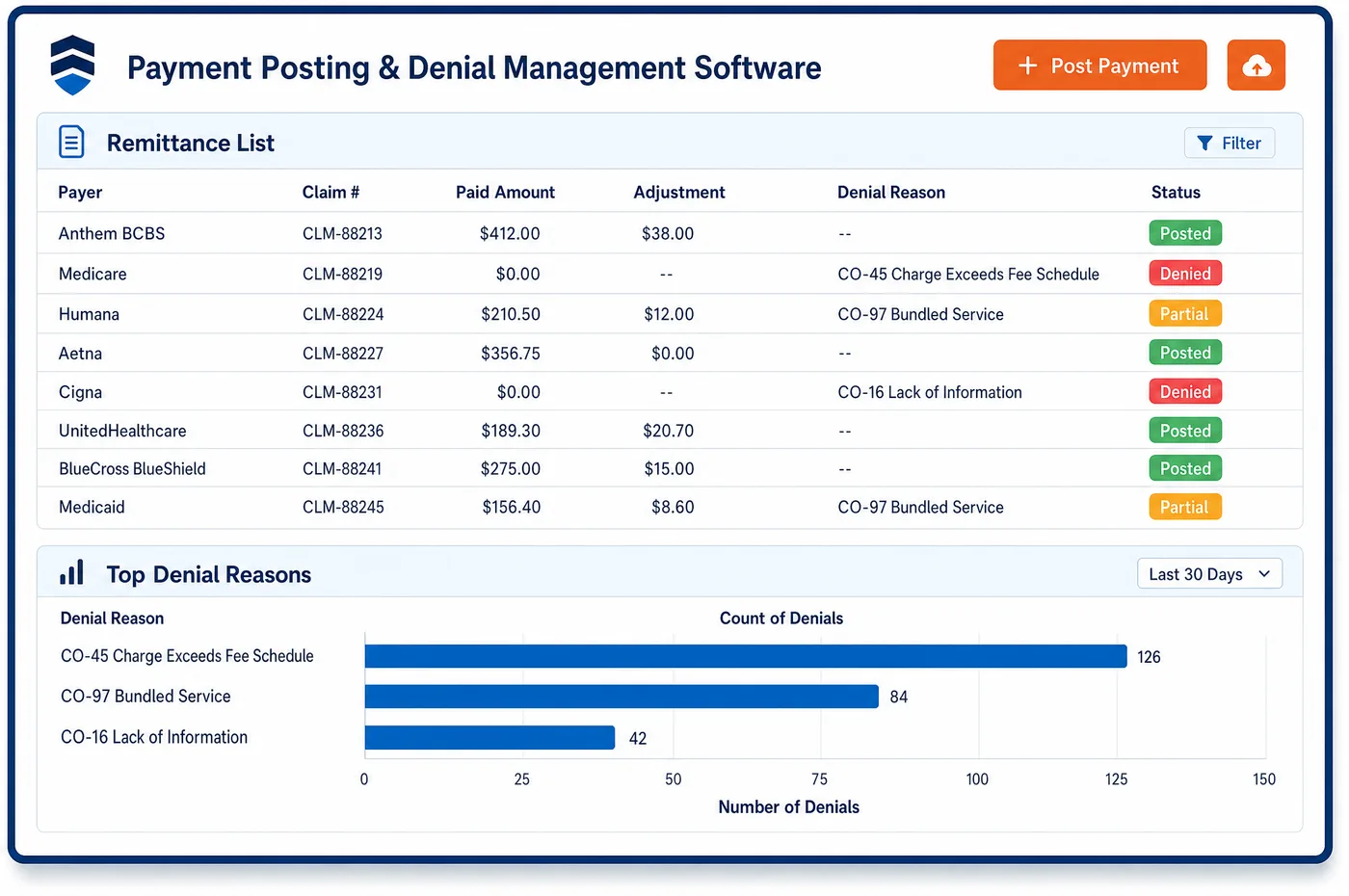
Integrated Patient Payments in a Cardiology Practice
Cardiology payments come at many points in care. Before a planned nuclear stress test or cardiac CT, staff can collect a deposit against the estimate. At a cardiac rehab session, the copay can be taken at check-in. Device clinic and remote monitoring patients may owe a small amount each period, which suits a stored card the patient has agreed to. After an ablation or cath, a large deductible balance can move to a payment plan. Integrated patient payments handle all of these in one place. Text-to-pay and email reminders link straight to a secure payment page. Card data is held by the payment gateway as a token, not in the chart. Each payment posts to the patient's account as it clears, so the front desk, the billing team and the patient all see the same balance. Nothing is keyed in twice from a separate card terminal or a lockbox report.
Why Is Integrated Patient Payments Different in Cardiology?
Cardiology has more repeat small balances than most specialties. Patients with pacemakers, ICDs and loop recorders send data on a schedule, and the practice bills each monitoring period. Patients on home blood pressure monitoring may be billed monthly. Rehab programs bill each session. If each of those balances needs a statement and a phone call, the cost of collecting can top the balance. A stored card, used with the patient's consent after the payer pays, turns those small amounts into routine payments.
At the other end are large balances. Elective ablations, device implants and caths often happen early in the year, before the patient has met a deductible. Patients may not be able to pay that in one go. A payment plan that drafts on a set schedule keeps the account current without staff chasing each payment. Plans tie to the same balance shown on cardiology patient billing statements, so patients and staff never argue about which number is right.
Deposits before planned tests are the third use. Many stress tests and cardiac imaging studies are booked ahead, so the practice knows the likely cost. Collecting part of it at booking or check-in, against a written estimate, reduces later balances. When the claim pays, the deposit is applied to the real amount and any credit is returned. That only works if the payment system and the billing ledger are the same, which is the point of card-on-file payments built into billing.
What Cardiology Integrated Patient Payments Software Handles
- Remote physiologic monitoring (99445, 99454, 99457, 99470)
- For 2026, CPT added 99445 for a shorter run of readings and 99470 for a shorter management time, and Medicare's fee schedule pays them alongside 99454 and 99457. Only one device code is billed per period, so any coinsurance arrives once per period and can be charged to a stored card. (Federal Register: CY 2026 Medicare Physician Fee Schedule final rule (remote monitoring codes, ASM, MVP subgroups))
- Remote interrogation periods (93294 to 93296)
- Device check claims follow the monitoring period, and Novitas tells Medicare billers to report them no more than once every ninety days. Any patient share is charged after the claim pays, not at the time of the transmission. (CMS Medicare Coverage Database, Billing and Coding Article A56602: Cardiac Rhythm Device Evaluation (Novitas))
- Cardiac rehab sessions (93798)
- Rehab sessions are covered under 42 CFR 410.49, and Part B cost sharing can apply to each one. Copays can be taken at check-in or charged to a stored card after the claim pays. (42 CFR 410.49: Cardiac rehabilitation program and intensive cardiac rehabilitation program)
- Deposits against good faith estimates
- For uninsured and self-pay patients, the deposit is tied to the good faith estimate on the account. When the final bill is ready, the deposit is applied and the two are compared. (CMS: Good faith estimates for uninsured or self-pay patients (No Surprises Act))
- PCI DSS card security
- Card numbers are tokenized by a PCI DSS compliant payment gateway. Staff see only the last digits, and the token, not the card number, is stored with the account. (PCI Security Standards Council: PCI Data Security Standard)
How Does Cardiology Integrated Patient Payments Software Work?
1. Get consent and store the card
When a patient agrees, the card is stored as a token with a note of what it may be used for, such as device check balances. The patient can change or remove it at any time.
2. Collect deposits for planned tests
Staff collect a deposit against the estimate for a planned stress test, imaging study or procedure. The deposit sits on the account until the claim pays.
3. Charge after the payer pays
Stored cards are charged only after the final patient share is known. A text or email receipt follows each charge.
4. Set up plans for large balances
A large procedure balance can move to a payment plan with a set draft date. Missed drafts create a task for staff rather than a silent failure.
5. Post as payments clear
Every payment posts to the patient's account when it clears. The posting matches the deposit report, so cardiology accounting sees the same cash.
Cardiology Integrated Patient Payments Software vs. Generic Software
| Area | Generic approach | Unlimited Systems |
|---|---|---|
| Recurring device balances | A statement and call for each period. | Charged to a stored card with patient consent. |
| Planned test deposits | Rarely collected, so balances arrive later. | Collected against the estimate and applied when the claim pays. |
| Large procedure balances | Collections after a few statements. | Payment plans that draft on schedule. |
| Card terminal | Separate system, keyed back into billing. | Payments post straight to the ledger. |
| Card security | Card numbers written on forms. | Tokens from a PCI DSS compliant gateway. |
Who Uses It in a Cardiology Practice
- Device clinic coordinator: Fewer calls about small balances, because patients who agreed to card-on-file payment are charged after each period's claim pays.
- Front desk: Deposits and copays taken at booking or check-in, with each payment shown on the account at once.
- Billing manager: Patient payments that post themselves, plans that run without chasing, and a deposit report that matches the ledger.
Cardiology Integrated Patient Payments Software FAQs
Integrated patient payments let a device clinic patient store a card with consent. After each monitoring period's claim pays, any patient share is charged to that card and a receipt goes out. The patient does not get a paper bill for each small amount. The charge posts to the account at once, so staff see the paid balance.
A deposit can be taken at booking or check-in for a planned nuclear stress test, stress echo or cardiac CT. It is tied to the estimate and stays on the account until the claim pays. Then it is applied to the actual patient share. If the deposit was more than the patient owed, the credit can be refunded or kept as the practice's policy says.
Large balances after an ablation, device implant or cath can move to a payment plan with a set amount and draft date. The plan charges the stored card or bank account on schedule. Each draft posts to the account. If a draft fails, staff get a task to reach the patient, instead of finding out weeks later.
Card data is never stored in the chart. A PCI DSS compliant payment gateway turns the card into a token, and only that token and the last few digits are kept with the account. Staff can see that a card is on file and what it may be used for, but they cannot see the full number.
Cardiac rehab copays can be collected at check-in for each session, or charged to a stored card once the claim pays. Either way, the payment posts to the same account. Patients who prefer one payment can have their session balances grouped and charged together after each billing period.
Patients can pay from a text or email link, or log in to the portal to see statements and pay. Reminders link straight to the payment page. Calls are only needed for patients who want to set up a plan with a person or ask about a charge.
Related Cardiology Software
Payments & AR
In the revenue cycle
Integrated Patient Payments for related specialties
Sources
- Federal Register: CY 2026 Medicare Physician Fee Schedule final rule (remote monitoring codes, ASM, MVP subgroups)
- CMS Medicare Coverage Database, Billing and Coding Article A56602: Cardiac Rhythm Device Evaluation (Novitas)
- 42 CFR 410.49: Cardiac rehabilitation program and intensive cardiac rehabilitation program
- CMS: Good faith estimates for uninsured or self-pay patients (No Surprises Act)
- PCI Security Standards Council: PCI Data Security Standard
GET STARTED
See Unlimited Systems in Action
Whether you're actively evaluating new technology or simply preparing for your next vendor renewal, Unlimited Systems can help you understand where your current workflows may be creating avoidable revenue risk.