

Analytics & value-based care
Cardiology Reporting Software
Scheduled cardiology reports for owners, labs, device clinics, hospitals and quality programs, all built from live billing data.
Cardiology Reporting Software produces the reports a cardiology group runs on. It covers production and collections by physician and site, test volume by lab, device clinic billing, aging and denials. It also builds quality measure lists for MIPS. Reports are scheduled and sent to the right people, so every site works from the same numbers.



 6,500+ specialty providers

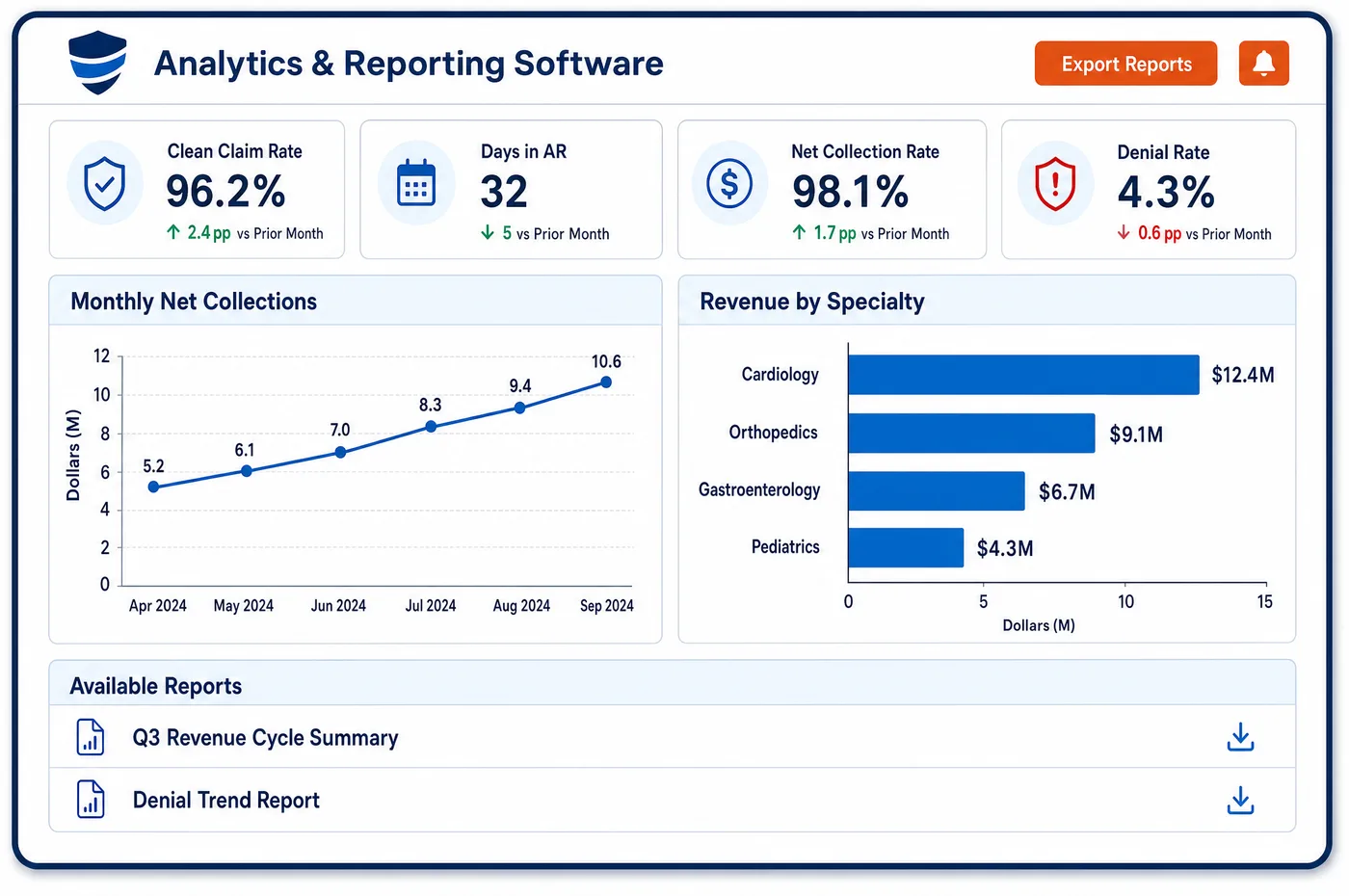
Reporting in a Cardiology Practice
A cardiology group answers to many audiences. Owners want collections by physician and site each month. Lab managers want echo, nuclear and stress volume against capacity. The device clinic needs a list of patients whose monitoring periods have not been billed. Hospitals that contract with the group for reads may want counts of studies interpreted. Quality staff need patient lists for MIPS measures such as heart failure beta-blocker therapy. Reporting in cardiology means building each of these once and sending it on a schedule. A standard library covers production, collections, aging, denials and payer mix. Custom reports add the filters each group needs, such as modality, component or hospital. Reports run on live data, so a number on Monday matches what staff see in the system. Each one can go out as a PDF or CSV to a set list, with access limited to the sites and data the reader is allowed to see.
Why Is Reporting Different in Cardiology?
Cardiology reports need more ways to slice the data than most. Revenue has to split by site and by component, because office tests and hospital reads earn very different amounts. Volume has to split by modality, because echo, nuclear and device work are run by different teams. A report built for a single-site primary care practice cannot answer those questions, so cardiology groups often end up building spreadsheets by hand.
Quality reporting is also specialty-shaped. The MIPS Value Pathway built for heart disease asks for four quality measures, with at least one outcome measure, or a high priority measure when no outcome measure applies. Its measures include heart failure therapy for left ventricular systolic dysfunction, CAD antiplatelet therapy, atrial fibrillation anticoagulation and cardiac rehab referral. Starting with the 2026 performance period, a multispecialty group that wants to report an MVP must report as subgroups or as individuals. Cardiology staff need patient-level lists for each measure well before the submission window.
New programs add more. Cardiologists selected for CMS's Ambulatory Specialty Model begin its first performance year in 2027, and they report quality, improvement activity and interoperability data after each year ends. Reports that pull the same measure data used for MIPS keep the work in one place. The summary numbers should agree with cardiology analytics and the cardiology dashboards leaders already use, since all three read the same data.
What Cardiology Reporting Software Handles
- Advancing Care for Heart Disease MVP
- Patient lists are built for measures in this MVP, such as Q005 and Q008 for heart failure with left ventricular systolic dysfunction, Q326 for atrial fibrillation anticoagulation and Q243 for cardiac rehab referral. Staff review gaps before submission. (CMS Quality Payment Program: CY 2026 Finalized MIPS Value Pathways (Advancing Care for Heart Disease MVP, Table B.3))
- MVP subgroup reporting (2026 performance period)
- Beginning in 2026, a multispecialty group that reports an MVP must divide into subgroups or report as individuals. Reports can be cut by the cardiology clinicians in a subgroup. (Federal Register: CY 2026 Medicare Physician Fee Schedule final rule (MVP subgroup reporting))
- Ambulatory Specialty Model reporting
- ASM's first performance year starts January 1, 2027, and participants report required data by March 31 after each year ends. The model identifies participants by TIN and NPI, so reports can be cut the same way. (CMS Innovation Center: Ambulatory Specialty Model (ASM))
- Remote interrogation billing (93294 to 93296)
- A device clinic report lists enrolled patients whose latest monitoring period has no claim. A Novitas article for Medicare says these codes are reported no more than once every ninety days, which sets the expected interval. (CMS Medicare Coverage Database, Billing and Coding Article A56602: Cardiac Rhythm Device Evaluation (Novitas))
- Technical and professional revenue
- Production reports show global, professional and technical revenue by site, using each code's PC/TC status. Owners see office and hospital work apart. (Medicare Claims Processing Manual, Chapter 12: Physicians/Nonphysician Practitioners (PC/TC indicators))
How Does Cardiology Reporting Software Work?
1. Start from the library
Standard reports for production, collections, aging, denials and payer mix are ready to run. Each can be filtered by site, physician, modality and component.
2. Build what is missing
Custom reports add the views a cardiology group needs, such as device clinic gaps or reads by hospital. They are saved and shared like standard reports.
3. Schedule and send
Reports run on a schedule and go out as PDF or CSV. Physicians, lab managers and owners each get their own set.
4. Limit what each reader sees
Access follows the reader's role and sites. A lab manager sees the lab, and an owner sees the whole group.
5. Prepare quality lists
Measure lists for MIPS reporting are run during the year, not only in the submission window. Staff close gaps while patients can still be seen.
Cardiology Reporting Software vs. Generic Software
| Area | Generic approach | Unlimited Systems |
|---|---|---|
| Monthly owner pack | Built by hand from exports. | Scheduled and sent from live data. |
| Site and component | Not split in standard reports. | Every revenue report can split by site and component. |
| Device clinic | No report on unbilled periods. | Enrolled patients without a claim for the latest period. |
| Quality measures | Pulled from charts at year end. | Patient lists run during the year. |
| Access | One report sent to everyone. | Each reader gets the sites and data their role allows. |
Who Uses It in a Cardiology Practice
- Physician owners: A monthly pack of production, collections and test volume by site, sent without anyone building it.
- Quality coordinator: Patient lists for heart disease MVP measures and future ASM reporting, run as often as needed.
- Lab and device clinic managers: Volume, capacity and unbilled work for their own area, delivered on a set schedule.
Cardiology Reporting Software FAQs
Most cardiology groups schedule production and collections by physician and site, test volume by modality, aging and denials by payer, and a device clinic list of unbilled periods. Owners get a summary, and managers get the detail for their own areas. Because cardiology reporting runs on live data, the numbers match what staff see in the system that day.
The Advancing Care for Heart Disease MVP is built for cardiology. Its measures include heart failure therapy for left ventricular systolic dysfunction (Q005, Q008), CAD antiplatelet and beta-blocker therapy (Q006, Q007), atrial fibrillation anticoagulation (Q326) and cardiac rehab referral (Q243). An MVP report needs four quality measures, with at least one outcome or high priority measure.
Beginning with the 2026 MIPS performance period, a multispecialty group that wants to report an MVP must split into subgroups or report as individuals. A cardiology subgroup can then report the heart disease MVP. Reports can be filtered to the clinicians in that subgroup so their measures are reviewed on their own.
The Ambulatory Specialty Model is a mandatory CMS model for selected specialists who treat heart failure or low back pain. For heart failure, it covers selected cardiologists in chosen areas. Its first performance year is calendar 2027, and participants report quality and other data by March 31 after each year. Payment adjustments are based on performance against peers.
A report of studies interpreted by the group at each hospital can be built and sent on a schedule. It can list reads by modality and physician for the period. Access is limited to that hospital's data, so one hospital never sees another's numbers.
Reporting data can be exported for a group's own data warehouse or BI tools, as well as sent as PDF or CSV reports. That lets a larger group combine billing data with its other systems while the core reports still come from the same source.
Related Cardiology Software
Analytics & value-based care
In the revenue cycle
Reporting for related specialties
Sources
- CMS Quality Payment Program: CY 2026 Finalized MIPS Value Pathways (Advancing Care for Heart Disease MVP, Table B.3)
- Federal Register: CY 2026 Medicare Physician Fee Schedule final rule (MVP subgroup reporting)
- CMS Innovation Center: Ambulatory Specialty Model (ASM)
- CMS Medicare Coverage Database, Billing and Coding Article A56602: Cardiac Rhythm Device Evaluation (Novitas)
- Medicare Claims Processing Manual, Chapter 12: Physicians/Nonphysician Practitioners (PC/TC indicators)
GET STARTED
See Unlimited Systems in Action
Whether you're actively evaluating new technology or simply preparing for your next vendor renewal, Unlimited Systems can help you understand where your current workflows may be creating avoidable revenue risk.