

Analytics & value-based care
Cardiology Value-Based Care Software
Track heart disease MVP measures, heart failure cost and Ambulatory Specialty Model readiness alongside the cardiology billing workflow.
Cardiology Value-Based Care Software tracks the quality, cost and risk programs that now shape cardiology pay. It follows heart disease MVP measures during the year, flags care gaps while patients are still in the practice, watches heart failure and PCI cost measures, and prepares selected cardiologists for the Ambulatory Specialty Model that begins in 2027.



 6,500+ specialty providers

Value-Based Care in a Cardiology Practice
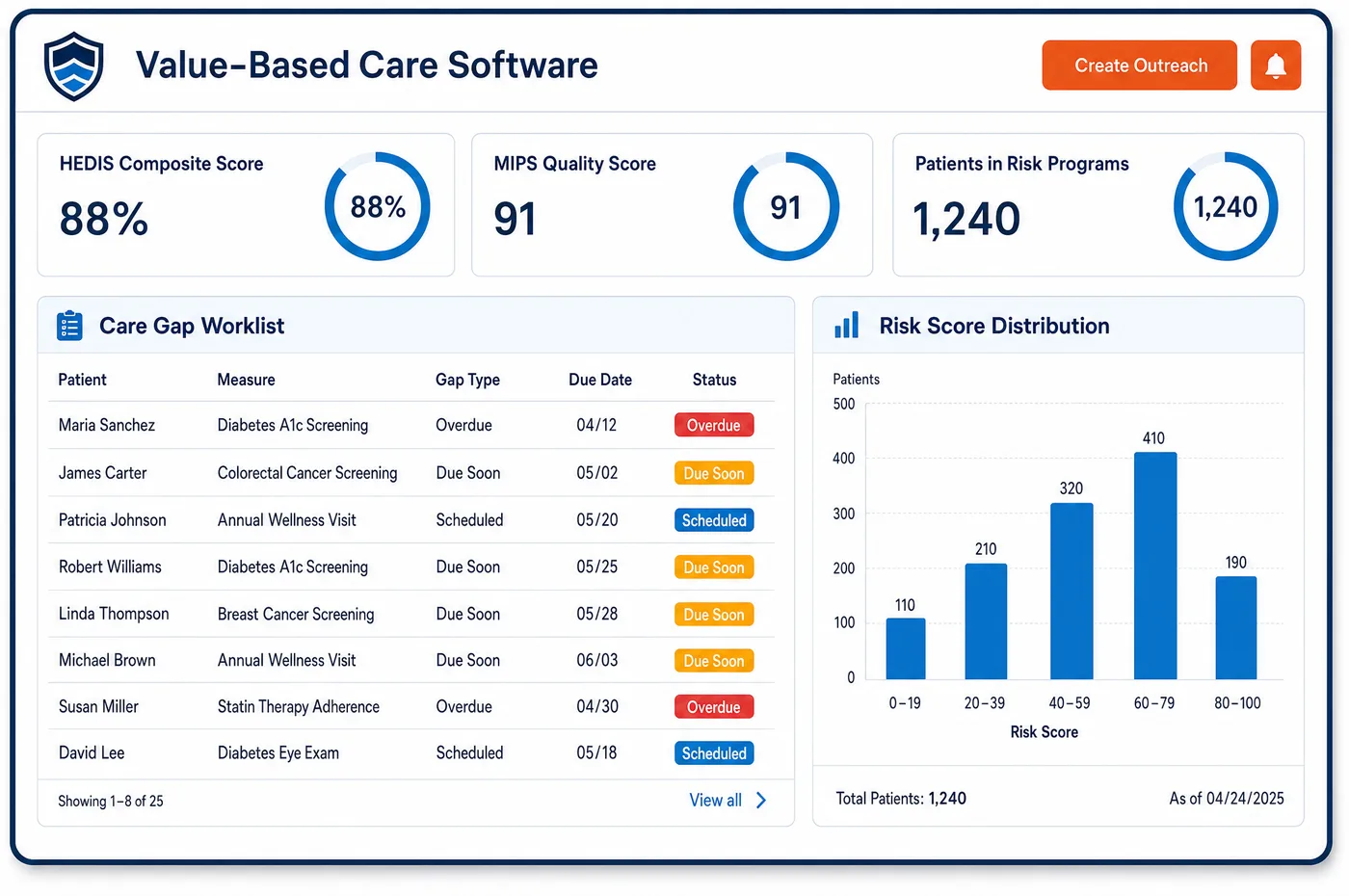
Value-based care in cardiology runs on three tracks at once in 2026. The first is MIPS, where many cardiologists report the Advancing Care for Heart Disease MVP. Its quality measures cover heart failure drugs, CAD drugs, blood thinners for atrial fibrillation and cardiac rehab referral. CMS also scores cost, using measures such as heart failure and elective outpatient PCI episodes. The second is the Ambulatory Specialty Model. Selected cardiologists who treat heart failure in chosen areas must take part from 2027. Their Part B pay will move up or down based on how they compare with peers. The third is shared savings and payer risk contracts, where cardiologists work inside ACO and health plan networks. Unlimited Systems keeps the measure data, gap lists and contract results next to the billing workflow. Gaps show up while the patient can still be seen. Cost and episode results are tracked against the ledger rather than in a separate spreadsheet.
Why Is Value-Based Care Different in Cardiology?
Cardiology quality measures depend on details charted during the visit. A heart failure patient with left ventricular systolic dysfunction needs a documented ACE inhibitor, ARB or ARNI, and a beta-blocker, or a recorded reason why not. A patient with atrial fibrillation needs anticoagulation or an exception. If those details are missed at the visit, the measure fails and the chance to fix it may be gone. Tracking gaps during the year, not after it, is what moves a score.
Cost now counts as much as quality for many cardiologists. The heart disease MIPS Value Pathway includes cost measures for heart failure, elective outpatient PCI and inpatient PCI, plus total per capita cost. Those measures count spending outside the practice, such as hospital stays and rehab after discharge. A cardiology group cannot manage them from its own claims alone. It needs to know which patients are attributed and where their care is going.
Mandatory models raise the stakes. The Ambulatory Specialty Model puts selected cardiologists at two-sided risk on heart failure care through Part B payment adjustments. It is built on the MVP framework. Participants are generally exempt from MIPS in the years they must meet model rules. Separately, hospitals in CMS's TEAM model are accountable for CABG episodes. Value-based care work in cardiology has to follow each program's rules and feed the cardiology reporting that supports each submission.
What Cardiology Value-Based Care Software Handles
- Advancing Care for Heart Disease MVP
- Gap lists are built for MVP measures such as Q005, Q008, Q007, Q326 and Q243. The MVP requires four quality measures, with at least one outcome or high priority measure. (CMS Quality Payment Program: CY 2026 Finalized MIPS Value Pathways (Advancing Care for Heart Disease MVP, Table B.3))
- Heart failure and PCI cost measures (COST_HF_1, COST_EOPCI_1, COST_STEMI_1)
- These episode-based cost measures are calculated by CMS from claims. Attributed patients and their outside admissions are tracked so the group can see what drives its cost score. (CMS Quality Payment Program: CY 2026 Finalized MIPS Value Pathways (Advancing Care for Heart Disease MVP, Table B.3))
- Ambulatory Specialty Model (heart failure cohort)
- ASM is mandatory for selected cardiologists in chosen areas, with performance years from 2027 through 2031. Participants are identified by TIN and NPI, and payment adjustments apply to later Part B claims. (CMS Innovation Center: Ambulatory Specialty Model (ASM))
- TEAM: CABG episodes
- TEAM, which started January 1, 2026, makes selected hospitals accountable for CABG and other surgical episodes. Cardiology groups that care for these patients after discharge can track their share of that care. (CMS Innovation Center: Transforming Episode Accountability Model (TEAM))
- ACCESS Model (cardio-kidney-metabolic tracks)
- ACCESS is a voluntary CMS model that began July 5, 2026, with tracks covering hypertension, dyslipidemia and atherosclerotic heart disease. Referring clinicians may bill a co-management payment for reviewing patient updates, and the practice can track those patients. (CMS Innovation Center: ACCESS (Advancing Chronic Care with Effective, Scalable Solutions) Model)
How Does Cardiology Value-Based Care Software Work?
1. Know who is attributed
Patients attributed under MIPS cost measures, ASM or payer contracts are flagged on the record. Staff can see which program each patient counts toward.
2. Find gaps before the visit
Open measure gaps show on the schedule and at check-in. The physician sees, for example, that a heart failure patient has no beta-blocker recorded.
3. Capture the data at the visit
Medications, exceptions and referrals are recorded while the patient is there. Risk documentation for chronic conditions is flagged for completeness.
4. Watch cost and outside care
Admissions and post-acute care for attributed patients are tracked where data is available. Follow-up after a heart failure stay is scheduled quickly.
5. Report and reconcile
Measure lists feed MIPS and ASM reporting. Shared savings and risk results are tracked in the ledger against what the contract promised.
Cardiology Value-Based Care Software vs. Generic Software
| Area | Generic approach | Unlimited Systems |
|---|---|---|
| Measure gaps | Found after year end in a chart review. | Shown on the schedule while the patient can still be seen. |
| Cost measures | Seen only in CMS feedback reports. | Attributed patients and outside care tracked during the year. |
| ASM readiness | Unknown until the first adjustment. | Selected cardiologists and their measures tracked from the start. |
| Program mix | Each program tracked in a separate file. | MIPS, ASM and payer contracts tracked side by side. |
| Contract results | Shared savings estimated by a consultant. | Tracked in the ledger next to billed revenue. |
Who Uses It in a Cardiology Practice
- Cardiologist: A short list of open gaps for each patient on the day's schedule, so measures are met during the visit.
- Quality coordinator: Gap lists, attribution and measure status for the heart disease MVP and ASM in one place.
- Practice CFO: Program results, risk exposure and shared savings tracked next to cardiology analytics and the ledger.
Cardiology Value-Based Care Software FAQs
Cardiology value-based care in 2026 centers on MIPS, often through the Advancing Care for Heart Disease MVP. Many cardiologists also take part in ACO and health plan risk contracts. Selected cardiologists must join the Ambulatory Specialty Model from 2027. Hospitals in TEAM are accountable for CABG episodes, and the voluntary ACCESS model covers some cardio-metabolic conditions.
ASM's heart failure cohort covers selected cardiologists in chosen geographic areas who have treated enough heart failure patients in the past. Participants are identified by TIN and NPI. The first performance year is 2027, and later Part B payments are adjusted up or down based on performance against peers. CMS posts the participant list on its data site.
Patients with heart failure and left ventricular systolic dysfunction are flagged when they lack a recorded ACE inhibitor, ARB or ARNI, or a beta-blocker, without a reason. The gap shows on the schedule before the visit. The physician can prescribe or record why not, and the measure updates. Gaps are worked during the year, not found after it.
Cost measures such as heart failure and elective outpatient PCI include spending outside the practice, like admissions. A group cannot control all of it, but it can see which attributed patients are driving cost, see them soon after a hospital stay and coordinate with primary care. Tracking that during the year gives the group a chance to act.
BPCI Advanced ended on December 31, 2025, so it no longer covers cardiac episodes. For 2026, CMS's TEAM model makes selected hospitals accountable for surgical episodes, including CABG. Cardiology groups now rely mostly on MIPS cost measures, ASM and payer contracts for episode-based accountability.
Shared savings and risk results from ACO and payer contracts are tracked in the ledger, next to billed and collected revenue. The practice can see expected results during the year and compare them with what the payer reports at settlement. That avoids surprise adjustments after the year closes.
Related Cardiology Software
Analytics & value-based care
In the revenue cycle
Value-Based Care for related specialties
Sources
- CMS Quality Payment Program: CY 2026 Finalized MIPS Value Pathways (Advancing Care for Heart Disease MVP, Table B.3)
- CMS Innovation Center: Ambulatory Specialty Model (ASM)
- CMS Innovation Center: Transforming Episode Accountability Model (TEAM)
- CMS Innovation Center: ACCESS (Advancing Chronic Care with Effective, Scalable Solutions) Model
- CMS Innovation Center: BPCI Advanced
GET STARTED
See Unlimited Systems in Action
Whether you're actively evaluating new technology or simply preparing for your next vendor renewal, Unlimited Systems can help you understand where your current workflows may be creating avoidable revenue risk.