6,500+ specialty providers
Visit-ready
Keep authorization and coverage aligned before the appointment is booked.
Master complex tumor resection coding, sentinel node biopsy billing, and major cancer surgery authorizations. See why surgical oncology practices choose Unlimited Systems for practice management and RCM software.
Surgical oncology practices perform some of the most complex, highest-acuity procedures in medicine, combining extensive tumor resections, sentinel lymph node mapping, and immediate reconstructive procedures into single operative sessions that demand precise multi-code billing. Generic RCM platforms struggle to correctly bundle resection and reconstruction codes, miss separately billable sentinel node biopsy components, and fail to navigate the extensive prior authorization documentation required before insurers approve major cancer surgeries.
A single mastectomy with axillary sentinel lymph node biopsy and immediate reconstruction involves multiple distinct procedure codes that must be sequenced correctly to reflect the primary resection, the separately identifiable lymph node mapping and biopsy procedure, and the reconstructive component, each subject to its own bundling edits and global period considerations. Before the surgery can even be scheduled, payers typically require extensive documentation including biopsy-confirmed pathology, staging imaging, and multidisciplinary tumor board review, and any gap in this authorization chain can delay a time-sensitive cancer surgery or result in the entire surgical claim being denied after the fact.

Trusted Payer & EHR Integration Partners













Our connected workflows are built to make you and your work easier to do and increase your revenue.
Keep authorization and coverage aligned before the appointment is booked.
Validate surgical oncology codes, modifiers, and documentation before submission.
Give teams one view of denials, margin, and A/R priorities.
Routine surgical oncology work clears itself. Your team sees only what needs their judgment.
Specialty practices describe, in their own words, what changed after moving to Unlimited Systems.

“As I look back at the transition, the support and the collaboration with the folks at Unlimited really helped make us feel at ease. We had a partner that really wanted us to be successful.”
- Michelle Leandri, CEO, Hematology and Oncology Associates of Northeastern PA
Drag the sliders to estimate how much unrealized cash remains locked in your current specialty billing cycles before optimization.
Adjust both inputs to match your practice.
Enter your work email to unlock your estimated annual recovery.
Every surgical oncology capability, grouped around the way your practice works.
Register, schedule and clear patients before the visit.
Turn documented care into clean claims and work denials.
Post payments, collect patient balances and work open AR.
Measure performance, report it and manage quality programs.
Automation, workflow, integration and the platform underneath.
That's putting it nicely based on what we hear every day.
A support line that never picks up. An overseas call center that's never heard of your account. Errors nobody catches until the denial shows up. We're Midwest-based, not offshore, and the team that answers already knows your account. Practices that switch tend to wish they'd done it sooner.
“I would recommend Unlimited Financials to other specialty practices.”
Michelle LeandriCEO, NEPA
“We transitioned to Unlimited Financials in 2024... the team and platform are absolutely amazing.”
GinaAdministrator, FOUR
“We have been on Unlimited Financials for over three years and love it. Our claims are being processed faster and more efficiently, which means we are receiving payment more quickly.”
Renee BernacchiAccounts Receivable Coordinator, COAS
Each module is configured for the codes, modifiers, and payer rules surgical oncology teams work with, not adapted from generic billing software.
These are the places surgical oncology practices most often lose revenue when their billing platform wasn’t built for the work. Unlimited Systems closes each one with rules configured for your specialty.
Review your workflowCommon surgical oncology revenue leaks
The work that generic platforms leave to your staff is the work surgical oncology margin actually turns on.
See why surgical oncology practices move off general-purpose billing platforms.
You don't have to be actively replacing your current system to have a useful conversation with Unlimited Systems. Many specialty practices talk with us months before a contract renewal, system evaluation, or operational change so they can understand where revenue leakage, denial risk, prior authorization delays, and reporting gaps may already be showing up.
You don't have to wait until your contract is up to start evaluating your options. The best time to assess your revenue cycle technology is before renewal pressure begins. Unlimited Systems can help you understand where your current workflows may be creating avoidable denials, manual work, charge capture gaps, or reporting limitations, so you're better prepared for renewal, replacement, or future planning.
That concern is valid, specialty practice operations are too important to disrupt. A conversation with Unlimited Systems doesn't mean an immediate rip-and-replace. We help teams evaluate workflows, identify gaps, and build a realistic path forward based on specialty, volume, payer mix, locations, integrations, and internal readiness.
Most specialty teams are already stretched thin. That's why the evaluation should focus on where the largest operational burden exists today, prior authorization, denials, charge capture, reporting, manual reconciliation, or payer-specific follow-up. The goal isn't to add work. It's to understand where better systems can remove it.
“Good enough” can still hide revenue leakage. Many practices aren't losing revenue because claims aren't being submitted, they're losing it through preventable denials, underpayments, missed modifiers, incomplete documentation, delayed authorizations, manual workarounds, and limited visibility into payer performance.
Unlimited Systems isn't designed to replace the expertise of your billing team. It's designed to give them better tools, cleaner workflows, better visibility, and fewer manual workarounds. Strong teams still need technology that helps them prioritize the right work, catch issues earlier, and reduce preventable rework.
Cash flow continuity is one of the biggest reasons to evaluate carefully and early. Unlimited Systems can help practices understand potential risk areas before a transition plan is ever built, including claim flow, authorizations, charge capture, payer rules, reporting, and operational dependencies.
Change management matters. The right platform should simplify daily work, not create unnecessary complexity. Unlimited Systems focuses on specialty workflows that align with how teams already manage authorizations, charges, denials, documentation, and financial follow-up.
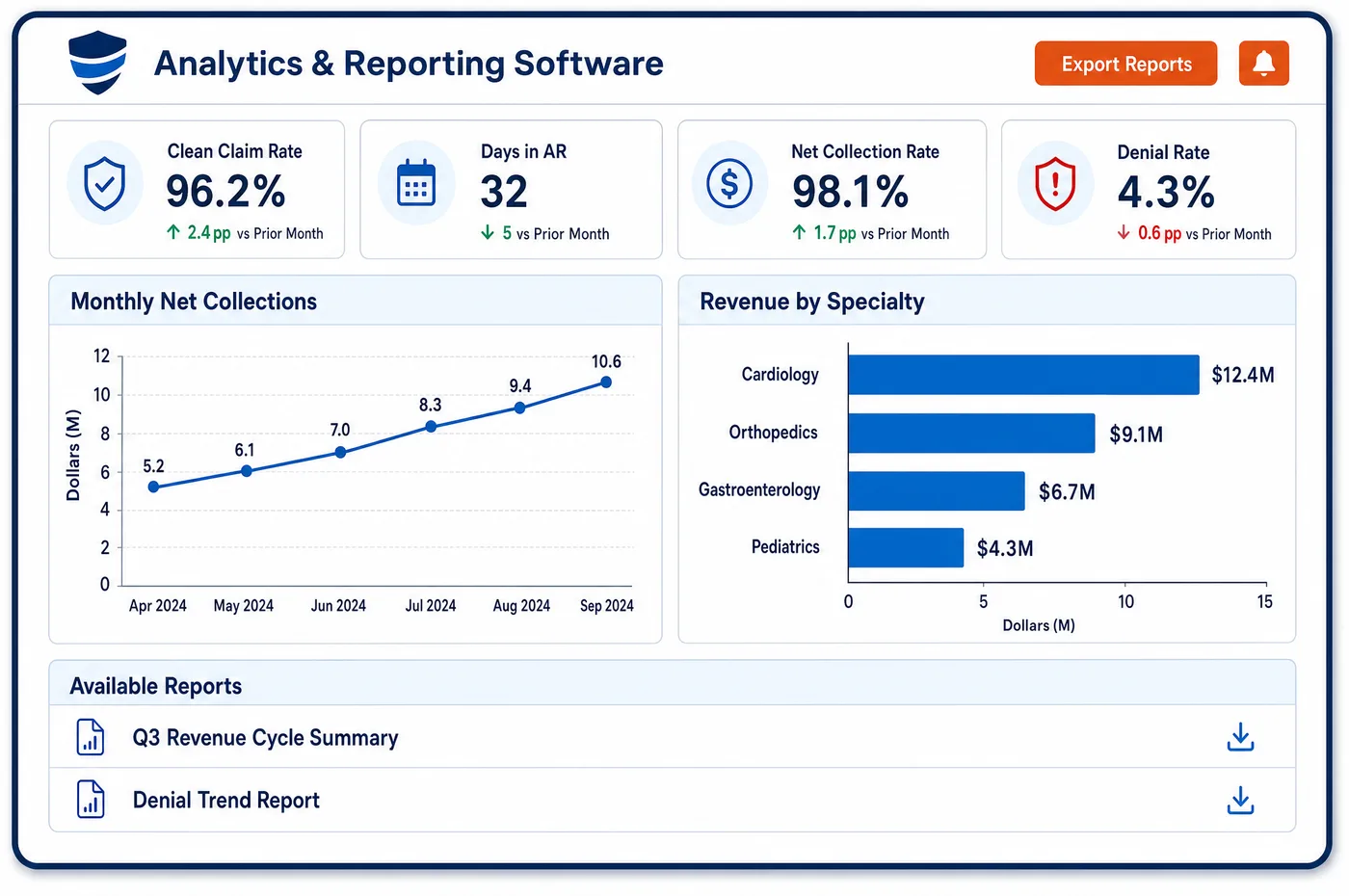
Reporting is often the first visible symptom of a deeper workflow issue. If leadership can't clearly see denial trends, underpayments, authorization delays, payer behavior, or staff workload, it's harder to know what to fix. Unlimited Systems combines workflow tools with Power BI analytics to help leaders see where performance is improving and where revenue is still at risk.
That's a smart approach. A conversation with Unlimited Systems can help identify the financial case before a buying decision. Common areas to evaluate include denial reduction, staff efficiency, underpayment detection, charge capture improvement, prior authorization turnaround, and reduced manual reconciliation.
Specialty practices often depend on EHRs, clearinghouses, payment tools, drug workflows, and reporting systems. Unlimited Systems is designed to act as a connected financial workflow layer that helps reduce fragmentation, not add more disconnected work.
That caution is healthy. Automation should make decisions easier to see, not harder. Unlimited Systems is designed to surface why a claim is flagged, which payer rule applies, and where a human should step in, so your team stays in control while routine work is handled for them.
You don't need to be ready to buy to have a useful conversation. Many practices start by comparing their current workflows against what specialty-specific revenue cycle technology can support. That gives leadership a clearer view of what to fix now, what to plan for, and what questions to ask before the next renewal.
Specialty rules and connected data keep your team focused on the exceptions that need judgment.
Coverage and authorization stay tied to the order.
Code, unit, and modifier checks happen before filing.
Denials and A/R are ranked by value and filing risk.

The same connected system handles the operational work that sits either side of billing.
Digital intake, eligibility, and demographic capture before the visit.
Explore Patient IntakeSmart calendars and resource scheduling across providers and locations.
Explore Patient SchedulingAutomated eligibility checks and prior authorization management.
Explore Financial ClearancePre-claim scrubbing for coding, modifiers, and compliance accuracy.
Explore Charge ValidationEight stages, one record. Nothing is rekeyed between systems, so a detail captured at the front desk is still there when the claim goes out, and when the remittance comes back.
Walk the workflow with usPart of Oncology
Our charge engine evaluates whether the reconstructive procedure performed immediately following tumor resection is bundled into the resection code under NCCI edits or is separately payable. When separately payable, the system applies the correct modifier (such as -58 or -59) and sequences both procedures on the claim with appropriate documentation linkage.
Sentinel lymph node biopsy involves a distinct mapping injection, intraoperative identification, and biopsy procedure that is separately billable from the primary tumor resection. Our system automatically generates the SLNB procedure code alongside the resection code, sequenced correctly to avoid NCCI bundling denials.
Major cancer surgery authorization typically requires biopsy-confirmed pathology results, staging imaging (CT, MRI, or PET), and documentation of multidisciplinary tumor board review supporting the surgical plan. Our authorization manager compiles all required documentation into a single package and tracks the authorization through approval before the case is scheduled.
When two surgeons from different specialties each perform a distinct, identifiable portion of the same operative session, our system applies modifier-62 (co-surgeon) to each surgeon's claim for the appropriate procedure codes, with documentation supporting the distinct role each surgeon played.
A re-excision procedure performed after pathology reveals positive margins from the initial resection is billed as a separate, distinct procedure with its own documentation of medical necessity, rather than being bundled into or denied as a duplicate of the original resection.
Yes. Intraoperative frozen section consultations performed by pathology during the surgical case are tracked and billed under the correct pathology CPT codes, separate from the surgeon's procedural billing, ensuring this consultation revenue is not lost.
Complex repair, adjacent tissue transfer, and flap reconstruction codes following tumor excision are billed according to the size and complexity documented, with the system verifying that the closure code is appropriate relative to the excision defect size and is not already included in the resection code's global package.
For cancer surgeries requiring staged procedures, such as initial resection followed by a planned subsequent reconstruction, our system tracks each stage as part of a connected case, applying the correct staged procedure modifier (-58) and ensuring each stage is billed within its appropriate global period context.
New to revenue cycle terminology? Browse our healthcare RCM & billing glossary.
Practices like yours, on what changed after moving to Unlimited Financials.
The system continues to grow with features as it should, with how healthcare changes. So, if you are looking for a company that is innovative and truly cares, I would recommend Unlimited Financials.
Unlimited Financials has been the easiest and best practice management system I have used. It is easy to navigate and do what I need to do.
We have been on Unlimited Financials for over three years and love it. Our claims are being processed faster and more efficiently, which means we are receiving payment more quickly.
Unlimited Financials has allowed us to extend our workforce in some areas due to the workflow efficiencies and given a better patient experience.
Knowledge of the patient's coverage has been a game changer. The ability to verify benefits before the patient comes in has saved us on time and denials, so there is no delay in treatment.
Using Unlimited Systems has allowed us to get a much better handle on our AR and claim management.
Connect with a specialized Surgical Oncology RCM expert for a personal workflow walkthrough, and see where your current setup is creating avoidable revenue risk.