

Platform & AI
Allergy & Immunology Workflow Software
Work queues that route each allergy task to an owner, from vial builds waiting to be charged to biologic renewals and held shot claims.
Allergy & Immunology Workflow Software assigns every allergy task to a queue and a person, with a date it is due. Vial builds waiting for a dose charge, biologic authorizations coming up for renewal, shot claims held by an edit and patient balance questions each route to the right person, with escalation when work stalls.



 6,500+ specialty providers

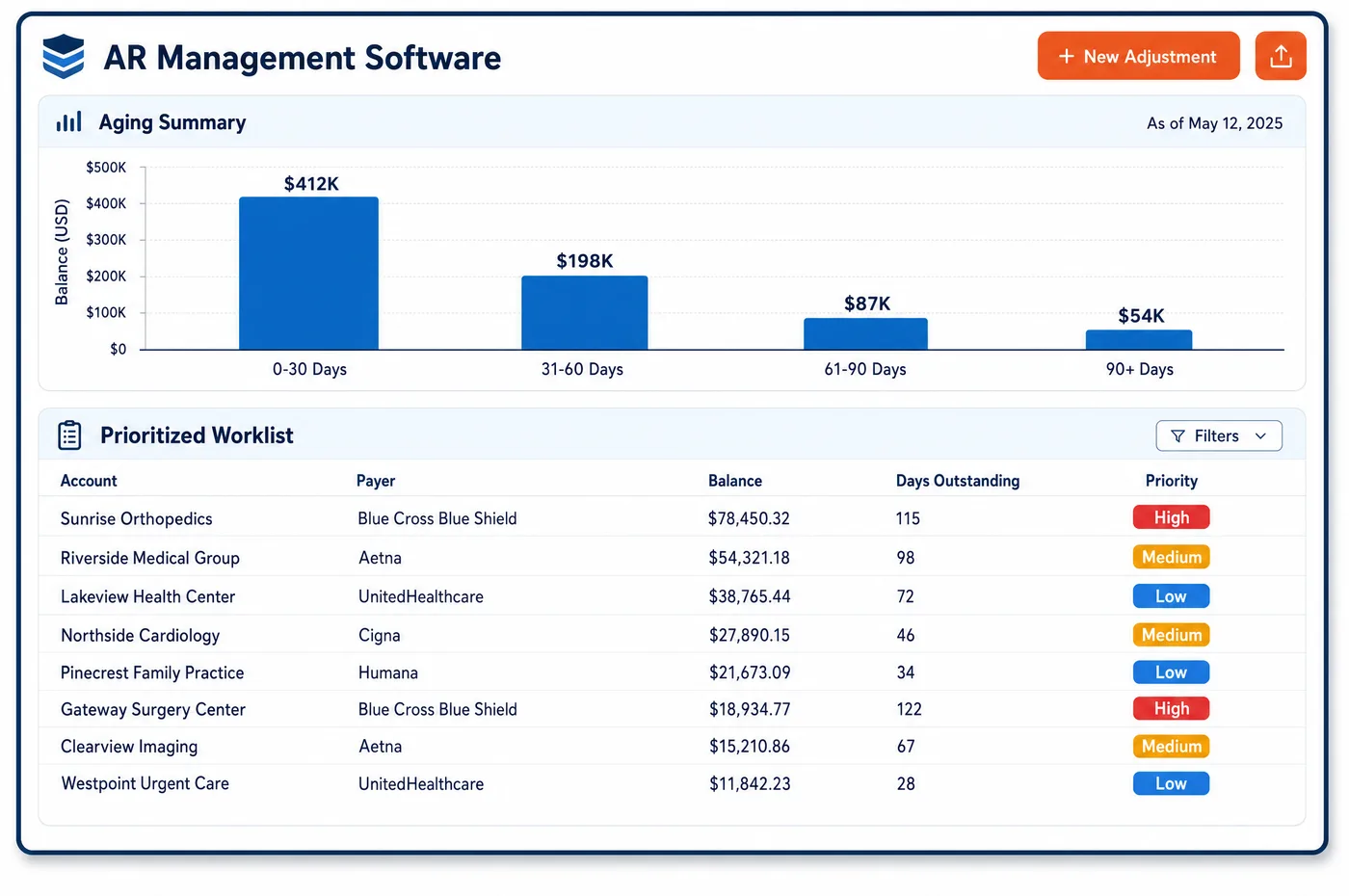
Workflow in a Allergy & Immunology Practice
Work in an allergy practice crosses many hands. A nurse prepares a patient vial, and billing needs to charge the 95165 doses. A biologic patient's approval nears its end, and someone must request a renewal before the next dose. A claim is held because an office visit and a shot share a date without modifier 25. A parent calls about a testing bill. If each item lives in someone's inbox, things slip. Unlimited Systems drops every task into a role queue, assigns it to a person and sets when it is due. Queues follow how an allergy practice runs: a shot clinic queue, a vial build queue, a biologic queue, a coding queue and a patient account queue. Tickets cross departments too, letting the checkout desk pass a testing-bill question to a financial counselor. Items close to a payer or filing deadline escalate to a supervisor. Unattended steps are left to allergy automation, so queues hold only the work that needs a person.
Why Is Workflow Different in Allergy & Immunology?
Allergy billing has handoffs that clinical teams do not see. A vial is mixed in the extract room, but the doses it supports are billed through 95165. Medicare counts the doses planned at the moment of mixing, not the shots given later. If no one tells billing a vial was built, the charge can wait or go missing. A queue that opens a billing task for every vial build closes that gap.
Biologics need a different kind of control. Each dose is expensive, and it should be given only when an authorization is on file, approved units remain and payment is expected to cover the cost. A pre-dose checklist in the workflow puts those checks in front of the nurse and the biologic coordinator. Renewals are opened as tasks before the approval runs out.
Deadlines set the order of work. A Medicare claim has a twelve-month filing window, and payers set appeal windows of their own. For Medicare Advantage, Medicaid and CHIP payers, CMS-0057-F requires decisions on standard prior authorization requests within seven calendar days and on expedited requests within seventy-two hours. Workflow in an allergy practice uses those dates to decide which item is worked first and when it moves up to a supervisor.
What Allergy & Immunology Workflow Software Handles
- Vial build to 95165 charge
- Medicare bills the doses planned when the vial is prepared. Each vial build opens a billing task, so the dose charge is entered and checked against the vial size. (Medicare Claims Processing Manual, Chapter 12, Section 200: Allergy Testing and Immunotherapy)
- Modifier 25 holds
- Medicare pays a visit with a 95115 to 95199 service only when modifier 25 applies. Held claims go to a coding queue, where a coder reads the note and decides. (Medicare Claims Processing Manual, Chapter 12, Section 200: Allergy Testing and Immunotherapy)
- Authorization denials (CARC 197)
- Claims denied for missing authorization route to the biologic coordinator with the drug, units and payer shown. Repeat cases point to a gap in the pre-dose checklist. (X12 Claim Adjustment Reason Codes)
- Prior authorization decision times (CMS-0057-F)
- Medicare Advantage, Medicaid and CHIP payers must decide standard requests within seven calendar days and expedited ones within seventy-two hours. Requests past those times escalate for follow-up with the payer. (CMS Interoperability and Prior Authorization Final Rule (CMS-0057-F))
- Timely filing escalation
- A Medicare claim is late once twelve months pass after the date of service. Claims nearing that limit, or a commercial payer's limit, move up to a supervisor. (42 CFR 424.44: Time limits for filing Medicare claims)
- Waste documentation for Medicare biologics
- Discarded amounts from single-dose containers must be documented in the record. A Medicare drug line billed with JW opens a check that the discarded amount is charted. (CMS JW and JZ Modifier Policy FAQs)
How Does Allergy & Immunology Workflow Software Work?
1. Set up role queues
Queues match how the practice runs: shot clinic, vial builds, biologics, coding, AR and patient accounts. Every allergy queue gets a named owner plus a backup.
2. Route each item
Tasks open from events such as a vial build, a held claim or an expiring approval. Each one goes to the queue that owns it, with the details attached.
3. Check before the dose
Before a biologic is given, a checklist confirms the authorization, the units left and the expected payment. Gaps hold the dose task until they are fixed with help from allergy financial clearance.
4. Hand off across teams
Tickets move between departments, such as from checkout to a financial counselor. Each handoff keeps its history, so no one asks the patient twice.
5. Escalate what stalls
Items near a filing, appeal or authorization deadline move up to a supervisor. Unattended steps stay with rule-based automation.
Allergy & Immunology Workflow Software vs. Generic Software
| Area | Generic approach | Unlimited Systems |
|---|---|---|
| Vial builds | Billing learns of new vials when someone remembers. | Each vial build opens a 95165 charge task. |
| Biologic renewals | Noticed only after a drug claim comes back denied. | Renewal tasks open before the approval ends. |
| Held claims | Sit in one shared list with no owner. | Routed to a coding queue with the rule that held them. |
| Patient questions | Messages passed along by sticky note. | Tickets routed to financial counselors with history kept. |
| Deadlines | Tracked in staff memory. | Items escalate as filing and appeal limits near. |
Who Uses It in a Allergy & Immunology Practice
- Biologic coordinator: A queue of upcoming doses with authorization, units left and expected payment shown, plus renewal tasks before approvals end.
- Coder: A coding worklist of held shot and testing claims, each with the edit that stopped it.
- Billing supervisor: Escalations for stalled items and a view of every queue's load, with denial patterns passed on to denial prevention and appeals.
Allergy & Immunology Workflow Software FAQs
Workflow software creates a task from an event in the practice, such as a vial build, a held claim or an approval nearing its end. Each task lands in the queue that owns it and carries an owner, a deadline and the details. Items that stall, or that come close to a payer deadline, move up to a supervisor.
Each vial build opens a billing task in the vial build queue. The task carries the patient, the vial and the planned dose count, so the 95165 charge can be entered and checked against the vial size. Because Medicare bills the dose count planned at mixing, the task opens at preparation.
A pre-dose checklist confirms that an authorization is on file, that approved units remain and that expected payment is in line with what the practice paid for the drug. If a check fails, the dose task waits until the coordinator resolves it. That keeps an expensive dose from being given without the paperwork to bill it.
Renewal tasks open before an approval runs out and go to the biologic coordinator. If a payer does not answer in time, the task escalates. For Medicare Advantage, Medicaid and CHIP payers, CMS-0057-F sets decision times for prior authorization requests, which helps the team know when to follow up.
Checkout can open a ticket for a financial counselor when a patient asks about a testing bill, a biologic balance or a payment plan. The ticket keeps the history of the question, so the patient does not have to repeat it. The counselor closes the ticket once the question is answered.
Automation handles steps that follow clear rules, such as eligibility checks, claim status requests and ERA posting. Workflow handles work that needs a person, such as a held claim, a reauthorization or a patient question. The two meet at the handoff: whatever a rule leaves unresolved turns into a task for a person.
Related Allergy & Immunology Software
Platform & AI
In the revenue cycle
Workflow for related specialties
Sources
GET STARTED
See Unlimited Systems in Action
Whether you're actively evaluating new technology or simply preparing for your next vendor renewal, Unlimited Systems can help you understand where your current workflows may be creating avoidable revenue risk.