

Payments & AR
Ambulatory Surgery Center Integrated Patient Payments Software
Collect ASC deposits, day-of-surgery payments and balance plans by card, ACH or text link, with every payment posted to the case ledger.
Ambulatory Surgery Center Integrated Patient Payments Software takes card, ACH, mobile wallet and text-to-pay payments and posts each one to the patient's case ledger. Staff can collect a deposit when surgery is booked, keep a card on file for the balance after the remit, and set up installment plans for larger shares.



 6,500+ specialty providers

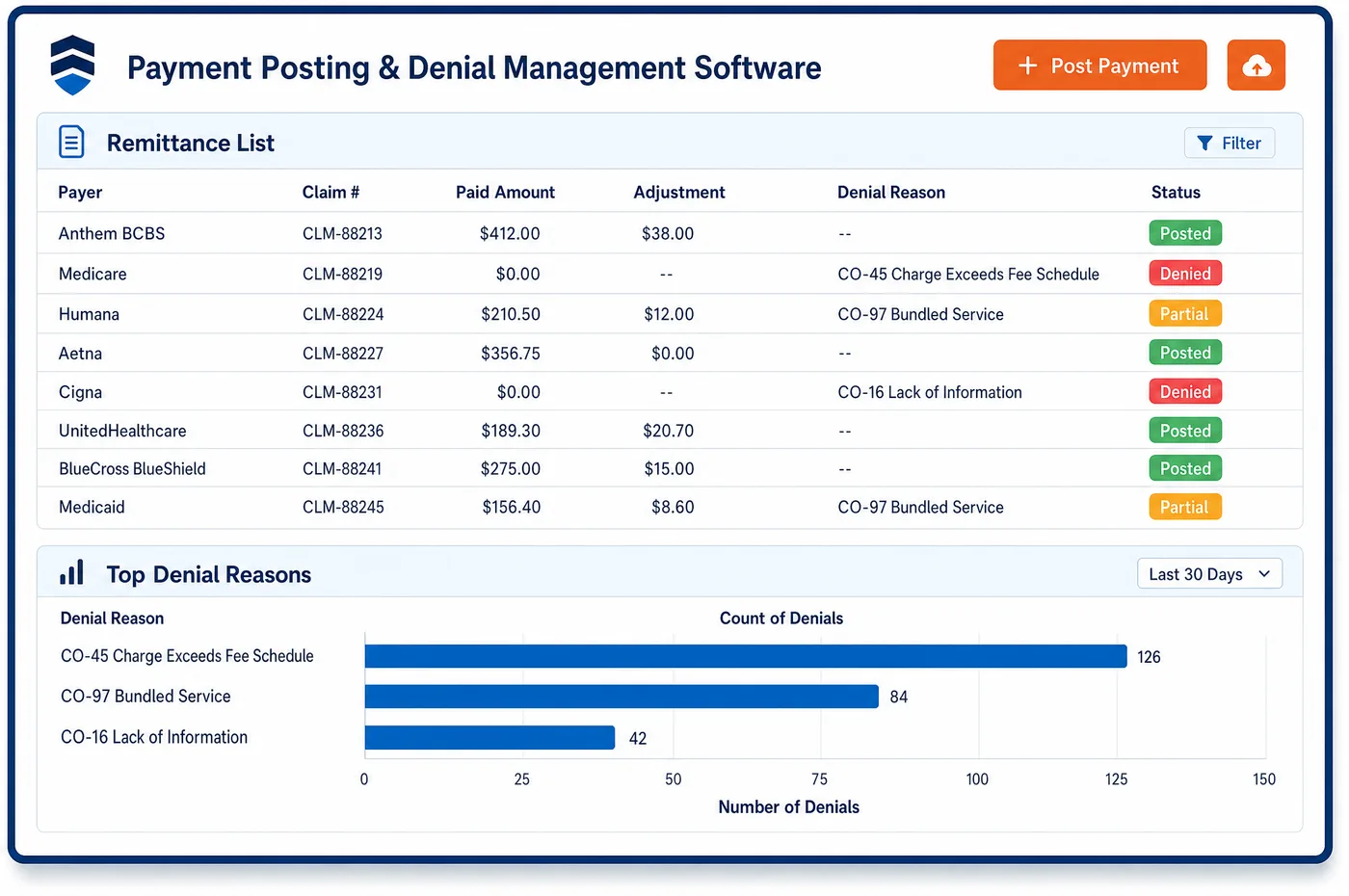
Integrated Patient Payments in a Ambulatory Surgery Center Practice
Payments in an ASC cluster around the surgery date. Pre-admission staff estimate the facility share and ask for a deposit when the case is booked or at check-in. The surgeon's office may take its own payment for the professional fee, so the facility deposit is tied to the ASC case, not to the surgeon's account. With integrated patient payments, the deposit posts to the ledger the moment it clears. After surgery, the payer's 835 sets the real patient share. If it is lower than the deposit, the credit is flagged for refund. If it is higher, the patient gets a text link for the rest, or the card on file is charged under the terms the patient agreed to. Larger balances can move to an installment plan that drafts on a set schedule. Card data stays with a PCI DSS-compliant payment gateway, and the ASC keeps a token, not the card number.
Why Is Integrated Patient Payments Different in Ambulatory Surgery Center?
ASC collections rest on one moment. Before surgery, patients are focused on the case and willing to settle their share. After discharge, the facility bill arrives next to the surgeon's and the anesthesia group's, and it can sit unpaid. Taking a deposit at booking or check-in, and keeping a card on file for the rest, keeps the facility share from aging. That only works when the payment system and the case ledger are the same.
The deposit is an estimate, not the final bill. The payer's remit can change the share because of an added procedure or a deductible the patient met elsewhere. Integrated patient payments have to apply the deposit, refund any overpayment, and bill any gap, using the posted 835. A payment tool that sits apart from the ledger leaves staff to match deposits to cases by hand. Statement work then passes to ASC patient billing with the deposit already applied.
Medicare adds a limit. ASCs must accept Medicare's payment as payment in full for ASC services, so the patient owes the deductible and coinsurance, plus any non-covered item the patient chose, such as a premium lens function. Any deposit above the share on the remit becomes a credit owed back to the patient. Self-pay patients, who get a good faith estimate, may be asked to pay the estimated facility price before the case under the center's policy.
What Ambulatory Surgery Center Integrated Patient Payments Software Handles
- Medicare assignment for ASC services
- ASCs must accept Medicare's payment as payment in full for ASC services. Deposits for Medicare patients are set from the expected deductible and coinsurance, and any excess shows as a credit once the remit posts. (Medicare Claims Processing Manual, Chapter 14: Ambulatory Surgical Centers (sections 10, 30.1, 40.9))
- Premium lens deposits (V2787, V2788)
- A patient who chooses an astigmatism-correcting or presbyopia-correcting lens owes for the non-covered lens function, which the ASC reports with V2787 or V2788. That amount can be collected as its own deposit line before surgery. (Medicare Claims Processing Manual, Chapter 14: Ambulatory Surgical Centers (sections 10, 30.1, 40.9))
- Screening colonoscopy deposits
- For Medicare screening colonoscopy, no deductible applies, even when a polyp is removed in the same encounter. Deposit rules can leave the deductible out for these cases, so patients are not over-collected. (Medicare Claims Processing Manual, Chapter 14: Ambulatory Surgical Centers (sections 10, 30.1, 40.9))
- Good faith estimate for self-pay cases
- Self-pay patients who schedule ahead receive a good faith estimate. A self-pay deposit is tied to that estimate, so the final charge can be checked against it. (CMS Medical Bill Rights: Good faith estimates)
- PCI DSS card security
- Card numbers are handled by a PCI DSS-compliant payment gateway. The ASC stores a token for card-on-file charges, not the card number itself. (PCI Security Standards Council: PCI Data Security Standard (PCI DSS))
- CARC 1, 2 and 3 on the 835
- The remit reports deductible, coinsurance and copay with CARC 1, 2 and 3. The deposit is applied against those amounts, so the true-up uses exactly what the payer reported. (X12 Claim Adjustment Reason Codes)
How Does Ambulatory Surgery Center Integrated Patient Payments Software Work?
1. Estimate the facility share
The facility share is set during ASC financial clearance from benefits and the contract rate. The estimate is stored with the case.
2. Collect the deposit
A deposit link goes out by text when the case is booked, or the deposit is taken at check-in. It posts to the case ledger once it clears.
3. Save a card on file
With the patient's consent, a card or bank account is saved as a token. The terms for later charges are recorded with it.
4. True up after the remit
When the 835 posts, the deposit is applied to the real share. Credits go to refund review, and gaps are billed by text link or to the card on file.
5. Set up a plan for large balances
Patients can choose an installment plan that drafts on a set schedule. Each draft posts to the ledger as it clears.
6. Reconcile settlements by entity
Card and ACH settlements are matched to posted payments. Each settlement is booked to the ASC that collected it, which keeps ASC accounting clean.
Ambulatory Surgery Center Integrated Patient Payments Software vs. Generic Software
| Area | Generic approach | Unlimited Systems |
|---|---|---|
| Deposits | Taken on a separate terminal and keyed in later. | Posted to the case ledger when the payment clears. |
| Card storage | Card numbers written on paper forms. | Tokens held by a PCI DSS-compliant gateway. |
| True-up | Refunds and balances worked by hand. | Deposits applied against the share on the posted remit. |
| Payment options | Check or card at the window. | Card, ACH, mobile wallet and text link. |
| Plans | Tracked on a spreadsheet. | Installment drafts that post as they clear. |
Who Uses It in a Ambulatory Surgery Center Practice
- Pre-admission coordinator: A deposit link to send when the case is booked, plus a text-to-pay option for patients who want to pay from their phone.
- Front desk at check-in: One screen to take the day-of-surgery payment and save a card on file with the patient's consent.
- Business office: Deposits, refunds and plan payments that already sit on the case ledger, so true-ups after the remit need no search.
Ambulatory Surgery Center Integrated Patient Payments Software FAQs
Integrated patient payments for an ASC are card, ACH, mobile wallet and text-link payments that post straight to the patient's case ledger. Staff take deposits at booking or check-in, keep a card on file for the balance, and set up plans for large shares. Because the payment and the ledger are one system, deposits apply to the case without manual matching.
The deposit is set from the facility estimate made during financial clearance. That estimate uses the patient's benefits, the remaining deductible and the contract or Medicare rate for the planned procedure. For Medicare patients, the deposit covers only the expected deductible and coinsurance, plus any non-covered item the patient chose, such as a premium lens function.
When the 835 shows a smaller patient share than the deposit, the difference becomes a credit balance on the account. The credit goes to refund review, where staff check for other open balances the patient has agreed to cover. The refund then goes back to the card or account used, and it posts to the ledger.
Card numbers are held by a PCI DSS-compliant payment gateway, and the ASC keeps only a token. The patient agrees to the terms for later charges, such as the balance after the remit, and those terms are saved with the token. Staff can see that a card is on file but never the full card number.
Patients can pay by text message through a secure link to a payment page. The link opens the balance for that case, shows what insurance paid, and accepts card, ACH or mobile wallet payments. The payment posts to the ledger once it clears, so the next statement already shows it.
Self-pay patients who schedule ahead get a good faith estimate for the facility charges. A center may ask for the estimated facility price before the case, under its own policy. The payment posts against the case, and the final charge is compared with the estimate, so any gap is clear before a statement goes out.
Related Ambulatory Surgery Center Software
Payments & AR
In the revenue cycle
Integrated Patient Payments for related specialties
Sources
GET STARTED
See Unlimited Systems in Action
Whether you're actively evaluating new technology or simply preparing for your next vendor renewal, Unlimited Systems can help you understand where your current workflows may be creating avoidable revenue risk.