

Payments & AR
Ambulatory Surgery Center Payment Posting Software
Post each ASC facility remit line by line, with multiple-procedure cuts, packaged-item denials and device credits checked against what should have paid.
Ambulatory Surgery Center Payment Posting Software applies 835 remits and patient payments to the facility claim for each surgical case. It checks every line against the expected rate, flags multiple-procedure cuts placed on the wrong line, sorts packaged-item denials from real ones, and matches each deposit to the bank so cash and ledger agree.



 6,500+ specialty providers

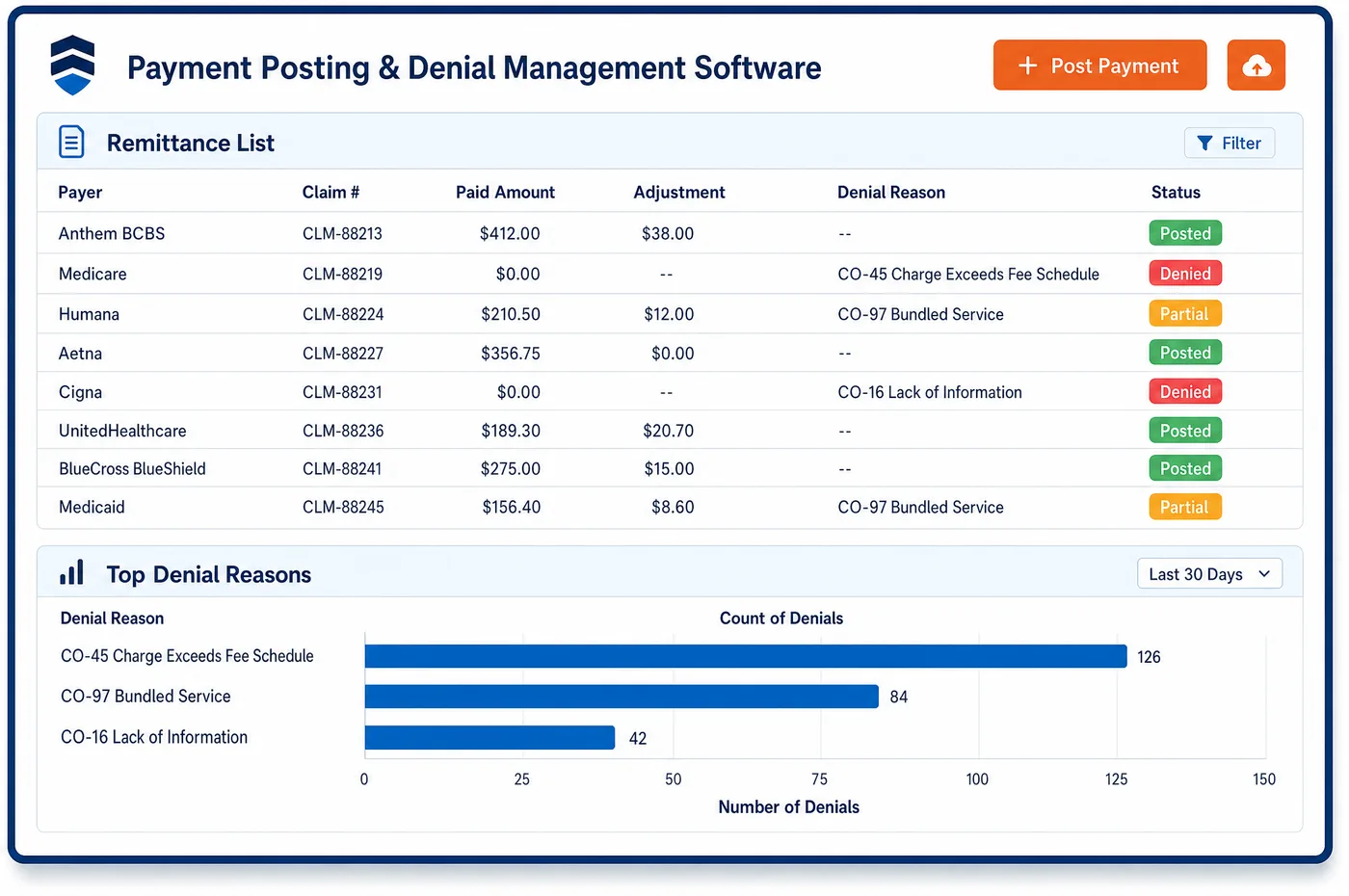
Payment Posting in a Ambulatory Surgery Center Practice
A facility remit for one ASC case often holds several lines. For Medicare, the highest-paying procedure subject to discounting is paid at its full rate, and each other discounted procedure is paid at half. A bilateral procedure counts as two procedures, so one side is discounted too. Payment posting starts by importing the 835 from the clearinghouse and matching each service line to the CPT code, modifier and units billed. A CARC 59 reduction is then checked against the line the contract says should take it. A CO-97 denial on a separately billed implant is often correct, because Medicare packages most implants into the procedure rate. A line with modifier 73 should pay at half, and a line with modifier 74 should pay in full. Short pays go to an underpayment queue with the reason code attached. The EFT is matched to its 835 by trace number, and the deposit is booked to the ASC that earned it.
Why Is Payment Posting Different in Ambulatory Surgery Center?
Most ASC payment problems hide inside lines that look paid. A remit can show the right total and still put the discount on the wrong procedure. Medicare ranks procedures for the discount by the lower of the billed charge or the ASC rate, so a low charge on the main procedure can shift the full payment to a smaller one. Commercial contracts add case rates, carve-outs, rates set off the Medicare schedule and their own discount rules. A poster who keys only the check total misses all of it.
Device rules change the expected amount, too. When an ASC gets a covered device at no cost or with full credit, such as after a recall, Medicare requires modifier FB on the procedure and pays less. A partial credit of half the device cost or more calls for modifier FC. Pass-through devices are paid apart from the procedure on invoice cost, and the procedure rate may carry a device offset. Each of these lowers or splits the payment for a sound reason, and posting has to tell them apart from a payer error.
Case mix and ownership raise the stakes. A center may run many short endoscopy cases in a day and a few long orthopedic cases, each paid on a different basis. Many ASCs are owned by surgeons or run as joint ventures, and owners watch net revenue closely. Posted cash feeds ASC accounting and the results the board reviews. Zero-pay lines also need to move straight to denial work for the center instead of sitting in the ledger.
What Ambulatory Surgery Center Payment Posting Software Handles
- Medicare multiple-procedure discount
- Lines subject to the discount are checked so the highest-paying procedure pays at its full rate and the others at half. The poster sees when a payer cut the primary line instead. (Medicare Claims Processing Manual, Chapter 14: Ambulatory Surgical Centers (sections 40.4, 40.5, 40.7, 40.8, 60.2))
- Bilateral procedures on ASC claims
- Medicare wants a bilateral procedure on two lines, or with two units on one line, and the discount applies to one side. Posting checks that the second side paid at the reduced rate, not at zero. (Medicare Claims Processing Manual, Chapter 14: Ambulatory Surgical Centers (sections 40.4, 40.5, 40.7, 40.8, 60.2))
- Modifiers 73, 74 and 52
- A case stopped before anesthesia (modifier 73) should pay at half the rate, and one stopped after anesthesia began (modifier 74) pays in full. Lines billed with 73 or 52 are not discounted again, so a second cut is flagged. (Medicare Claims Processing Manual, Chapter 14: Ambulatory Surgical Centers (sections 40.4, 40.5, 40.7, 40.8, 60.2))
- FB and FC device credit modifiers
- When a device came at no cost or full credit, the procedure carries FB and Medicare pays a reduced amount. FC applies to a partial credit of half the device cost or more. The expected amount uses the reduced rate, so a correct cut is not chased. (Medicare Claims Processing Manual, Chapter 14: Ambulatory Surgical Centers (sections 40.4, 40.5, 40.7, 40.8, 60.2))
- CO-97 with RARC M97 on implant lines
- Medicare denies separately billed implantable devices that are packaged into the procedure. These lines close as expected when the device is not pass-through, and the charge fix goes back to billing so the cost rolls into the procedure line next time. (Medicare Claims Processing Manual, Chapter 14: Ambulatory Surgical Centers (sections 40.4, 40.5, 40.7, 40.8, 60.2))
- CARC 59 and CARC 45 adjustments
- CARC 59 marks a multiple or concurrent procedure cut, and CARC 45 marks the gap between the charge and the allowed amount. Each posts as its own line, so the contractual write-off can be checked. (X12 Claim Adjustment Reason Codes)
- ERA and EFT reassociation
- Each EFT is matched to its 835 through the trace number that the CAQH CORE rules define. Deposits are then booked to the right ASC entity and bank account. (CAQH CORE Operating Rules (including EFT and ERA reassociation))
How Does Ambulatory Surgery Center Payment Posting Software Work?
1. Import and balance the 835
Each ERA is pulled from the clearinghouse and balanced to its payment total. A file that does not balance stops before any line posts.
2. Match lines to the case
Lines are matched to the CPT codes, modifiers and units on the facility claim. The order of procedures on the case is kept, so the discount can be checked line by line.
3. Compare with the expected rate
Allowed amounts are compared with the Medicare ASC rate or the contract for that payer. Case rates, carve-outs and device credits are part of the expected amount.
4. Close expected packaging denials
Denials for packaged items are matched to their Medicare payment indicator. Correct ones close, and charge-entry fixes go back to the billing team.
5. Route short pays and true denials
Underpaid lines go to an underpayment work queue with the CARC and RARC shown. Denied cases move to the staff who own them, so no one sorts them by hand.
6. Reconcile the deposit by entity
Each day's posted totals are tied out against the bank deposit and lockbox file. Each deposit is booked to the ASC, or the entity, that earned it.
Ambulatory Surgery Center Payment Posting Software vs. Generic Software
| Area | Generic approach | Unlimited Systems |
|---|---|---|
| Multiple-procedure cuts | Accepted when the check total looked close. | Each line checked so the discount lands on the right procedure. |
| Packaged implant denials | Appealed out of habit, wasting staff time. | Closed as expected when Medicare packages the device. |
| Device credits | FB and FC cuts chased as underpayments. | Expected amount set from the reduced device-credit rate. |
| Terminated cases | Modifier 73 and 74 lines posted without a check. | Half or full payment checked against the modifier billed. |
| Deposits | Matched to bank statements at month end. | Matched to each 835 by trace number as payments post. |
Who Uses It in a Ambulatory Surgery Center Practice
- Payment poster: A short list of exceptions, such as unbalanced files, short pays and device-credit lines, with the remit detail beside the case.
- Business office manager: Underpayments by payer and CPT code, so a payer that keeps cutting the wrong line can be raised with its contract team.
- Administrator and physician owners: Cash that agrees with the bank and is booked by entity, so monthly results start from posted numbers rather than estimates.
Ambulatory Surgery Center Payment Posting Software FAQs
ASC payment posting checks each surgical line against the amount it should pay for its place in the case. Under Medicare, the highest-paying procedure subject to the discount pays at its full rate and the others pay at half. If the payer discounted the main procedure, or discounted a line billed with modifier 73 a second time, the line is flagged as short and its CARC is shown beside it.
Medicare packages most implants into the payment for the surgical procedure, so a device billed on its own line is denied with CARC 97 and RARC M97. That denial is expected, and the line can close. The exception is a pass-through device, which Medicare pays apart from the procedure based on invoice cost. Posting treats the two cases differently, so staff appeal only the lines that should have paid.
A procedure billed with FB or FC is paid at a reduced amount that CMS sets for the device credit. Posting uses that reduced amount as the expected payment, so the cut is not chased as an underpayment. When an ASC billed before the manufacturer's credit was known, the first payment is conditional, and a later claim adjustment posts against the same case.
Commercial case rates, carve-outs and contracts priced off the Medicare ASC schedule can be loaded as expected amounts by payer. Each payment is compared with its contract term when the 835 posts. Lines that pay short move to an underpayment queue with the remit detail, so the business office can appeal them or raise the pattern with the payer.
Each EFT is matched to its 835 using the trace number, and lockbox files are matched to posted checks. The deposit is then booked to the ASC entity that earned it. Payments that arrive without a matching remit, and remits with no matching deposit, show up on a reconciliation list for the finance team to clear.
Patient payments, such as deposits taken before surgery and balances paid after the remit, post to the same case ledger as insurance payments. When the 835 shows a different patient share than the estimate, the balance updates. Any credit balance appears for refund review, and any amount still owed moves on to patient statements.
Related Ambulatory Surgery Center Software
Payments & AR
In the revenue cycle
Payment Posting for related specialties
Sources
GET STARTED
See Unlimited Systems in Action
Whether you're actively evaluating new technology or simply preparing for your next vendor renewal, Unlimited Systems can help you understand where your current workflows may be creating avoidable revenue risk.