

Payments & AR
Ambulatory Surgery Center AR Management Software
Work open ASC facility claims by value and filing deadline, from pended operative-note requests to device-credit adjustments and secondary balances.
Ambulatory Surgery Center AR Management Software keeps every unpaid facility claim moving until it is paid, denied for good or written off with a reason. It ranks open cases by balance, payer and filing deadline, checks claim status in bulk, tracks record requests, and bills secondary payers once the primary remit posts.



 6,500+ specialty providers

AR Management in a Ambulatory Surgery Center Practice
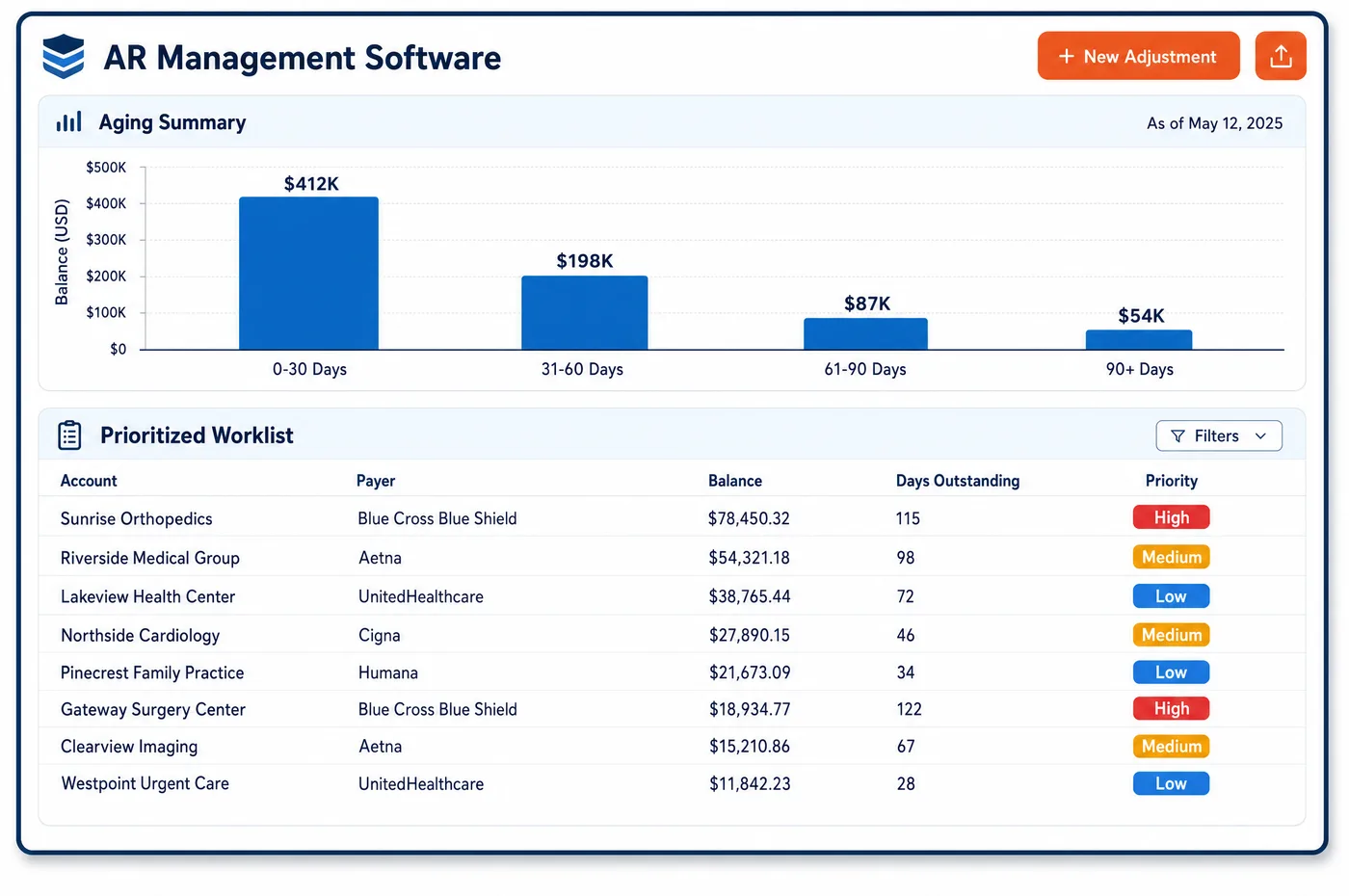
ASC receivables are lumpy. A cataract day may create many small claims, while one spine or joint case can carry a large balance on its own. AR management sorts that mix so the right claim is worked first. Each open claim sits in an aging bucket by payer and date of service. Bulk 276 status requests return the payer's 277 answer before anyone calls or logs into a portal. Claims pended for an operative report or a device invoice get a task with a due date. Claims held for a maker's device credit are tracked until the credit is known and the claim is adjusted. When the primary remit posts, the secondary claim goes out, and any patient share moves to statements. For Medicare, the filing limit is one calendar year after the date of service, while commercial limits are set in each contract. The worklist puts claims near their limit at the top.
Why Is AR Management Different in Ambulatory Surgery Center?
Each ASC case is a high-value claim with several ways to stall. A payer may pend it for the operative note, ask for an implant invoice on a carve-out line, or deny it because the procedure is not on its ASC list. Some of those fixes need the surgeon's office, which sits outside the center. Without clear owners and due dates, a pended case ages quietly while staff chase newer ones.
Payment rules also leave balances that look open but are not. A terminated case billed with modifier 73 pays at half the rate on purpose. A device credit billed with FC pays less by design. Medicare packages most supplies and implants, so a denied packaged line is not a balance to chase. AR staff need to see which open amounts are real before they spend time on them, and that depends on clean data from ASC payment posting.
Filing limits close the door for good. Medicare allows one calendar year from the date of service, and many commercial ASC contracts allow less. Workers' compensation and auto claims follow state rules that differ from one state to the next. A worklist that sorts only by age misses a young claim with a short limit. ASC AR management has to rank by both value and deadline, then send what it finds to denial management or to the patient.
What Ambulatory Surgery Center AR Management Software Handles
- Medicare timely filing (42 CFR 424.44)
- Medicare claims must be filed by the close of the period ending one calendar year after the date of service. Each open facility claim shows its last filing date, and claims close to it rise to the top of the worklist. (eCFR: 42 CFR 424.44, Time limits for filing claims)
- X12 276 and 277 claim status
- Status requests go out in bulk as X12 276 transactions, and payer answers come back as 277 responses. Staff see pended, denied and in-process claims without phone calls. (X12 transaction sets, including 276/277 claim status and 835 remittance)
- Terminated case records (modifiers 73 and 74)
- Medicare expects the ASC to keep an operative report for a terminated case that gives the reason it stopped and the services and supplies used. When a payer asks for it, the request is tracked on the claim until the report is sent. (Medicare Claims Processing Manual, Chapter 14: Ambulatory Surgical Centers (sections 40.4, 40.8, 60.2))
- Claims held for an FC device credit
- An ASC may hold a claim until the maker decides on a partial device credit, or bill first and ask for an adjustment later. Held claims and conditional payments each get a follow-up task, so neither is forgotten. (Medicare Claims Processing Manual, Chapter 14: Ambulatory Surgical Centers (sections 40.4, 40.8, 60.2))
- Ancillary lines returned with CO-16 and M51
- Medicare returns drug, device and other ancillary lines as unprocessable when there is no approved ASC procedure on the same date for that ASC. These lines go back to billing to rebill on the same claim as the procedure. (Medicare Claims Processing Manual, Chapter 14: Ambulatory Surgical Centers (sections 40.4, 40.8, 60.2))
- Services off the ASC payment files (CO-8 with N95)
- Medicare denies services that are not on the ASC payment files when an ASC bills them. These denials are sorted apart from routine ones, so staff check the code billed before they decide on an appeal. (Medicare Claims Processing Manual, Chapter 14: Ambulatory Surgical Centers (sections 40.4, 40.8, 60.2))
How Does Ambulatory Surgery Center AR Management Software Work?
1. Build the worklist
Open claims are sorted by balance, payer, aging bucket and filing deadline. Each collector starts the day with the claims most at risk.
2. Check status in bulk
Bulk 276 requests go out for open claims, and 277 answers update each one. Only claims the payer has not answered are left for a call.
3. Answer record requests
Requests for operative notes, implant invoices or discharge notes become tasks with due dates. Tasks that need the surgeon's office are routed to the right contact there.
4. Bill the next payer
When the primary 835 posts, the secondary claim is built and sent. The remaining patient share moves to ASC patient billing.
5. Escalate before the limit
Claims that near their filing limit, or sit pended past their due date, move up to a lead. Appeals carry their own deadlines on the same claim.
6. Close with a reason
Write-offs need a reason code and an owner. Small balances, packaged-line denials and timely filing losses are tracked apart, so leaders see why money was lost.
Ambulatory Surgery Center AR Management Software vs. Generic Software
| Area | Generic approach | Unlimited Systems |
|---|---|---|
| Prioritization | Claims worked in date order. | Claims sorted by value, payer and filing deadline. |
| Claim status | Calls and payer portals for each claim. | Bulk 276 requests with 277 answers on the claim. |
| Record requests | Kept in email and sticky notes. | Tasks with due dates linked to the claim. |
| Secondary claims | Sent when someone remembers. | Sent once the primary remit posts. |
| Write-offs | Taken without a reason. | Coded by reason, so losses can be traced. |
Who Uses It in a Ambulatory Surgery Center Practice
- AR specialist: One sorted list of open facility claims, with payer status, pended requests and filing dates on the same screen.
- Business office manager: Aging by payer, procedure type and entity, plus a view of claims waiting on the surgeon's office, so delays outside the center are visible.
- CFO or administrator: Days in AR and write-offs by reason for each ASC, which feed ASC analytics and the monthly close.
Ambulatory Surgery Center AR Management Software FAQs
AR management for an ASC covers every facility claim that has been sent but not fully paid. It ranks claims by balance and filing deadline, checks status with payers in bulk, tracks requests for operative notes or invoices, and bills the secondary payer after the primary pays. The work ends when each claim is paid, appealed or written off with a reason.
For Medicare, a facility claim must be filed by the close of the period ending one calendar year after the date of service, with limited exceptions set out in 42 CFR 424.44. Commercial and Medicare Advantage limits are set in each contract and are often shorter. Each claim carries its own last filing date, so claims close to the limit are worked first.
A case stopped before anesthesia is billed with modifier 73 and pays at half the rate under Medicare. A case stopped after anesthesia began is billed with modifier 74 and pays in full. Payers may ask for the operative report that explains why the case stopped. The request is tracked on the claim until the report is sent and the claim pays.
Claim status is checked with X12 276 requests sent in bulk to payers that support them. The payer's 277 response shows whether a claim is pending, paid, denied or needs more information. Each answer updates the claim, so collectors call payers only when a status is missing or unclear.
A request for an implant invoice becomes a task on the claim with a due date. Staff find the invoice in purchasing records and send it the way the payer asks. The claim stays on the worklist until it pays, so a carve-out line does not age while the paperwork sits in an inbox.
Patient balances are tracked next to insurance AR, but they move to patient statements once insurance has paid its share. The facility balance is separate from the surgeon's and the anesthesia group's bills. Leaders can see insurance aging and patient aging side by side for each ASC, which shows where follow-up should go next.
Related Ambulatory Surgery Center Software
Payments & AR
In the revenue cycle
AR Management for related specialties
Sources
GET STARTED
See Unlimited Systems in Action
Whether you're actively evaluating new technology or simply preparing for your next vendor renewal, Unlimited Systems can help you understand where your current workflows may be creating avoidable revenue risk.