

Billing & claims
Ambulatory Surgery Center Denial Management Software
Sort ASC denials by their reason and remark codes, work them before deadlines, and send each root cause back to clearance, coding or charge setup.
Ambulatory Surgery Center Denial Management Software sorts every denied or returned facility line by its reason and remark codes, routes it to the right person, and tracks the fix or appeal to payment. It also finds patterns, such as packaged items billed alone or ancillary lines sent without the surgery, and sends them back upstream.



 6,500+ specialty providers

Denial Management in a Ambulatory Surgery Center Practice
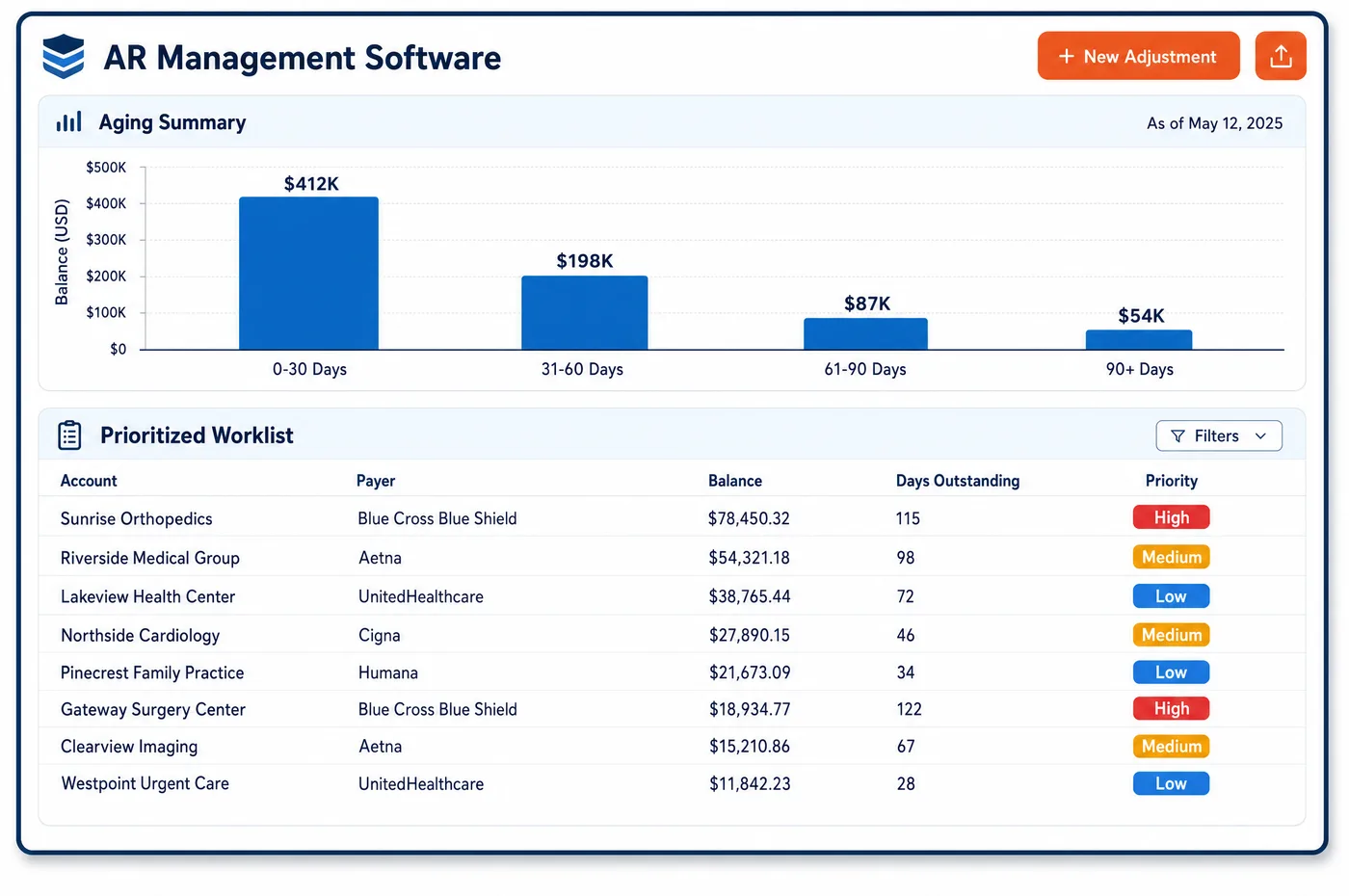
ASC denials follow patterns that Medicare spells out. A pass-through device billed on a claim of its own is returned, because no surgical procedure is on file. An implant without pass-through status is denied as packaged. A code with no ASC payment is denied, and the patient may be liable for the facility charge. When the 835 posts, each denied line is read for its group code, CARC and RARC. The line then routes to a queue for that kind of problem: coding, clearance, charge setup or the payer. Work is sorted by dollars at risk and the time left to correct, reopen or appeal. Each item arrives with the likely cause and the papers it needs, such as the operative report or the device invoice. Ambulatory surgery center denial management also counts repeat causes by payer, code and surgeon, so the fix lands in ASC charge validation or financial clearance instead of the appeal queue.
Why Is Denial Management Different in Ambulatory Surgery Center?
Many ASC denials have nothing to do with medical necessity. They come from how the claim was built: a packaged supply on its own line, a drug sent on a separate claim from the surgery, or a code with no ASC payment. Returned claims are not appealed. They are fixed and sent again, often as a corrected claim. Packaging denials point to a charge setup problem that will repeat until someone fixes it.
Group codes change who pays. A CO denial stays with the center unless the claim can be fixed. A PR denial moves the amount to the patient, as Medicare does for codes that are not valid for payment, such as indicator E5. Staff need to know which is which before they bill a patient or write off a balance, which makes the claim adjustment group code as important as the reason code.
The ten states in Medicare's ASC prior authorization test add another path. A claim for a targeted service sent without a UTN goes to prepayment review, with a request for records. A non-affirmation from the MAC cannot be appealed, but a claim that is later denied can be. Denial management in an ASC tracks these cases apart, with the records request and its due date on the case.
What Ambulatory Surgery Center Denial Management Software Handles
- Separately billed implants (CO-97, M97)
- Medicare denies implantable devices billed on their own lines when they lack pass-through status, using group CO, CARC 97 and RARC M97. These denials go to charge setup, since the cost belongs in the procedure line. (Medicare Claims Processing Manual, Chapter 14: Ambulatory Surgical Centers (section 60, remittance messages))
- Ancillary lines without a surgery (CO-16, M51)
- If a device, drug, brachytherapy or radiology line has no approved surgical procedure for the same patient, ASC and date, the MAC returns it with CO-16 and M51. The fix is to bill it with the surgery, not to appeal. (Medicare Claims Processing Manual, Chapter 14: Ambulatory Surgical Centers (section 60, remittance messages))
- Packaged items (CO-97, N390)
- Codes with payment indicators N1, L1 or S1 are packaged, and the MAC denies them with CO-97 and N390. Repeats point to a chargemaster line that should not be billed. (Medicare Claims Processing Manual, Chapter 14: Ambulatory Surgical Centers (section 60, remittance messages))
- Codes not payable in the ASC (CO-5 and PR-96)
- Codes with indicators C5, M6, U5 or X5 deny with CO-5, and codes with E5 or Y5 deny with PR-96 and N425. Medicare assigns the patient liability for the facility charge on C5, E5, U5 and X5 codes, which shapes the next step. (Medicare Claims Processing Manual, Chapter 14: Ambulatory Surgical Centers (section 60, remittance messages))
- Prepayment review and non-affirmations
- In demonstration states, a claim sent without prior authorization gets an additional documentation request before payment. A non-affirmation is not an initial determination, so it cannot be appealed, but a later claim denial can be. (CMS FAQs: Prior Authorization Demonstration for Certain ASC Services (December 2025))
- Medicare appeal levels
- A denied Medicare claim can be appealed, starting with redetermination by the MAC, then reconsideration and the later levels. Appeal deadlines are tracked on each item so none lapse. (CMS Original Medicare (Fee-for-Service) Appeals)
How Does Ambulatory Surgery Center Denial Management Software Work?
1. Read the remit
Each denied or returned line is read for group code, CARC and RARC when the 835 posts. The case and claim are linked to it.
2. Route by cause
Reason codes map to queues for coding, clearance, charge setup or payer follow-up. Each item has an owner.
3. Work by value and deadline
Items are sorted by dollars at risk and the time left to correct or appeal. The likely cause and needed documents come with each one.
4. Fix, correct or appeal
Returned lines are rebuilt and resent, and packaging errors are fixed at the source. True disputes go to appeal with the operative report or invoice attached.
5. Feed the cause upstream
Repeat causes are counted by payer, code and surgeon. Fixes go to ASC charge assembly, clearance or the chargemaster so the denial does not come back.
Ambulatory Surgery Center Denial Management Software vs. Generic Software
| Area | Generic approach | Unlimited Systems |
|---|---|---|
| Sorting | Denials worked oldest first. | Sorted by dollars at risk and deadline. |
| Returned claims | Treated like denials and appealed. | Rebuilt and resent, since they are not appealable. |
| Group codes | CO and PR amounts handled the same way. | Patient liability billed only where the remit assigns it. |
| Root cause | The same packaging denial every month. | Repeats traced to the charge setup and fixed. |
| Prepayment review | Records requests lost in the mail. | Requests and due dates tracked on the case. |
Who Uses It in a Ambulatory Surgery Center Practice
- Denial specialist: A queue of denials with the cause, documents and deadline on each, so time goes to the ones worth working.
- Business office manager: Counts of denials by payer, reason and surgeon, so fixes go where they help most.
- Coding and charge lead: A list of charge setup errors behind packaging and ancillary denials, ready to correct in the chargemaster.
Ambulatory Surgery Center Denial Management Software FAQs
Denial management for an ASC deals with many denials that come from how the claim was built rather than medical necessity. Packaged items billed alone, ancillary lines sent without the surgery, and codes with no ASC payment each have their own Medicare reason and remark codes. Reading those codes points to the fix, which is often a corrected claim or a charge setup change.
Medicare uses group code CO, CARC 97 and RARC M97 when an ASC bills an implantable device separately and the device has no pass-through status. The device's payment is already part of the procedure payment. The fix is to stop billing that device line and build its cost into the procedure charge.
Medicare returns ancillary lines with CO-16 and M51 when it finds no approved surgical procedure for the same patient, center and date. That often happens when a drug or device is sent on a separate claim. A returned line is not appealed. It is billed again with the surgery on the same claim.
The group code decides. A PR denial, such as PR-96 with N425 for a code not valid for Medicare payment, assigns the amount to the patient. Medicare also assigns patient liability for facility charges on codes with indicators C5, E5, U5 and X5. A CO denial is not billed to the patient, so staff check the group code first.
A non-affirmation in Medicare's ASC prior authorization test is not an initial determination, so it cannot be appealed. The ASC can fix the request and send it again as many times as needed. If the claim is then submitted and denied, that denial can be appealed through the normal Medicare appeal levels.
Each denial is grouped by payer, code, surgeon and reason. When the same cause shows up again, it goes to the team that can fix it, such as charge setup or clearance. Claims are also checked before they go out against the patterns that denied before, so likely denials are held for a fix.
Related Ambulatory Surgery Center Software
Billing & claims
In the revenue cycle
Denial Management for related specialties
Sources
GET STARTED
See Unlimited Systems in Action
Whether you're actively evaluating new technology or simply preparing for your next vendor renewal, Unlimited Systems can help you understand where your current workflows may be creating avoidable revenue risk.