

Billing & claims
Ambulatory Surgery Center RCM Software
The ASC revenue cycle from booking to final payment, measured case by case on one platform.
Ambulatory Surgery Center RCM Software runs the facility's revenue cycle from the surgeon's booking to the last patient payment. It ties clearance, coding, the facility claim, payment posting, denials and patient balances to each case. Leaders see collections, denials and days in AR by payer, procedure and surgeon, so they know which cases pay and which do not.



 6,500+ specialty providers

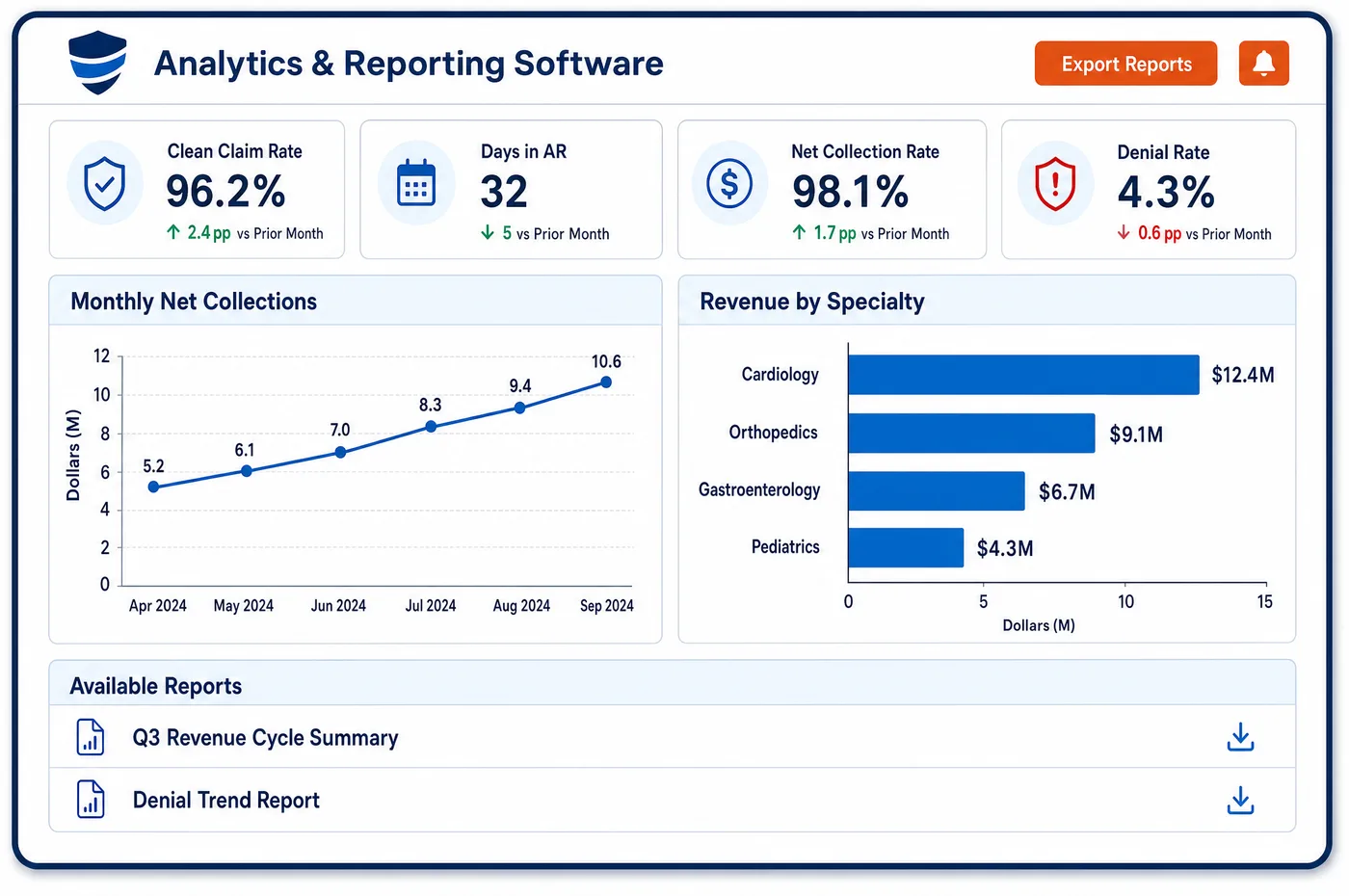
RCM in a Ambulatory Surgery Center Practice
Revenue cycle management at a surgery center follows the case. Before the date, clearance confirms benefits, the payer's site rules and any approval. After surgery, coders turn the operative note into CPT codes, and charge lines are built for the procedure and any separately payable drug, device or radiology service. The facility claim is scrubbed and sent through ASC medical billing. When the 835 arrives, payments post on their own, and each one is compared with the expected amount for that payer. Denials route to a work queue sorted by dollars and deadline. The patient's share then moves to statements and online payment. Ambulatory surgery center RCM software tracks the whole path in one place, so a manager can see where a case is stuck and what each payer, procedure and surgeon brings in.
Why Is RCM Different in Ambulatory Surgery Center?
ASC payment is per case, and the margin on each case can be thin. Medicare pays the lesser of the billed charge or the ASC rate for each line, and most supplies, drugs and implants are packaged into the procedure payment. A center that sets charges below the rate, or bills packaged items on their own lines, loses money without ever seeing a denial. RCM for an ASC has to watch payment at the line level, not just the claim total.
The rules change every year. CMS sets most ASC rates from hospital outpatient rates, adjusts them for local wages and updates them each calendar year. For CY 2026, CMS added procedures to the ASC covered list and kept using the hospital market basket for the update. Centers that do not report quality data get a smaller update. An ASC revenue cycle needs the new list, rates and indicators loaded before the first claim of the year.
Centers also choose how to staff the work. Some bill in house, some use an outside billing company, and some split the work by payer or task. Either way, the center should own its data and see the same numbers its billers see. RCM software that shows days in AR, denials and collections per case lets owners judge the work, whoever does it.
What Ambulatory Surgery Center RCM Software Handles
- Lesser of charge or ASC rate, line by line
- Medicare pays the lower of the billed charge or the ASC payment rate and compares them line by line. Packaged items are not billed on their own lines, so their charges are built into the separately payable line they go with. (Medicare Claims Processing Manual, Chapter 14: Ambulatory Surgical Centers (sections 30 and 40))
- Rates set from the OPPS and wage-adjusted
- Most ASC rates are based on the hospital outpatient rate and adjusted for the wage index where the center sits. Fee schedules are loaded for each calendar year and quarterly update, so expected payments match what the MAC will pay. (Medicare Claims Processing Manual, Chapter 14: Ambulatory Surgical Centers (sections 30 and 40))
- CY 2026 ASC list and update
- For CY 2026, CMS added procedures to the ASC covered procedures list and extended the hospital market basket for the ASC update. New procedures open new case types, and the update changes the expected payment on every case. (CMS fact sheet: CY 2026 OPPS and ASC Payment System Final Rule (CMS-1834-FC))
- ASC Quality Reporting penalty
- ASCs that do not meet ASCQR reporting rules get a reduced annual payment update. Quality reporting is tracked with the revenue cycle, since missing it lowers payment on every Medicare case in the affected year. (CMS fact sheet: CY 2026 OPPS and ASC Payment System Final Rule (CMS-1834-FC))
- Prepayment review in demonstration states
- In the ten states in Medicare's ASC prior authorization test, claims for the five targeted service groups that skip prior authorization go to prepayment review. That slows cash, so RCM reports show those cases apart. (CMS Prior Authorization Demonstration for Certain Ambulatory Surgical Center (ASC) Services)
How Does Ambulatory Surgery Center RCM Software Work?
1. Clear the case
Benefits, the payer's site rules and approvals are checked before the date. Estimates set the patient's share up front.
2. Code and build charges
Coders assign CPT codes from the operative note. Charge lines are built for the procedure and any separately payable item, then checked against ASC rules.
3. Send the facility claim
The claim is scrubbed and sent electronically, and acknowledgments and status are tracked. Rejections come back to a queue so they can be fixed the same day.
4. Post and compare
ERA payments post on their own, and each one is compared with the expected amount for that payer and code. Short payments are flagged for follow-up.
5. Work denials and patient balances
Denials route to work queues by value and deadline through ASC denial management. The patient's share goes to statements and online payment.
Ambulatory Surgery Center RCM Software vs. Generic Software
| Area | Generic approach | Unlimited Systems |
|---|---|---|
| Expected payment | Payments accepted as final. | Each payment compared with the expected amount for the payer and code. |
| Fee schedule updates | New-year rates loaded late or by hand. | Rates and payment indicators updated for each calendar year and quarter. |
| Denials | Worked oldest first. | Ordered by amount at risk and time left before the filing limit. |
| KPIs | Monthly spreadsheets built from several systems. | Live dashboards by payer, procedure and surgeon. |
| Outside billing | The center cannot see what its billing company sees. | Owners and billers work from the same data and reports. |
Who Uses It in a Ambulatory Surgery Center Practice
- Administrator: Collections, denials and days in AR by payer, procedure and surgeon, so case mix and contract talks rest on real numbers.
- Business office manager: One set of work queues for claims, denials and patient balances, with each item tied to its case.
- Physician owners: A clear view of how the center is paid on each kind of case, and how a payer or rule change will move it.
Ambulatory Surgery Center RCM Software FAQs
RCM software for an ambulatory surgery center runs the revenue cycle case by case. It clears benefits and approvals before the date, builds the facility charges, sends the claim, posts the payment and works denials and patient balances. Each step is tied to the case, so staff can see where any case stands and what it was paid.
Useful numbers include collections per case, days in AR, denial rate by payer and reason, clean claim rate, and the gap between expected and actual payment. Splitting them by procedure, surgeon and payer shows where money is made and lost. Canceled and stopped cases are worth tracking too, since they cost the center even when little or nothing is billed.
A center can run billing in house, use an outside billing company, or mix the two. In each case, staff and outside billers can work from the same queues and reports. The center keeps its own data and sees the same numbers its billers see, which makes the work easier to judge and easier to move if needed.
Each calendar year, CMS publishes new ASC rates, payment indicators and changes to the covered procedures list, with quarterly updates in between. The new values are loaded so expected payments and code checks match what the MAC will pay. Commercial contracts priced off Medicare rates follow the same update.
Medicare pays the lower of the billed charge or the ASC rate for each line, and packages most supplies, drugs and implants into the procedure payment. Extra procedures in one session are discounted. Patients also owe their deductible and coinsurance. Comparing each payment with the expected amount shows which gaps are normal and which are real underpayments.
The surgeon and the anesthesia group bill their own claims, so the center's revenue cycle covers only the facility side. The case record notes the other groups, so staff can answer patient questions. When the center and a physician group share owners, each entity keeps its own books under its own tax ID in one database.
Related Ambulatory Surgery Center Software
Billing & claims
RCM for related specialties
Sources
GET STARTED
See Unlimited Systems in Action
Whether you're actively evaluating new technology or simply preparing for your next vendor renewal, Unlimited Systems can help you understand where your current workflows may be creating avoidable revenue risk.