

Billing & claims
Ambulatory Surgery Center Invoicing Software
Bill what a routine claim does not reach: device and tissue costs, vendor credits, self-pay packages, patient-owed items and carrier forms, each tracked to payment.
Ambulatory Surgery Center Invoicing Software produces and tracks the bills an ASC sends beyond the routine claim. That includes invoice support for pass-through devices and corneal tissue, self-pay package bills, patient invoices for non-covered lens upgrades or off-list procedures, and bills to carriers with their own formats. Each invoice is formatted for its payer and followed until paid.



 6,500+ specialty providers

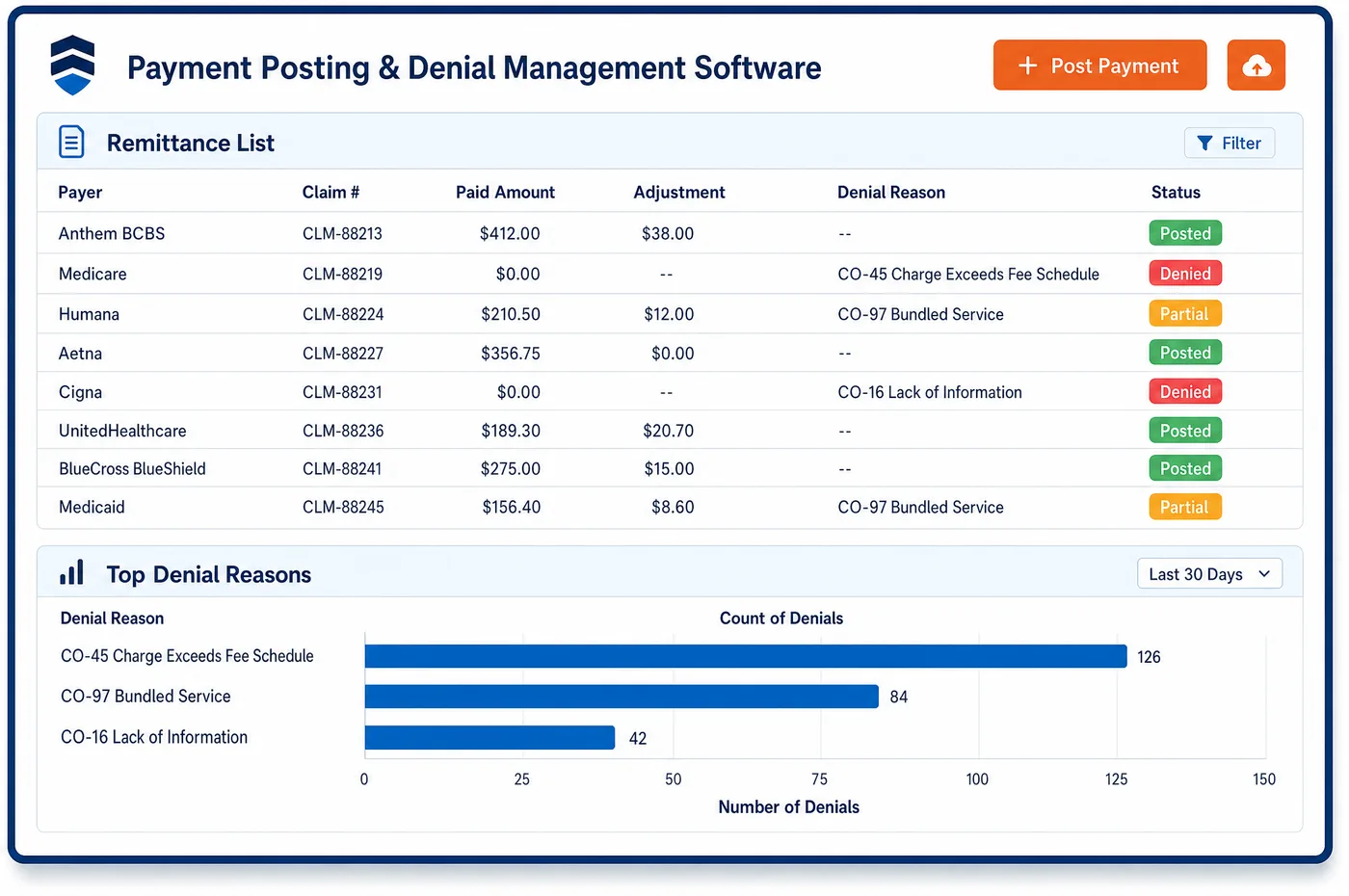
Invoicing in a Ambulatory Surgery Center Practice
Some ASC payments depend on a paper trail. Medicare prices pass-through devices and corneal tissue from the center's cost, so the MAC needs the invoice price, and any vendor credit, with the claim. Commercial contracts that carve out implants may ask for the manufacturer invoice as well. Patients may also owe the center directly: a self-pay package for a cosmetic case, the non-covered part of a premium lens, or the facility fee for a procedure Medicare will not cover in an ASC. Workers' compensation and auto carriers may want their own forms, which vary by state. Unlimited Systems formats each bill to the rules set for that payer and files it electronically over a real-time clearinghouse link where the payer accepts it. Patient invoices go out by email or text with a link to pay. Ambulatory surgery center invoicing tracks every bill to payment, and open items move to ASC AR follow-up.
Why Is Invoicing Different in Ambulatory Surgery Center?
ASC billing has more cost-based items than most settings. A pass-through device is contractor-priced, and the MAC may ask for the invoice before it pays. Corneal tissue is paid on acquisition cost or invoice. When a vendor gives a credit on a pass-through device, the credit and the invoice price both go on the claim. If the invoice is missing or does not match, the line waits, so ASC invoicing keeps the cost support on the case.
Patients are billed directly more often too. Self-pay patients may buy a package price for a cosmetic or elective case, and they are owed a good faith estimate first. Medicare patients may pay the non-covered part of a premium lens, or the facility fee for a procedure off the ASC list. Each bill should match what the patient was told before surgery, or the center will spend its time on disputes.
Contract and carrier billing add a third kind of invoice. Commercial ASC contracts may pay a case rate, a share of Medicare rates, or invoice cost for implants, and each needs its own support. Workers' compensation and auto carriers follow state rules that vary. Invoicing in an ASC keeps these bills apart from routine claims, with their documents and follow-up dates, so none of them slip through.
What Ambulatory Surgery Center Invoicing Software Handles
- Pass-through device pricing (J7)
- Pass-through devices are contractor-priced, and the MAC requires invoice information to price them. The invoice price is stored with the device line, so it is ready when the claim is built or the MAC asks. (Noridian JE Part B (Medicare Administrative Contractor): ASC Payment Indicators)
- Corneal tissue acquisition (V2785)
- Medicare pays ASCs separately for corneal tissue, billed with V2785, based on acquisition cost or invoice. The eye bank invoice is kept with the case for the claim. (Medicare Claims Processing Manual, Chapter 14: Ambulatory Surgical Centers (sections 10.3, 40 and 40.8))
- Credits on pass-through devices
- When a pass-through device comes with a credit, the ASC reports the credit amount along with the invoice price, and the device line's charge must reflect the credit. The vendor's credit memo is matched to the case before the claim goes out. (Medicare Claims Processing Manual, Chapter 14: Ambulatory Surgical Centers (sections 10.3, 40 and 40.8))
- Facility charges for off-list procedures
- When a surgical procedure is not on the ASC list, Medicare does not pay the facility, and the ASC bills the patient for the facility charges. That bill goes out as a patient invoice tied to the case. (Medicare Claims Processing Manual, Chapter 14: Ambulatory Surgical Centers (sections 10.3, 40 and 40.8))
- Self-pay estimates and disputes
- Uninsured and self-pay patients receive a good faith estimate, and if the final bill is far enough above it, they can start patient-provider dispute resolution. Self-pay invoices are built from the estimate so the two agree. (CMS No Surprises Act: Overview of Key Consumer Protections)
How Does Ambulatory Surgery Center Invoicing Software Work?
1. Spot cases that need invoicing
Cases with pass-through devices, corneal tissue, carve-out implants, self-pay packages or non-covered items are flagged. Each needs a bill or a document beyond the routine claim.
2. Attach the cost support
Staff add the device or tissue invoice and any vendor credit to the case. The invoice price and credit fill the claim fields that need them.
3. Format for the payer
Each bill follows the format set for that payer, from the MAC to a carrier with its own form. Bills go out electronically where the payer accepts them.
4. Invoice the patient
Patient invoices go out by email or text with a link to pay, and they match what the patient was told before surgery. Payments post to the same ledger through integrated payments.
5. Track to payment
Each invoice has a status and a follow-up date. Unpaid bills move to the AR queue with their documents attached.
Ambulatory Surgery Center Invoicing Software vs. Generic Software
| Area | Generic approach | Unlimited Systems |
|---|---|---|
| Device invoices | Kept in the materials office and found only when the MAC asks. | Stored with the case and the device line. |
| Vendor credits | Credit memos never reach billing. | Credits matched to the case before the claim goes out. |
| Patient-owed items | Billed late on a generic statement. | Invoiced from the case, matching the estimate. |
| Carrier formats | Re-keyed by hand for each carrier. | Format set per payer and applied each time. |
| Follow-up | Open invoices tracked on a spreadsheet. | Each invoice tracked to payment with a follow-up date. |
Who Uses It in a Ambulatory Surgery Center Practice
- ASC biller: Device and tissue invoices on the case, with prices and credits ready for the claim.
- Materials manager: A clear path from vendor invoice and credit memo to the bill, so a credit is never left out of the claim.
- Patient financial counselor: Patient invoices that match the estimate, sent by email or text, with balances in one ledger.
Ambulatory Surgery Center Invoicing Software FAQs
Invoicing at a surgery center covers bills and cost records beyond the routine claim. That includes invoice support for pass-through devices and corneal tissue, vendor credits, carve-out implants, self-pay packages, non-covered upgrades and off-list procedures billed to patients, and carrier bills with their own forms. Each item is tied to the case and tracked to payment.
Pass-through devices are paid separately and priced by the MAC, which requires invoice information to set the amount. Corneal tissue is also paid on acquisition cost or invoice. Keeping these invoices with the case means the claim can carry the price, and the center can answer a MAC request quickly.
For a pass-through device that came with a credit, the ASC reports the credit amount with the invoice price, and the device line's charge must reflect the credit. For other listed devices, a full credit, or one of at least half the cost, is shown with modifier FB or FC on the procedure. Matching the credit memo to the case keeps both right.
Patient invoices go out by email or text with a secure link to pay by card, and a card on file can be used where the patient agreed to it. Payments post to the same ledger staff use, so the balance updates at once. Patients can also see their balance in the portal.
A self-pay patient gets a good faith estimate when the case is scheduled. The final invoice is built from that estimate, so the items and amounts line up. If the final bill runs far enough above the estimate, an uninsured patient can use patient-provider dispute resolution, so the center keeps the two documents together.
Workers' compensation and auto carriers set their own billing rules, and those rules vary by state. Some take a standard claim with extra fields, while others want their own forms or attachments. The format for each carrier is set once, so staff do not rebuild the bill for every case.
Related Ambulatory Surgery Center Software
Billing & claims
Invoicing for related specialties
Sources
GET STARTED
See Unlimited Systems in Action
Whether you're actively evaluating new technology or simply preparing for your next vendor renewal, Unlimited Systems can help you understand where your current workflows may be creating avoidable revenue risk.