

Billing & claims
Ambulatory Surgery Center Medical Billing Software
Build, scrub, send and track the facility claim in the format each payer expects.
Ambulatory Surgery Center Medical Billing Software builds the facility claim for each case and sends it to the payer. For Medicare, that means an 837 professional claim under the center's own NPI with place of service 24. Each claim is scrubbed before it leaves, sent through the clearinghouse, and tracked from acknowledgment to payment.



 6,500+ specialty providers

Medical Billing in a Ambulatory Surgery Center Practice
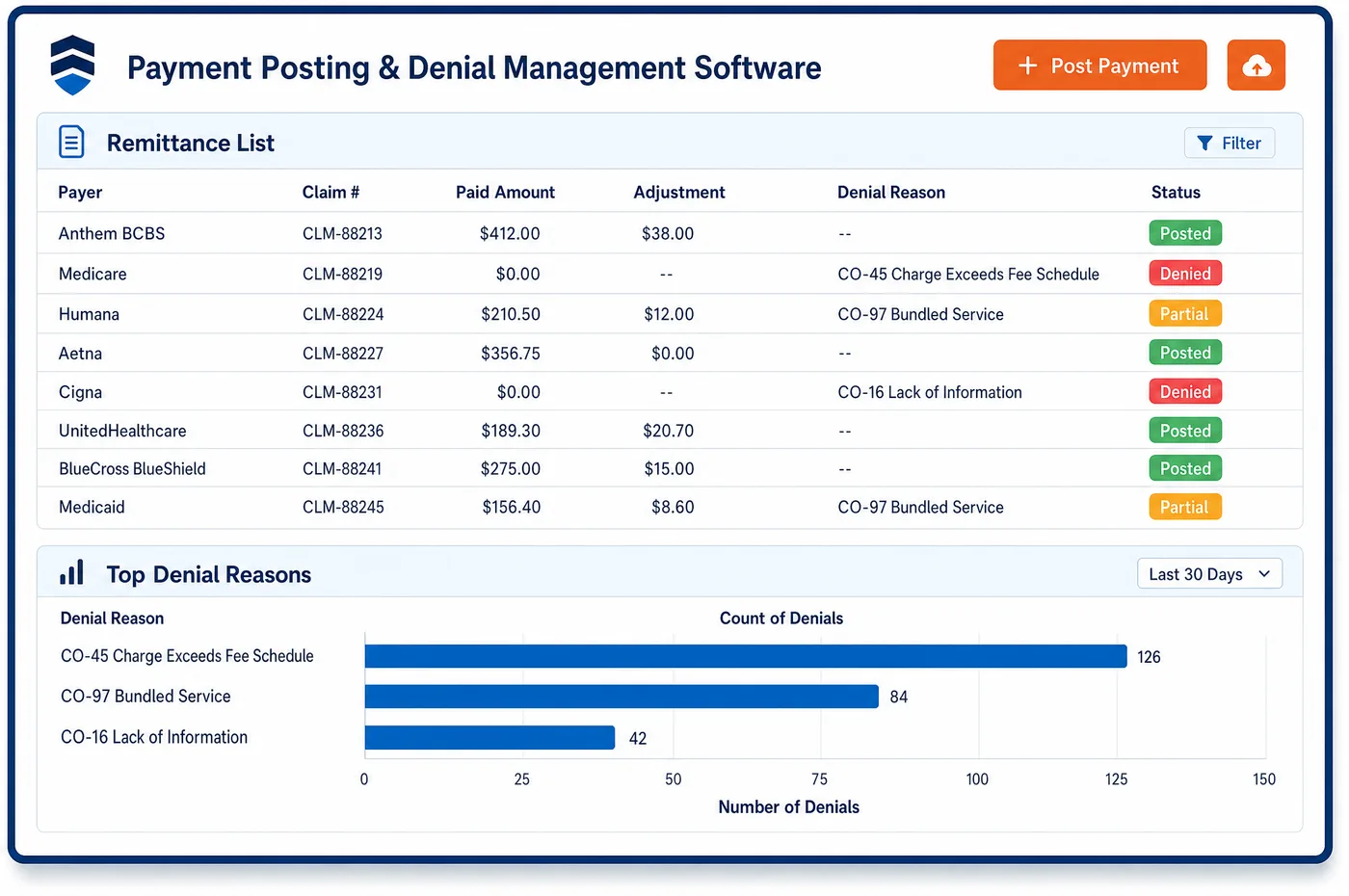
Billing starts when the case is coded and the charges are checked. The claim holds the center as billing provider, the patient and payer from registration, the diagnosis codes, and a line for each procedure and each separately payable item. Packaged supplies are not listed on their own lines. Their charges are built into the procedure line instead. Any approval number or UTN from clearance goes in its claim field. Before the claim leaves, the scrubber checks codes, modifiers, units, provider data and payer rules. The claim then goes out over a real-time clearinghouse link. The 999 and 277CA responses come back to the claim, and rejections land in a queue to fix and resend. Status checks follow the claim until the 835 arrives, and secondary claims go out from the primary payment. Ambulatory surgery center medical billing keeps each claim moving, while the ASC revenue cycle view shows where it sits.
Why Is Medical Billing Different in Ambulatory Surgery Center?
A surgery center claim looks like a physician claim but follows facility rules. Medicare ASCs bill their A/B MAC on the 837P with place of service 24, yet payment comes from the ASC fee schedule, not the physician fee schedule. Some commercial and Medicaid payers ask for an institutional claim instead. Claim format has to be set per payer, not assumed.
Line grouping matters too. Medicare wants drugs, pass-through devices, brachytherapy sources and radiology billed on the same claim as the surgery they support. If an ancillary line arrives alone and no approved surgical procedure exists for that date, it is returned as unprocessable. A radiology line billed as a technical component also needs the ordering or referring physician's name and NPI.
The claim must also carry what clearance found. In Medicare's ASC prior authorization test, the UTN has to be on the claim, or the claim goes to prepayment review. Commercial approvals have their own number fields. Medical billing for an ASC ties those numbers to the case, so they reach the claim without retyping.
What Ambulatory Surgery Center Medical Billing Software Handles
- 837P to the A/B MAC
- A Medicare-certified ASC bills its MAC on the ASC X12 837 professional claim, or in rare cases the CMS-1500, and is paid the ASC rate. Claims carry the center's own NPI as billing provider. (Medicare Claims Processing Manual, Chapter 14: Ambulatory Surgical Centers (sections 10, 40 and 50))
- Place of service 24 and type of service F
- ASC facility claims use place of service 24. Medicare assigns type of service F to codes billed by specialty 49 at that place of service, which marks them as ASC facility charges. (Medicare Claims Processing Manual, Chapter 14: Ambulatory Surgical Centers (sections 10, 40 and 50))
- Ancillary lines on the surgical claim
- Separately payable drugs, pass-through devices, brachytherapy sources and radiology belong on the same claim as the related surgery. If no approved surgical procedure exists for that date, the MAC returns the ancillary line as unprocessable. (Medicare Claims Processing Manual, Chapter 14: Ambulatory Surgical Centers (sections 10, 40 and 50))
- UTN placement for demonstration cases
- On an 837P, the prior authorization UTN goes in loop 2300, in the REF segment with qualifier G1. On a paper CMS-1500, it fills the first positions of item 23. (CMS FAQs: Prior Authorization Demonstration for Certain ASC Services (December 2025))
- Ordering or referring NPI on technical component lines
- When an ASC bills a line with modifier TC, the ordering or referring physician's name and NPI must be on the claim. Without them, the MAC returns the claim as unprocessable with CARC 16. (Medicare Claims Processing Manual, Chapter 14: Ambulatory Surgical Centers (sections 10, 40 and 50))
- Claim acknowledgments and status
- The 999 and 277CA confirm that the claim was received and accepted for processing, and 276/277 status checks follow it after that. Each response is stored on the claim. (X12 transaction sets, including 837, 999, 277CA and 276/277)
How Does Ambulatory Surgery Center Medical Billing Software Work?
1. Pull the coded case
Checked charge lines, diagnosis codes and case details come from ASC charge assembly. Packaged items stay off the claim.
2. Build the claim per payer
The format follows the payer's setup: the 837P for Medicare, or an institutional claim where a contract calls for it. Approval numbers and UTNs fill their fields.
3. Scrub before sending
Codes, modifiers, units, provider data and payer rules are checked. Claims that fail are held for a fix instead of going out.
4. Send and watch acknowledgments
Claims go out over a real-time clearinghouse link. Rejections from the 999 or 277CA land in a queue to correct and resend.
5. Track to payment
Status checks follow the claim until the 835 arrives. Secondary claims are filed from the primary payment, and denials move to their own queue.
Ambulatory Surgery Center Medical Billing Software vs. Generic Software
| Area | Generic approach | Unlimited Systems |
|---|---|---|
| Claim format | One format for every payer. | Format set per payer, professional or institutional. |
| Ancillary lines | Drug and device lines sent on a later claim and returned. | Ancillary lines kept on the surgical claim. |
| Approval numbers | Typed in from a sticky note. | Carried from clearance to the right claim field. |
| Rejections | Found later in a clearinghouse report. | Returned to a work queue as soon as they arrive. |
| Secondary claims | Filed by hand when someone remembers. | Filed from the primary payment automatically. |
Who Uses It in a Ambulatory Surgery Center Practice
- ASC biller: Claims built from checked charges with approval numbers already in place, and one queue for rejections.
- Business office manager: Status for every claim from send to payment, with ASC denial follow-up for anything that does not pay.
- Administrator: Fewer claims stuck between the center and the payer, and a clear view of what is still out.
Ambulatory Surgery Center Medical Billing Software FAQs
Medicare-certified ASCs bill their A/B MAC on the 837 professional claim, or on the paper CMS-1500 in rare cases. The claim uses place of service 24 and is paid from the ASC fee schedule. Other payers may ask for a different format, so the claim type is set for each payer in the billing setup.
In ASC medical billing, the center bills only the facility fee, under its own NPI. The surgeon sends a professional claim for the procedure, also with place of service 24, and the anesthesia group sends its own. Each claim is paid on a different fee schedule. The center's claims are built and tracked apart from the others.
Medicare wants separately payable drugs, pass-through devices, brachytherapy sources and radiology billed on the same claim as the surgery they support. If one arrives alone and no approved surgical procedure exists for that date, the MAC returns it as unprocessable. Keeping ancillary lines on the surgical claim avoids that return.
For Medicare's ASC prior authorization test, the UTN goes in loop 2300 of the 837P, in the REF segment with qualifier G1, or in item 23 of a paper CMS-1500. For other payers, the approval number goes in the field their companion guide names. The number is carried over from clearance, so no one retypes it.
Rejections come back in the 999 or 277CA and land in a work queue tied to the claim. Staff see the reason, fix the data and resend. Because the claim was scrubbed before it left, the rejections that remain tend to be about payer setup or eligibility changes rather than coding.
When the primary payer pays, the secondary claim is built from the primary payment details and sent electronically. That matters for Medicare patients with a supplement, since the supplement often covers the coinsurance on the facility fee. Secondary claims are tracked like any other, so balances do not wait on a claim that was never filed.
Related Ambulatory Surgery Center Software
Billing & claims
In the revenue cycle
Medical Billing for related specialties
Sources
GET STARTED
See Unlimited Systems in Action
Whether you're actively evaluating new technology or simply preparing for your next vendor renewal, Unlimited Systems can help you understand where your current workflows may be creating avoidable revenue risk.