

Billing & claims
Ambulatory Surgery Center Charge Validation Software
Check every facility charge line against ASC payment rules, NCCI edits, modifiers and payer policy before the claim is built.
Ambulatory Surgery Center Charge Validation Software checks each case's facility charges before the claim is built. It tests codes against NCCI edits and the ASC payment indicators, confirms modifiers such as 73, 74, 52, FB and FC, and checks units and payer rules. Lines that fail are held for a fix while the case is still fresh.



 6,500+ specialty providers

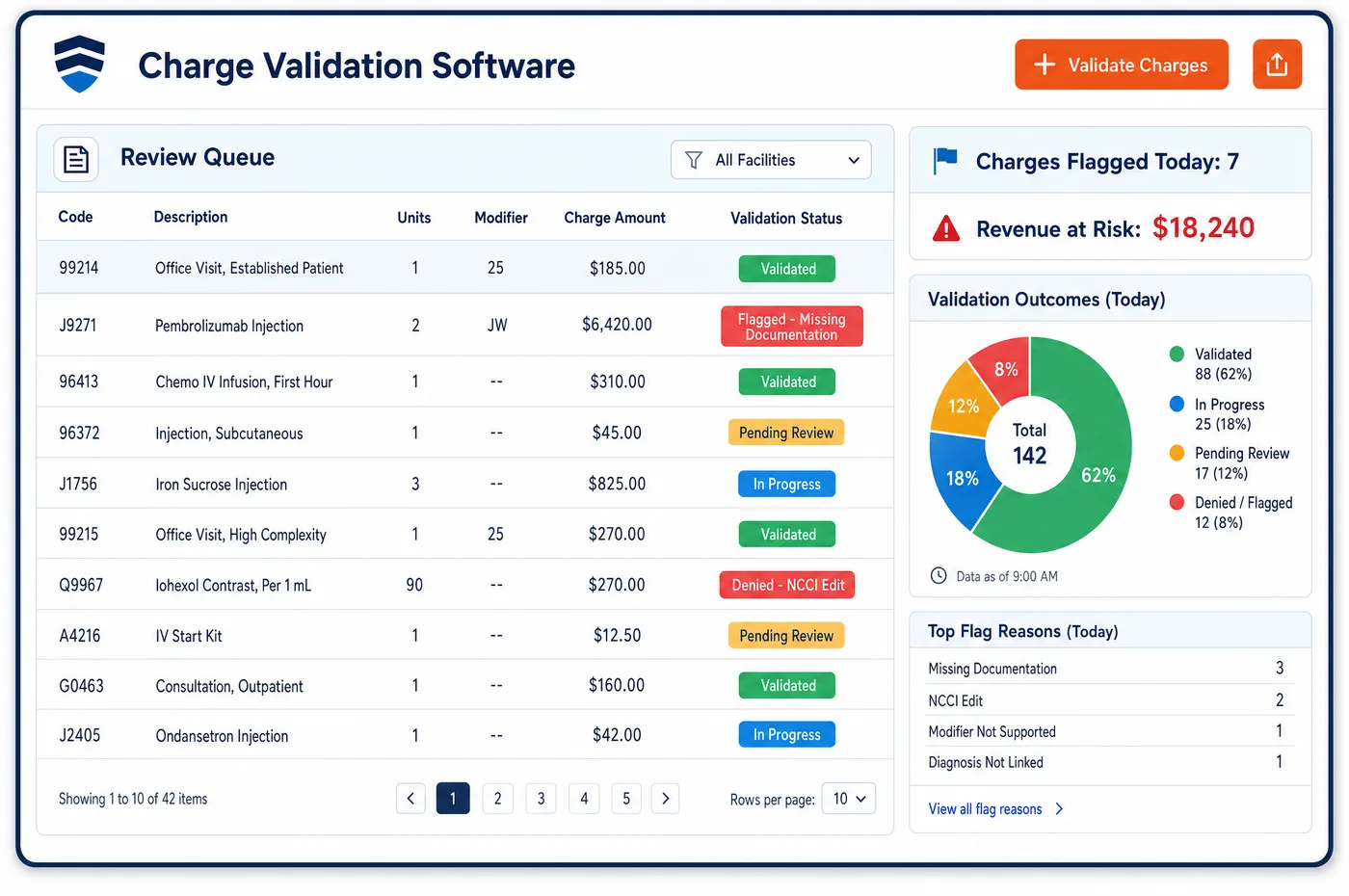
Charge Validation in a Ambulatory Surgery Center Practice
Validation starts once charge assembly has built the lines. First, each code is checked against the payment indicator in force on the date of service. A deleted code, or one with no ASC payment, is stopped. Next, NCCI edits run, since Medicare applies the correct coding rebundling rules to ASC claims. When a case was stopped early, the modifier is checked against the record: 73 before anesthesia, 74 after, and 52 for a stopped procedure that needs no anesthesia. Device-intensive procedures get extra checks for FB or FC when a device came free or with a credit. Then each charge is compared with the ASC rate, because Medicare pays the lower of the two and orders multiple procedures by that lower amount. Payer-specific edits run last. Ambulatory surgery center charge validation sends anything it holds to a person, with the reason attached, before the line reaches ASC medical billing.
Why Is Charge Validation Different in Ambulatory Surgery Center?
ASC payment rules change what common modifiers mean. Modifier 73 cuts the facility payment in half and modifier 74 pays it in full, so the choice turns on whether anesthesia had started. Lines with modifier 52 or 73 skip the multiple procedure discount, while a 74 line may still take it. A wrong modifier changes the payment, not just the look of the claim.
Device cases add more layers. For a device-intensive procedure stopped before anesthesia, Medicare removes the device portion before it applies the modifier 73 cut. When a listed device is replaced at no cost, or with a credit of at least half its cost, modifier FB or FC goes on the procedure code. For pass-through devices, the credit shows on the device line instead. Each rule depends on the device's payment status.
Bundling and charge amounts matter too. Medicare applies NCCI rebundling rules to ASC claims, so a code that is part of a more complete code on the same date is not paid. Because Medicare pays the lower of the charge or the rate on each line, a charge set below the rate loses money and can change which procedure gets the full rate. Charge validation for an ASC catches these before the claim goes out.
What Ambulatory Surgery Center Charge Validation Software Handles
- NCCI rebundling on ASC claims
- Medicare applies the general NCCI rebundling rules to ASC facility claims. If a billed code is part of a more complete code billed for the same patient and date, only the more complete code is covered, as long as it is on the ASC list. (Medicare Claims Processing Manual, Chapter 14: Ambulatory Surgical Centers (sections 20.3, 40.4, 40.5, 40.8, 40.10 and 60.3))
- Documentation for terminated cases
- A claim for a stopped case needs an operative report on file that gives the reason, the services and supplies used and not used, time in each stage, and the code that would have been billed. Validation holds the 73 or 74 line until that report is on the case. (Medicare Claims Processing Manual, Chapter 14: Ambulatory Surgical Centers (sections 20.3, 40.4, 40.5, 40.8, 40.10 and 60.3))
- Device-intensive cases stopped before anesthesia
- For a device-intensive procedure billed with modifier 73, Medicare removes the device portion first and then applies the reduction. An FB or FC modifier on that same line is ignored, so validation flags the pair. (Medicare Claims Processing Manual, Chapter 14: Ambulatory Surgical Centers (sections 20.3, 40.4, 40.5, 40.8, 40.10 and 60.3))
- No-cost and credited devices (FB and FC)
- FB goes on the procedure code when a listed device was free or fully credited, and FC when the credit was at least half the device's cost. The two never go on one code, and neither is used for a J7 pass-through device. (Medicare Claims Processing Manual, Chapter 14: Ambulatory Surgical Centers (sections 20.3, 40.4, 40.5, 40.8, 40.10 and 60.3))
- Codes the ASC cannot be paid for
- Codes with payment indicator D5 are deleted and returned, B5 means another code should be used, and C5, U5 and X5 are not paid in the ASC. Validation stops these lines before the claim is built. (Medicare Claims Processing Manual, Chapter 14: Ambulatory Surgical Centers (sections 20.3, 40.4, 40.5, 40.8, 40.10 and 60.3))
- Device-intensive indicator J8
- Procedures with payment indicator J8 are device-intensive and paid at an adjusted rate. Validation uses J8 to know when FB, FC and the device-portion rule for modifier 73 come into play. (Noridian JE Part B (Medicare Administrative Contractor): ASC Payment Indicators)
How Does Ambulatory Surgery Center Charge Validation Software Work?
1. Check codes against payment indicators
Each code is checked against the ASC payment indicator for its date of service. Deleted, non-payable or replaced codes are stopped.
2. Run NCCI and payer edits
NCCI rebundling rules and the center's payer edits run on every line. Codes that bundle into another are flagged with the edit that fired.
3. Confirm modifiers against the record
Side modifiers, 73, 74, 52, FB and FC are compared with the operative note and case log. A stopped case without its report is held.
4. Compare charges with rates
Each line's charge is compared with the ASC rate for that code. Charges below the rate are flagged for the person who owns the chargemaster.
5. Release or route
Clean lines move to the claim. Held lines go to a person with the reason attached, and repeat patterns feed ASC denial management so the cause gets fixed.
Ambulatory Surgery Center Charge Validation Software vs. Generic Software
| Area | Generic approach | Unlimited Systems |
|---|---|---|
| When checks run | After the payer denies the claim. | Before the claim is built, at charge entry. |
| Stopped cases | Modifier picked by habit. | 73, 74 or 52 checked against the record. |
| Device credits | FB and FC added from memory, or never. | Credit modifiers checked by device and procedure. |
| Charge amounts | Charges below the ASC rate go unnoticed. | Low charges flagged before they cut payment. |
| Edits | Generic physician edits only. | NCCI plus ASC payment indicators and payer edits. |
Who Uses It in a Ambulatory Surgery Center Practice
- Coder: A clear reason on each held line, tied to the record, so fixes are quick.
- Billing manager: Fewer claims sent with wrong modifiers or low charges, and a list of which edits fire most often.
- Administrator: Confidence that stopped cases, device credits and bundled codes are billed the way Medicare and each payer expect, with ASC charge assembly feeding clean lines upstream.
Ambulatory Surgery Center Charge Validation Software FAQs
Charge validation for an ASC checks each facility line before the claim is built. It confirms the code is payable in the ASC on that date, runs NCCI and payer edits, checks modifiers such as 73, 74, 52, FB and FC against the record, and compares the charge with the ASC rate. Lines that fail are held with a reason.
Modifier 73 is for a case stopped after the patient was prepped and taken to the room but before anesthesia was induced or the procedure started. Medicare pays half the rate. Modifier 74 is for a case stopped after anesthesia was induced or the procedure began, and Medicare pays in full. Both need an operative report that explains the stop.
Lines billed with modifier 52 or 73 are not discounted again under the multiple procedure rule. A line with modifier 74 may still be discounted if the procedure is subject to the rule. Validation checks the lines so the payment the center expects matches what Medicare will calculate.
When a listed device is replaced at no cost or with full credit, the ASC adds modifier FB to the procedure code. When the credit is at least half the device's cost, it adds FC. A code never gets both. For a pass-through device, the credit is shown on the device line and its charge instead.
Medicare pays the lower of the billed charge or the ASC rate, line by line. If a charge is set below the rate, the center is paid the lower charge. The lower amount is also used to order procedures for the multiple procedure discount. Validation flags charges below the rate so the chargemaster can be fixed.
Medicare applies the general NCCI rebundling rules to ASC facility claims. If a code is part of a more complete code billed for the same patient on the same date, only the more complete code is covered, provided it is on the ASC list. Validation runs these edits on every case before the claim is built.
Related Ambulatory Surgery Center Software
Billing & claims
In the revenue cycle
Charge Validation for related specialties
Sources
GET STARTED
See Unlimited Systems in Action
Whether you're actively evaluating new technology or simply preparing for your next vendor renewal, Unlimited Systems can help you understand where your current workflows may be creating avoidable revenue risk.