

Billing & claims
Ambulatory Surgery Center Charge Assembly Software
Turn each case's op note, drug record and implant log into facility charge lines, with packaged items kept inside the procedure line.
Ambulatory Surgery Center Charge Assembly Software gathers everything documented for a case and turns it into the facility's charge lines. Procedure codes come from the operative note. Separately payable drugs, pass-through devices and radiology get their own lines, while packaged supplies and implants are built into the procedure charge. Each assembled case is then ready for checks.



 6,500+ specialty providers

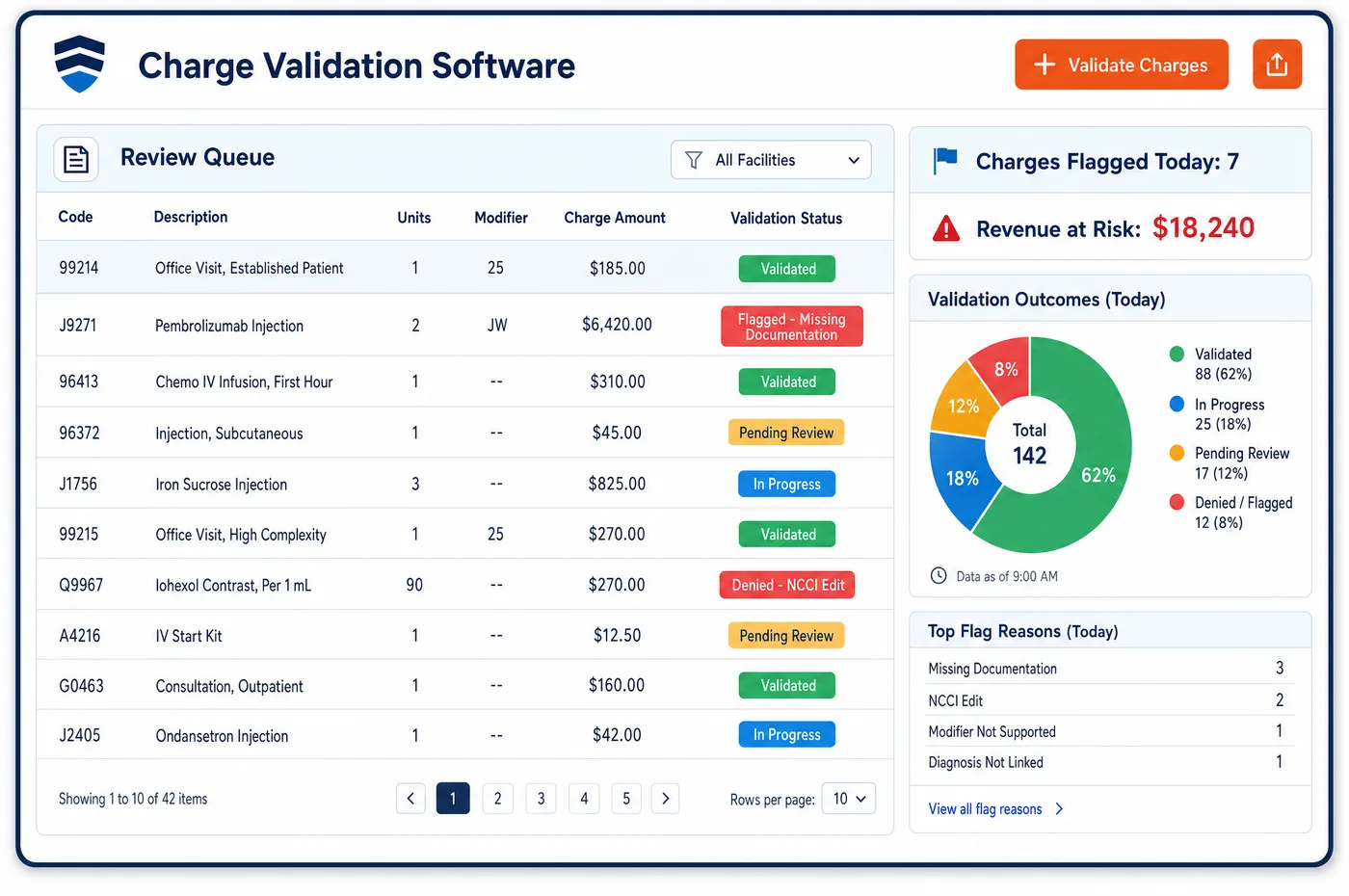
Charge Assembly in a Ambulatory Surgery Center Practice
A surgery case leaves a trail of records. The operative note names the procedures and sides. The anesthesia and nursing records list the drugs given. The implant log lists devices placed, and the supply record lists what was opened. Charge assembly brings these together on one case. Coders assign CPT and HCPCS codes from the note. The center's charge setup then decides how each item is billed. Most supplies, drugs and implants without pass-through status are packaged, so their cost is built into the procedure's charge. A drug with separate payment gets its own HCPCS line with units and, for Medicare, JW or JZ. A pass-through device gets its own C-code line. Cases that need a person, such as a missing implant record or a late op note, are flagged and assigned. Ambulatory surgery center charge assembly then hands the lines to ASC charge validation.
Why Is Charge Assembly Different in Ambulatory Surgery Center?
ASC payment packages most of what happens in the room. Under Medicare, nursing, supplies, most drugs, anesthesia materials and implants without pass-through status are all part of the procedure payment. ASCs are told not to list packaged items as separate lines, but to build their charges into the separately payable line. A chargemaster copied from a hospital, with a line for every item, works against that rule.
A few items are paid on top of the procedure, and missing them costs money. Medicare pays separately for certain drugs, pass-through devices, brachytherapy sources, corneal tissue and some radiology when they are integral to the surgery. From CY 2025 through CY 2027, qualifying non-opioid pain treatments are paid separately in the ASC too. Each needs its own line, with the right code and units, on the same claim as the surgery.
Cataract cases show how fine the line can be. The standard lens is packaged into the cataract payment and is not billed. A presbyopia- or astigmatism-correcting lens has a non-covered portion that may be billed to the patient, reported with V2788 or V2787. Charge assembly in an ASC has to know which part of each item Medicare pays, which part the patient pays and which part is simply cost.
What Ambulatory Surgery Center Charge Assembly Software Handles
- Packaged items and the procedure line
- Medicare packages supplies, most drugs, anesthesia materials and implants without pass-through status into the ASC procedure payment. Their charges are added to the separately payable procedure line rather than listed on their own. (Medicare Claims Processing Manual, Chapter 14: Ambulatory Surgical Centers (sections 10.2, 40, 40.7 and 40.9))
- Payment indicators K2 and N1
- A drug with payment indicator K2 is paid separately at the OPPS rate when given integral to the surgery, so it gets its own line. An item with N1 is packaged, with no separate payment. (Noridian JE Part B (Medicare Administrative Contractor): ASC Payment Indicators)
- Pass-through devices (payment indicator J7)
- An OPPS pass-through device is paid separately at a contractor-priced amount. Its C-code line goes on the surgical claim, and for listed device and procedure pairs the MAC takes an offset from the procedure payment. (Medicare Claims Processing Manual, Chapter 14: Ambulatory Surgical Centers (sections 10.2, 40, 40.7 and 40.9))
- Non-opioid pain treatments (NOPAIN)
- From CY 2025 through CY 2027, Medicare pays ASCs separately for qualifying non-opioid treatments for pain relief. For CY 2026, CMS listed five drugs and 11 devices that qualify, and each is billed on its own line. (CMS fact sheet: CY 2026 OPPS and ASC Payment System Final Rule (CMS-1834-FC))
- JW and JZ in the ASC
- In the ASC, only separately payable single-dose drugs need the JW or JZ modifier for Medicare. Packaged drugs do not, so the modifier is added only on lines that will be paid on their own. (CMS JW and JZ Modifier FAQs (Medicare Part B discarded drugs))
- Premium IOLs (V2787 and V2788)
- The conventional lens portion of a premium IOL stays bundled into the cataract payment. The non-covered astigmatism- or presbyopia-correcting portion is reported with V2787 or V2788. (Medicare Claims Processing Manual, Chapter 14: Ambulatory Surgical Centers (sections 10.2, 40, 40.7 and 40.9))
How Does Ambulatory Surgery Center Charge Assembly Software Work?
1. Gather the case records
The op note, anesthesia and nursing records, implant log and supply record come together on one case. A case missing any of them is flagged.
2. Code the procedures
Coders assign CPT codes and sides from the operative note. Each code is linked to its diagnosis.
3. Sort packaged and separate items
Each drug, device and supply is matched to the center's charge setup. Packaged items feed the procedure charge, and separately payable items get their own line.
4. Add units and modifiers
Drug lines get HCPCS units and, for Medicare, JW or JZ. Device lines carry their C-code, and premium lens portions get V2787 or V2788.
5. Assign and hand off
Cases that need a person are assigned to a coder or biller as a task. Finished cases move to charge checks and then to the facility claim.
Ambulatory Surgery Center Charge Assembly Software vs. Generic Software
| Area | Generic approach | Unlimited Systems |
|---|---|---|
| Packaged items | A line for every supply, copied from a hospital chargemaster. | Packaged charges built into the procedure line. |
| Separately paid drugs | Billed when someone remembers. | Matched from the drug record to a HCPCS line with units. |
| Pass-through devices | Left off the claim or sent on their own. | C-code line added to the surgical claim. |
| Premium lenses | Whole lens billed or left off. | Non-covered portion coded with V2787 or V2788. |
| Work ownership | Cases wait in a shared queue. | Cases assigned as tasks, with flags on those that need a person. |
Who Uses It in a Ambulatory Surgery Center Practice
- Coder: One case view with the op note, drug record and implant log side by side, and each code linked to its line.
- Billing lead: A task list of cases that need a person, so clean cases flow and problem cases get attention.
- Materials manager: A link between what the case used and how it was billed, so staff can compare implant and drug costs with what the case was paid.
Ambulatory Surgery Center Charge Assembly Software FAQs
Charge assembly for an ASC case turns the case records into facility charge lines. It takes the procedures from the operative note, the drugs from the anesthesia and nursing records, and the devices from the implant log. Packaged items are built into the procedure line, and separately payable items get their own lines. The case then moves to charge checks.
Medicare tells ASCs not to bill packaged items on separate lines. Supplies, most drugs and implants without pass-through status are part of the procedure payment, so their charges belong in the procedure line. Billing them separately can lower payment, since Medicare compares the charge and the rate line by line.
A device with OPPS pass-through status is billed on its own line with its C-code, on the same claim as the surgery. Medicare pays it separately at a contractor-priced amount, and the MAC may need invoice details. For some device and procedure pairs, Medicare also takes an offset from the procedure payment.
In the ASC setting, the JW and JZ rules apply only to separately payable drugs from single-dose containers. JW reports an amount that was discarded, and JZ states that nothing was discarded. Packaged drugs, which are paid within the procedure rate, take neither modifier.
The standard part of the lens is packaged into the cataract payment, so it is not billed. The extra astigmatism- or presbyopia-correcting function is not covered by Medicare and is reported with V2787 or V2788. The patient may pay that portion, so it should be explained to them before surgery.
If the op note, implant log or drug record has not arrived, the case is flagged and assigned to a person to follow up. The charges wait until the record is in, so the claim is not built from partial data. An at-a-glance view shows past billing for the patient while the case is worked.
Related Ambulatory Surgery Center Software
Billing & claims
In the revenue cycle
Charge Assembly for related specialties
Sources
- Medicare Claims Processing Manual, Chapter 14: Ambulatory Surgical Centers (sections 10.2, 40, 40.7 and 40.9)
- Noridian JE Part B (Medicare Administrative Contractor): ASC Payment Indicators
- CMS fact sheet: CY 2026 OPPS and ASC Payment System Final Rule (CMS-1834-FC)
- CMS JW and JZ Modifier FAQs (Medicare Part B discarded drugs)
GET STARTED
See Unlimited Systems in Action
Whether you're actively evaluating new technology or simply preparing for your next vendor renewal, Unlimited Systems can help you understand where your current workflows may be creating avoidable revenue risk.