

Front office
Ambulatory Surgery Center Patient Scheduling Software
Book each case into the right room, block and length, with anesthesia, equipment and approvals lined up before the patient hears a time.
Ambulatory Surgery Center Patient Scheduling Software books each case into an operating or procedure room within a surgeon's block. Case length follows the procedure and the surgeon, and turnover time is held between cases. Anesthesia, special equipment and pending approvals are tied to the case, so a slot is confirmed only when the case can actually go ahead.



 6,500+ specialty providers

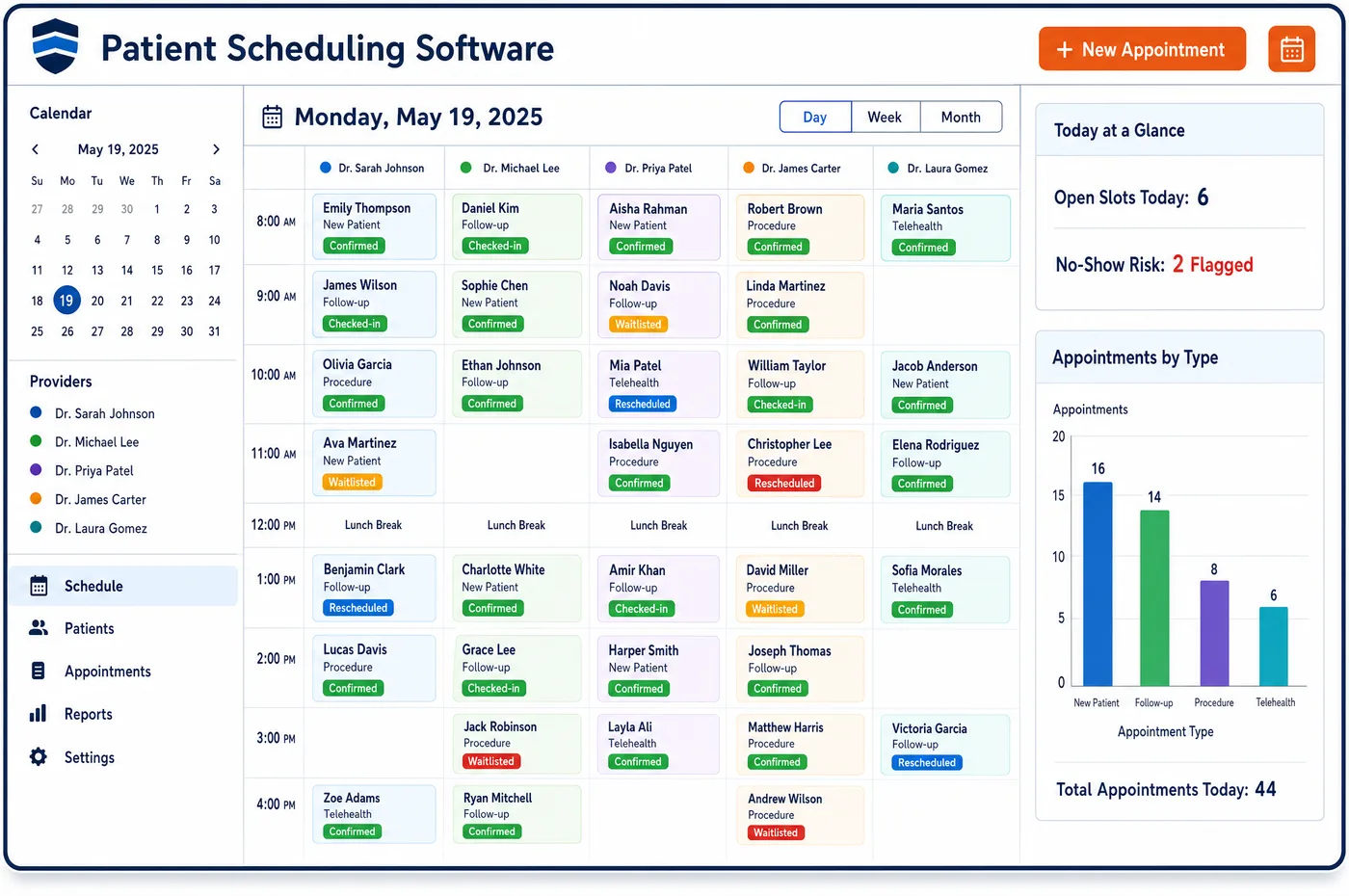
Patient Scheduling in a Ambulatory Surgery Center Practice
A surgery center schedule is built around rooms, not just people. Each room has its own equipment, such as a phaco machine for eye cases or a C-arm for pain injections. Surgeons hold block time on set days, and open time fills from requests sent by their offices. When a case is booked, the scheduler picks a room with the right equipment, sets the case length for that procedure and surgeon, and adds turnover before the next case. The anesthesia provider for the room is assigned. Any loaner tray or implant the surgeon wants is listed as an open item for staff to confirm with the vendor. If an approval is pending, the case is held. Reminders go out by text or email with the arrival time and the center's instructions. When a patient cancels, waitlist patients are offered the time. Ambulatory surgery center patient scheduling keeps the board full without double-booking rooms.
Why Is Patient Scheduling Different in Ambulatory Surgery Center?
Every case needs several things at once: a room, a surgeon, an anesthesia provider, instruments, and often an implant or a loaner tray. If any one is missing, the case slips or is canceled. A schedule that books by surgeon name alone will put two cases in a room with one C-arm, or start a cataract list with no phaco machine.
Timing also decides payment. Medicare pays the ASC nothing when a case is canceled before the patient enters the operating room. It pays half the rate, with modifier 73, when a case stops after the patient is prepped and in the room but before anesthesia. Once anesthesia starts, a stopped case is paid in full with modifier 74. Good patient scheduling, with clearance and intake done ahead, keeps those stops rare.
Block time is the other pressure. Surgeons who hold blocks expect them, and the center needs unused block released early enough for others to fill. Case lengths that are too short push the day late and add overtime. Lengths that are too long leave rooms empty. Managers set case lengths by procedure and surgeon, then adjust them as real case times come in.
What Ambulatory Surgery Center Patient Scheduling Software Handles
- Cases stopped before or after anesthesia (modifiers 73 and 74)
- Medicare does not pay for a case canceled before the patient enters the operating room. A case stopped after prep but before anesthesia is paid at half the rate with modifier 73, and one stopped after anesthesia is paid in full with modifier 74. Stop times and reasons are logged on the case for billing. (Medicare Claims Processing Manual, Chapter 14: Ambulatory Surgical Centers (sections 10, 40.4 and 40.5))
- Several procedures in one session
- When several ASC procedures are done in one session, Medicare pays the highest-paying one in full and the others at half the rate, where the discount applies. Booking every planned code keeps clearance and the estimate in line with the full case. (Medicare Claims Processing Manual, Chapter 14: Ambulatory Surgical Centers (sections 10, 40.4 and 40.5))
- ASC list in force on the date of service
- CMS updates the ASC covered procedures list each year, with quarterly updates for new codes. A case booked well ahead is checked against the list and payment indicators in force on its date of service. (Medicare Claims Processing Manual, Chapter 14: Ambulatory Surgical Centers (sections 10, 40.4 and 40.5))
- Approval window for demonstration cases
- In Medicare's ASC prior authorization test, each provisional affirmation is valid only for a set window from the decision date. If a case moves past that window, the scheduler holds it for a new request. (CMS FAQs: Prior Authorization Demonstration for Certain ASC Services (December 2025))
- Follow-up appointment at discharge (42 CFR 416.52(c))
- Patients leave with written discharge instructions and, when appropriate, a follow-up appointment with the physician. Staff note that appointment on the case so the post-op call can confirm it. (42 CFR 416.52: Patient admission, assessment and discharge (ASC conditions for coverage))
- Self-pay estimate deadline (No Surprises Act)
- For uninsured and self-pay patients, the deadline for the good faith estimate is counted from the day the case is scheduled. The booking date is stored with the case, so the estimate team knows when it is due. (CMS No Surprises Act: Overview of Key Consumer Protections)
How Does Ambulatory Surgery Center Patient Scheduling Software Work?
1. Set up rooms, blocks and case lengths
Each room is set up with its equipment, and surgeon blocks are placed on it by day. Case lengths and turnover times are set by procedure and surgeon.
2. Book the case from the surgeon's request
The surgeon's office sends the procedure, side and preferred date. The scheduler offers times in that surgeon's block or in open time, in a room with the right equipment.
3. Assign anesthesia and list open items
The anesthesia provider is assigned by room and day. Loaner trays, implants and special supplies are listed for staff to confirm with vendors.
4. Hold until cleared
Pending approvals and coverage checks hold the case. When ASC financial clearance is done, the hold lifts and the patient is told the arrival time.
5. Remind, refill and release
Reminders go out by text or email through ASC patient engagement, and patients confirm or ask to reschedule by reply. Canceled times are offered to waitlist patients, and staff release unused block time to other surgeons.
Ambulatory Surgery Center Patient Scheduling Software vs. Generic Software
| Area | Generic approach | Unlimited Systems |
|---|---|---|
| Rooms and equipment | Cases booked by surgeon name, so rooms and C-arms double-book. | Rooms booked with their equipment, so each case gets what it needs. |
| Case length | One default length for every case. | Lengths and turnover set by procedure and surgeon. |
| Block time | Unused block found the day before, too late to fill. | Unused block released to other surgeons and the waitlist. |
| Approvals | Cases confirmed while approvals are still pending. | Cases held until clearance is done. |
| Cancellations | Empty rooms when patients cancel late. | Waitlist patients offered the open time by text. |
Who Uses It in a Ambulatory Surgery Center Practice
- OR scheduler: One board of rooms, blocks and cases, with equipment and anesthesia shown for each slot.
- Surgeon's office: Clear booking with times in the surgeon's own block, and early word when a case is held for an approval.
- Nurse manager: A day planned around real case lengths and turnover, so staffing fits the board. Stop times and reasons reach the billing team for ASC charge validation.
Ambulatory Surgery Center Patient Scheduling Software FAQs
Patient scheduling at a surgery center books each case into a room inside a surgeon's block or open time. The case length follows the procedure and surgeon, turnover is held after it, and the room has the equipment the case needs. Anesthesia is assigned by room. The case is confirmed once approvals and coverage checks are done.
Surgeon blocks are set on each room by day of the week. Cases from that surgeon's office fill the block first. When a surgeon will not use a block, staff release it so other surgeons or waitlist patients can use the time. Managers can review how each block is used and adjust it with the surgeon.
Medicare pays nothing if a case is canceled before the patient enters the operating room. If the case stops after the patient is prepped and in the room but before anesthesia, it is billed with modifier 73 for half the rate. After anesthesia starts, modifier 74 applies and the rate is paid in full. Commercial contracts may differ.
Implants, loaner trays and special supplies are listed on the case when it is booked. Staff confirm each item with the vendor and mark it done. Open items show on the case, so the team can see which cases are not ready well before the day of surgery.
Once a case is cleared, the patient gets the arrival time by text or email, along with the center's instructions, such as fasting rules and the need for a ride home. Patients can confirm or ask to reschedule by reply. The schedule also syncs to the clinical system over HL7, so both systems show the same times.
One case can hold several planned procedures, each with its own code and side. The case length covers all of them. Booking every planned code lets clearance check approvals for each one, and keeps the estimate in line with Medicare's rule that lower-paying procedures in the same session are discounted.
Related Ambulatory Surgery Center Software
Front office
In the revenue cycle
Patient Scheduling for related specialties
Sources
- Medicare Claims Processing Manual, Chapter 14: Ambulatory Surgical Centers (sections 10, 40.4 and 40.5)
- CMS FAQs: Prior Authorization Demonstration for Certain ASC Services (December 2025)
- 42 CFR 416.52: Patient admission, assessment and discharge (ASC conditions for coverage)
- CMS No Surprises Act: Overview of Key Consumer Protections
GET STARTED
See Unlimited Systems in Action
Whether you're actively evaluating new technology or simply preparing for your next vendor renewal, Unlimited Systems can help you understand where your current workflows may be creating avoidable revenue risk.