

Front office
Ambulatory Surgery Center Financial Clearance Software
Check benefits, the ASC list, approvals and the patient's share before a case is confirmed.
Ambulatory Surgery Center Financial Clearance Software confirms the facility fee will be paid before a case is confirmed. It checks the patient's benefits for the facility, whether the payer pays for each planned procedure at an ASC, and any approval the case needs. Then it builds the estimate of what the patient will owe the center.



 6,500+ specialty providers

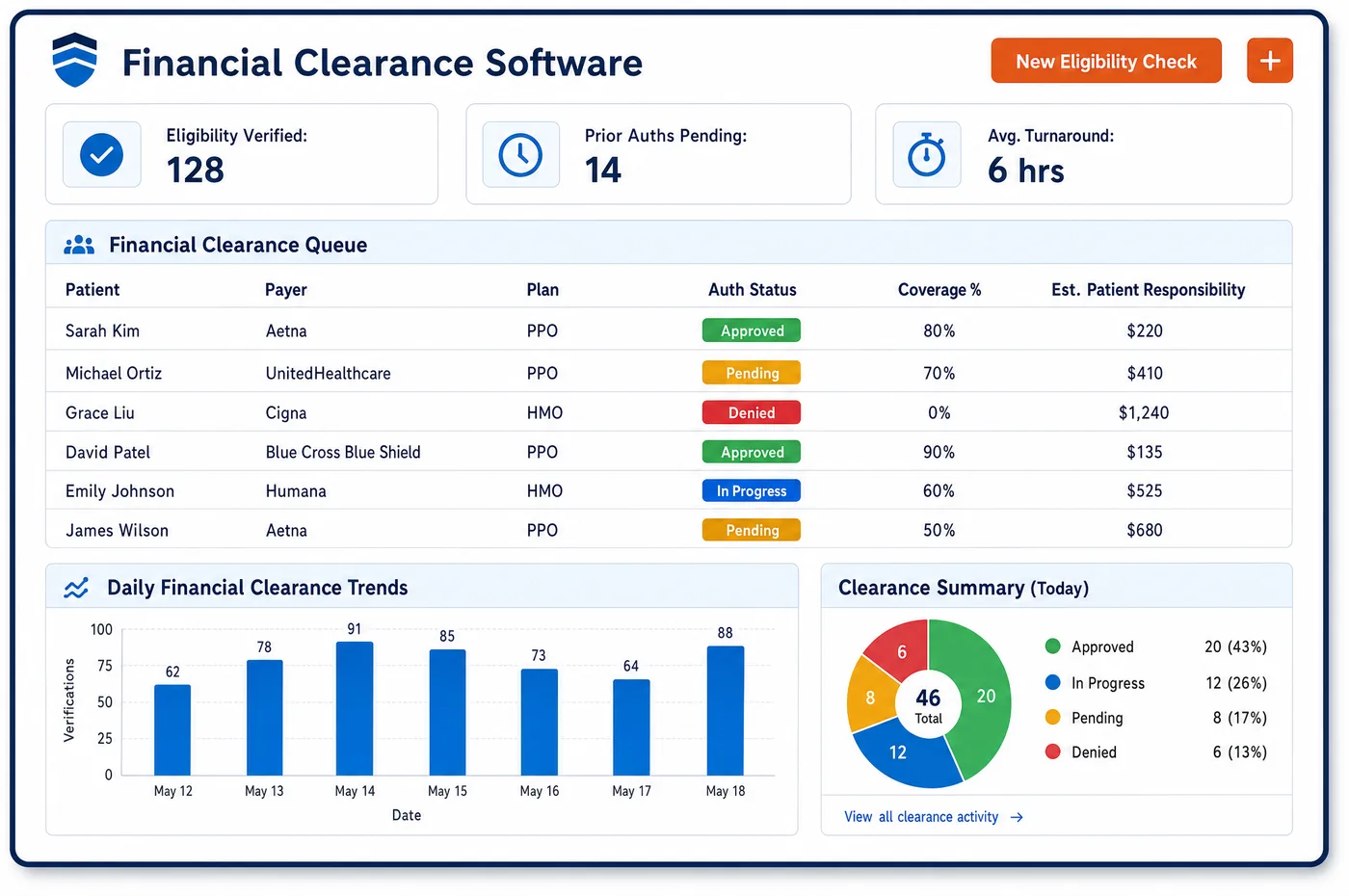
Financial Clearance in a Ambulatory Surgery Center Practice
Clearance at a surgery center works case by case. When a case is booked, a 270 eligibility inquiry goes to the payer, and the 271 reply returns the facility deductible, coinsurance and network status. Each planned CPT code is then checked against the payer's site rules. For Medicare, that means the ASC covered procedures list and the code's payment indicator. For many commercial and Medicare Advantage plans, it means an approval that matches the code and the site. Requests go out over the X12 278 or the payer's portal, and the case is held while a request is pending. In the ten states in Medicare's ASC test, five service groups need a provisional affirmation. Without one, the claim faces prepayment review. Last, the estimate combines the facility rate with the patient's remaining benefits. Ambulatory surgery center financial clearance then passes the cleared case to ASC patient scheduling to lock in the slot.
Why Is Financial Clearance Different in Ambulatory Surgery Center?
A surgery center bills its own facility claim, so it cannot lean on the surgeon's approval. Many authorizations are tied to a code and a site of care. A hospital outpatient approval may not carry over to the ASC, and an approval for one CPT code does not cover a different code added in the operating room. Clearance has to check what the center itself will bill.
Medicare adds rules of its own. It pays an ASC only for procedures on its ASC covered procedures list, which changes every year and again in quarterly updates. For CY 2026, CMS added procedures and loosened several of the list's general exclusions. A procedure off the list leaves the patient liable for the facility charges. In ten states, Medicare is also testing prior authorization for certain ASC procedures.
Patient cost is the last piece. The facility bill is separate from the surgeon's, so a second bill often surprises patients. Medicare screening colonoscopies have their own cost rules, even when a polyp comes out. Uninsured and self-pay patients are owed a good faith estimate. Insured patients are shielded from surprise bills by out-of-network anesthesia or pathology at an in-network ASC. Financial clearance in an ASC has to get each of these right before the date.
What Ambulatory Surgery Center Financial Clearance Software Handles
- Medicare ASC prior authorization demonstration
- Since early 2026, ASCs in ten states can ask Medicare for prior authorization for five service groups: blepharoplasty, botulinum toxin shots, panniculectomy, rhinoplasty and vein ablation. The states are California, Florida, Tennessee, Pennsylvania, Maryland, Georgia, New York, Texas, Arizona and Ohio. Asking is voluntary. A claim sent without it goes to prepayment medical review. (CMS Prior Authorization Demonstration for Certain Ambulatory Surgical Center (ASC) Services)
- Provisional affirmation and the UTN
- The MAC returns a provisional affirmation, a partial affirmation or a non-affirmation, each with a unique tracking number. A non-affirmed request can be corrected and sent again as often as needed, and the UTN is saved on the case for the claim. (CMS FAQs: Prior Authorization Demonstration for Certain ASC Services (December 2025))
- ASC covered procedures list and payment indicators
- Medicare pays the facility only for codes on the ASC list. Codes with payment indicators C5, E5, U5 or X5 are not paid and the patient is held liable for the facility charges, so they are flagged when the case is booked. (Medicare Claims Processing Manual, Chapter 14: Ambulatory Surgical Centers)
- Screening colonoscopy cost-sharing
- For a Medicare screening colonoscopy, no deductible applies, even if tissue is removed in the same visit. Coinsurance is being phased down and ends in 2030. Estimates for these GI cases follow that rule, not the usual Part B cost-sharing. (Medicare Claims Processing Manual, Chapter 14: Ambulatory Surgical Centers)
- Surprise billing protections at the ASC
- Under the No Surprises Act, an ASC is a facility for non-emergency care. At an in-network ASC, out-of-network anesthesia, pathology and radiology cannot balance bill an insured patient. Their bills are held to in-network cost-sharing, and counselors can tell patients so. (CMS No Surprises Act: Overview of Key Consumer Protections)
- Payer prior authorization rules (CMS-0057-F)
- Medicare Advantage plans, Medicaid and CHIP programs, and plans on the federal exchanges began facing faster prior authorization deadlines in 2026 and must offer a prior authorization API in 2027. They must also give a specific reason when they deny a request. (CMS Interoperability and Prior Authorization Final Rule (CMS-0057-F))
How Does Ambulatory Surgery Center Financial Clearance Software Work?
1. Run eligibility at booking
A 270 inquiry goes out when the case is booked, and the 271 reply shows the facility deductible, coinsurance and network status. Coverage is checked again in the background as the date gets close.
2. Check each code against the site
Planned CPT codes are checked against the ASC list and their payment indicators for Medicare, and against plan rules for other payers. A code that cannot be paid at the ASC is flagged for the surgeon's office.
3. Request and track approvals
Prior authorization requests go out over the 278 or the payer portal with the clinical notes the payer asks for. The case stays on hold until an approval or a UTN is on file.
4. Build the estimate
The facility rate is combined with the patient's remaining deductible and coinsurance. Self-pay patients get a good faith estimate, and insured patients see what they will owe the center.
5. Release the case
Once coverage, approvals and the estimate are set, the hold is lifted and the case is confirmed. The approval number follows the case into ASC medical billing.
Ambulatory Surgery Center Financial Clearance Software vs. Generic Software
| Area | Generic approach | Unlimited Systems |
|---|---|---|
| Facility benefits | Assumed from the surgeon's office check. | Checked with a 270/271 for the center's own claim. |
| Site of care | Approval obtained for the hospital, then denied at the ASC. | Codes and approvals checked with the ASC as the site. |
| Medicare ASC list | Off-list codes found after the claim denies. | Codes and payment indicators checked at booking. |
| Pending approvals | Cases go ahead while an approval is still pending. | The case is held until the approval or UTN is on file. |
| Patient cost | A second facility bill surprises the patient after surgery. | The facility estimate is shared before the date. |
Who Uses It in a Ambulatory Surgery Center Practice
- Authorization coordinator: One queue of cases that need approval, with each request's status and tracking number on the case, and pre-op forms from patient intake next to the clinical notes.
- Financial counselor: Estimates built from live benefits and the facility rate, ready to go over with the patient before surgery.
- Surgeon's office liaison: Early notice when a code is not payable at the ASC or an approval is missing, while the case can still be moved or fixed.
Ambulatory Surgery Center Financial Clearance Software FAQs
Financial clearance for an ASC case checks four things before the date: the patient's facility benefits, whether the payer pays for each planned code at an ASC, any prior authorization the case needs, and what the patient will owe the center. Each item is tied to the case. The case is confirmed only when all four are settled or a staff member signs off.
Original Medicare uses prior authorization only in targeted programs. One is a CMS test in ten states. There, ASCs can ask for approval for eyelid surgery, botulinum toxin shots, panniculectomy, nose surgery and vein ablation. Asking is voluntary, but claims sent without approval face prepayment medical review. Medicare Advantage and commercial plans keep their own lists.
Medicare does not pay the facility for a code that is missing from the ASC covered procedures list. Codes with payment indicators such as C5 or X5 are denied, and the patient is held liable for the facility charges. Clearance flags these codes at booking, so the surgeon's office can change the site of care or the patient can decide with full facts.
Medicare treats a screening colonoscopy as preventive even when the doctor removes a polyp in the same visit. No deductible applies, and the coinsurance is being phased down until it ends in 2030. Estimates for these GI cases follow that rule. A diagnostic colonoscopy booked because of symptoms follows normal Part B cost-sharing instead.
The center's estimate covers its own facility fee. Anesthesia and pathology send their own bills. For insured patients at an in-network ASC, the No Surprises Act holds the patient's share for out-of-network anesthesia, pathology or radiology to in-network cost-sharing. Self-pay estimate rules also reach co-providers, but CMS does not enforce that part yet.
Each approval request is tied to the case on the schedule. While a request is pending or an approval is close to its end date, the scheduler holds the case so it is not confirmed by mistake. When the approval or tracking number comes back, it is saved on the case and the hold is lifted.
Related Ambulatory Surgery Center Software
Front office
In the revenue cycle
Financial Clearance for related specialties
Sources
- CMS Prior Authorization Demonstration for Certain Ambulatory Surgical Center (ASC) Services
- CMS FAQs: Prior Authorization Demonstration for Certain ASC Services (December 2025)
- Medicare Claims Processing Manual, Chapter 14: Ambulatory Surgical Centers
- CMS No Surprises Act: Overview of Key Consumer Protections
- CMS Interoperability and Prior Authorization Final Rule (CMS-0057-F)
- CMS fact sheet: CY 2026 OPPS and ASC Payment System Final Rule (CMS-1834-FC)
GET STARTED
See Unlimited Systems in Action
Whether you're actively evaluating new technology or simply preparing for your next vendor renewal, Unlimited Systems can help you understand where your current workflows may be creating avoidable revenue risk.