

Analytics & value-based care
Ambulatory Surgery Center Value-Based Care Software
Capture ASCQR events as cases happen, track outcome measures and patient-reported data, and give bundled or episode contracts the case data they need.
Ambulatory Surgery Center Value-Based Care Software helps a surgery center meet the ASCQR Program and take part in payer contracts that pay for outcomes. It logs quality events on each case and tracks the hospital visit measures CMS builds from claims. It follows survey data for joint cases. It also gives episode contracts the cost and outcome data per case.



 6,500+ specialty providers

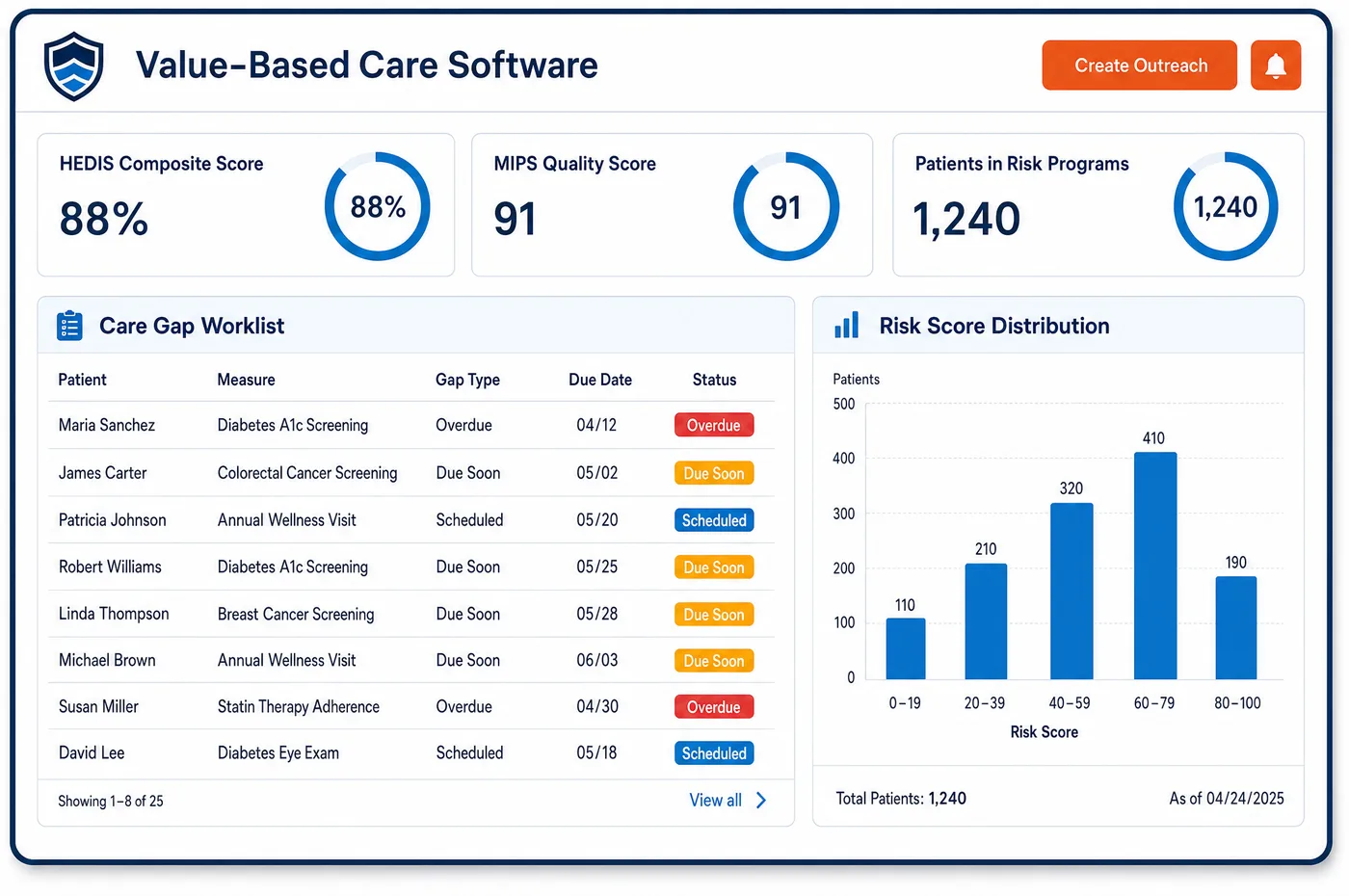
Value-Based Care in a Ambulatory Surgery Center Practice
Value-based care for an ASC starts with Medicare's quality program. The ASCQR Program is pay-for-reporting, so centers that meet the requirements keep their full annual payment update. Events such as patient burns, falls, wrong-site events and hospital transfers are logged on the case as they happen. Case-level measures, such as normothermia, are captured in structured fields, so the numerator and denominator build through the year. CMS calculates hospital visit measures after colonoscopy, orthopedic, urology and general surgery cases from paid claims, and those results show how patients fare after discharge. Joint programs can track the THA/TKA patient-reported outcome measure, which collects survey data before and after surgery. Beyond Medicare, some payers and surgeon groups sign bundled or episode contracts for joint, spine or cataract care. Those contracts need cost and outcome data for each case, and a center with its own figures is a stronger partner.
Why Is Value-Based Care Different in Ambulatory Surgery Center?
Quality in an ASC is measured mostly by rare events and by what happens after discharge. A fall or a burn may happen only now and then, which makes it easy to miss on paper. A hospital visit after an outpatient procedure happens outside the center and shows up only in Medicare claims. Value-based care for a surgery center means catching the rare events as they happen and watching the claims-based results CMS calculates.
The ASCQR Program does not pay for performance; it pays for complete reporting. Missing a requirement may cost the center a 2.0-point cut to its annual Medicare update, and results are published on data.cms.gov, where payers and patients can see them. For surgeon owners, those published results are also part of how the center competes for cases and contracts.
Commercial value-based deals take a different shape. A payer or a surgeon group may pay one price for a joint or spine episode, with the ASC's facility fee inside it. To price and defend its share, the center needs its own cost per case. It also needs its transfer and complication history and what patients report. ASC value-based care pulls that from the same case records used for ASC analytics and ASC reporting.
What Ambulatory Surgery Center Value-Based Care Software Handles
- ASC-1 to ASC-4 adverse events
- Patient burn, patient fall, wrong site, side, patient, procedure or implant, and all-cause hospital transfer or admission are logged on the case when they happen. The counts feed the annual HQR entry. (CMS Outpatient Quality Reporting support contractor: Guide to Successful Reporting in the ASCQR Program (CY 2025 reporting period))
- ASC-13 normothermia and ASC-14 unplanned anterior vitrectomy
- These case-level measures need structured fields on the anesthesia and cataract records. The numerator and denominator build through the year, so the center sees its rate before submission. (CMS Outpatient Quality Reporting support contractor: Guide to Successful Reporting in the ASCQR Program (CY 2025 reporting period))
- ASC-12 and ASC-17 to ASC-19 hospital visits
- CMS calculates these measures from paid Medicare claims for colonoscopy, orthopedic, urology and general surgery cases. No submission is needed, but the center can track its results by service line. (CMS Outpatient Quality Reporting support contractor: Guide to Successful Reporting in the ASCQR Program (CY 2025 reporting period))
- ASC-21 THA/TKA patient-reported outcomes
- The hip and knee replacement PRO-PM collects patient survey data before and after surgery, and it was voluntary for the CY 2025 reporting period. Joint programs can track which patients still need a survey. (CMS Outpatient Quality Reporting support contractor: Guide to Successful Reporting in the ASCQR Program (CY 2025 reporting period))
- ASC-11 cataract visual function
- ASC-11, improvement in visual function after cataract surgery, is a voluntary measure. Centers that report it track survey results from before and after surgery for each cataract patient. (CMS Outpatient Quality Reporting support contractor: Guide to Successful Reporting in the ASCQR Program (CY 2025 reporting period))
- ASCQR payment update reduction
- An ASC that does not meet program requirements may receive a 2.0-point reduction to its annual ASC fee schedule update. Status by requirement is tracked through the year. (CMS: Ambulatory Surgical Center Quality Reporting Program)
- Public reporting on data.cms.gov
- ASCQR results are made available to the public on data.cms.gov. The center can compare its published results with its own current counts. (CMS Provider Data Catalog: Ambulatory Surgical Centers)
How Does Ambulatory Surgery Center Value-Based Care Software Work?
1. Log events on the case
Falls, burns, wrong-site events and transfers are recorded in structured fields on the case. Each entry has a date, a type and the staff member who logged it.
2. Capture case-level measures
Fields for normothermia, vitrectomy and colonoscopy follow-up intervals are filled during the case. Required fields are checked while the record is still open.
3. Follow patient surveys
Joint and cataract patients who need surveys before and after surgery are tracked to completion. The OAS CAHPS vendor's quarterly submissions are logged.
4. Watch the claims-based results
Hospital visit measures that CMS calculates are tracked by service line. Rising visits after one type of case are flagged for clinical review.
5. Price the episode
For bundled contracts, each episode of care shows facility payment, case cost, transfers and patient-reported results. The center uses that to set and defend its price.
6. Submit and confirm
Counts are entered in HQR before the deadline, and each measure is checked as submitted. The year closes with a record of what was sent.
Ambulatory Surgery Center Value-Based Care Software vs. Generic Software
| Area | Generic approach | Unlimited Systems |
|---|---|---|
| Adverse events | Kept in incident binders. | Logged on the case and counted through the year. |
| Case-level measures | Found by chart review in spring. | Captured in required fields during the case. |
| Claims-based measures | Seen only when CMS publishes them. | Tracked by service line alongside volume. |
| Patient surveys | Tracked on a spreadsheet. | Followed to completion for each patient. |
| Episode contracts | Priced from guesses. | Priced from case cost, outcomes and transfers. |
Who Uses It in a Ambulatory Surgery Center Practice
- Quality coordinator: A year-round view of each ASCQR measure, with blank fields flagged and the HQR entry ready before the deadline.
- Medical director: Event trends and claims-based hospital visit results by service line and surgeon, ready for peer review.
- Physician owners: Cost and outcome data per case, tied to ASC accounting, to price bundled contracts and see how published results compare.
Ambulatory Surgery Center Value-Based Care Software FAQs
Value-based care for an ambulatory surgery center covers two things. One is Medicare's ASCQR Program. The other is any payer contract that ties pay to cost or outcomes. For Medicare, the center must report quality measures to keep its full payment update. For commercial deals, it needs case cost, transfer history and patient-reported results to price bundled or episode contracts.
The ASCQR Program is pay-for-reporting, not pay-for-performance. A center that meets the reporting requirements keeps its full annual update, and one that does not may lose two points from it. Results are still published on data.cms.gov, so performance matters for the center's standing with patients, payers and surgeons even though payment rests on reporting.
ASC-12, ASC-17, ASC-18 and ASC-19 are calculated by CMS from paid Medicare fee-for-service claims. They track hospital visits after colonoscopy and after orthopedic, urology and general surgery procedures in the ASC. The center does not submit anything for them, but it can track its results by service line to spot problems early.
Falls, burns, wrong-site events and hospital transfers are logged in structured fields on the case when they happen. Each entry has a date and type, and the counts add up through the year. When the HQR window opens, the totals are ready, and a year with no events is entered as zeros.
The THA/TKA PRO-PM applies to centers that perform elective primary hip and knee replacements. It collects patient survey data before and after surgery, and it was voluntary for the CY 2025 reporting period. Joint programs track which patients still need each survey, so the data is complete when reporting is required.
Some commercial payers and surgeon groups sign bundled or episode contracts that include the ASC facility fee. To price its share, the center needs cost per case, implant spend, transfer rates and patient-reported results. The same case records that feed ASCQR reporting supply that data, so the center can negotiate from its own numbers.
Related Ambulatory Surgery Center Software
Analytics & value-based care
In the revenue cycle
Value-Based Care for related specialties
Sources
GET STARTED
See Unlimited Systems in Action
Whether you're actively evaluating new technology or simply preparing for your next vendor renewal, Unlimited Systems can help you understand where your current workflows may be creating avoidable revenue risk.