

Analytics & value-based care
Ambulatory Surgery Center Reporting Software
Run and schedule ASC financial, operational and ASCQR reports for each center and the group, from daily cash to the annual HQR entry.
Ambulatory Surgery Center Reporting Software produces the standard and custom reports a surgery center runs on. It covers daily cash, case volume, payer aging and denials, and it counts the ASCQR events the center enters in the Hospital Quality Reporting system. Reports run on a schedule and reach each owner, board member or manager securely.



 6,500+ specialty providers

Reporting in a Ambulatory Surgery Center Practice
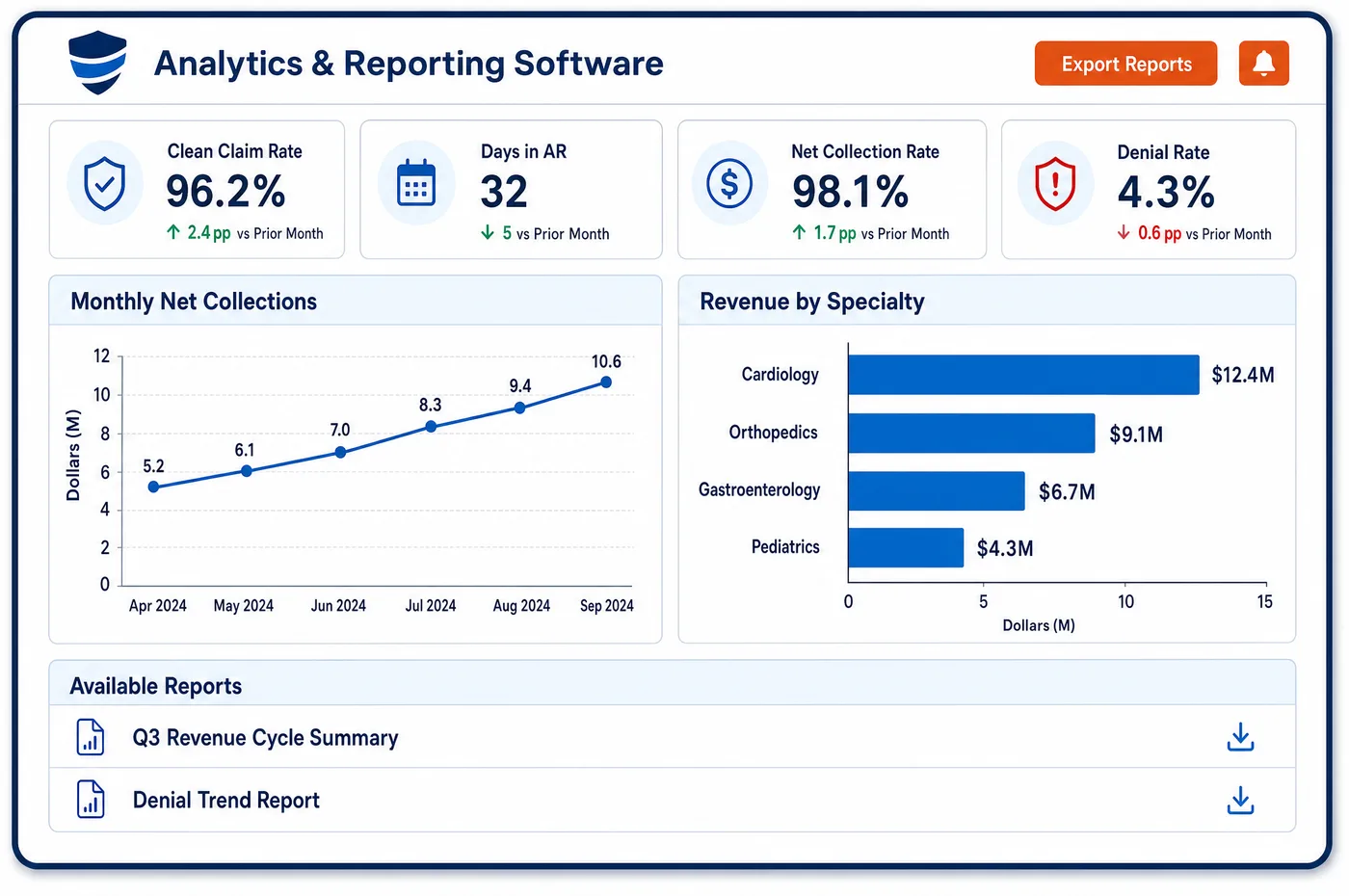
Reporting in an ASC serves three audiences. Staff need daily lists of cases billed, cash posted and claims pended. Leaders and owners need monthly packets by center, payer and surgeon. CMS needs quality data. For the ASCQR Program, most measure data is entered in the Hospital Quality Reporting (HQR) system once a year, and for CY 2025 cases the window ran from January 1 to May 15, 2026. Measures such as patient burns, falls, wrong-site events and hospital transfers are entered as aggregate counts, and an ASC with no events enters zeros. The OAS CAHPS survey is run by a CMS-approved vendor, and claims-based measures are calculated by CMS from paid claims. ASC reporting keeps a running count of each event through the year, so the annual entry matches the center's own log. Scheduled reports go out to owners and managers, and ASC analytics explains the numbers behind them.
Why Is Reporting Different in Ambulatory Surgery Center?
ASC reporting runs on two clocks. The business office needs daily and weekly views of cash, billing and pended claims. The board and the owners need a monthly packet that ties to the books. A single center may get by with exports, but a group of centers needs the same report, defined the same way, for each one and for the total.
Quality reporting adds a federal deadline. The ASCQR Program is pay-for-reporting, and an ASC that does not meet its requirements may face a 2.0-point cut to its annual Medicare payment update. Leaving a required measure blank counts as not meeting them. Events like falls and hospital transfers are easy to miss when they are tracked on paper, so counting them as they happen matters more than a scramble in spring.
Not every center has to take part. ASCs with fewer than 240 Medicare fee-for-service claims in the calendar year two years before a payment year are exempt for that year, so centers near the line need a claim count they can trust. Groups that submit for several centers can use the HQR file upload with a CSV template. ASCQR results are then published on data.cms.gov for patients and payers to see, and ASC value-based care builds on the same data.
What Ambulatory Surgery Center Reporting Software Handles
- HQR web-based measures (ASC-1 to ASC-4)
- Patient burn, patient fall, wrong site, side, patient, procedure or implant, and all-cause hospital transfer or admission are entered in HQR as aggregate counts. Each event is logged on the case when it happens, so the annual entry is a sum, not a chart hunt. (CMS Outpatient Quality Reporting support contractor: Guide to Successful Reporting in the ASCQR Program (CY 2025 reporting period))
- Zero entries and blank fields
- When an ASC has no events for an aggregate measure, it must enter zeros or attest. A blank required measure means the ASC misses the program requirements, so the report flags any measure without a value. (CMS Outpatient Quality Reporting support contractor: Guide to Successful Reporting in the ASCQR Program (CY 2025 reporting period))
- ASC-9, ASC-13 and ASC-14
- The colonoscopy follow-up interval, normothermia and unplanned anterior vitrectomy measures each need a numerator and denominator from case data. CMS has proposed removing ASC-9 starting with the CY 2027 reporting period, so the report keeps it until a final rule says otherwise. (CMS fact sheet: CY 2027 OPPS and ASC Payment System Proposed Rule (CMS-1850-P))
- OAS CAHPS survey (ASC-15a to ASC-15e)
- The patient experience survey is run by a CMS-approved vendor, with quarterly submission deadlines. The report tracks which quarters the vendor has submitted. (CMS Outpatient Quality Reporting support contractor: Guide to Successful Reporting in the ASCQR Program (CY 2025 reporting period))
- Low-volume threshold
- ASCs with fewer than 240 Medicare fee-for-service claims in the calendar year two years before a payment year are not required to take part for that year. A claim count by year shows whether a center is near the line. (CMS Outpatient Quality Reporting support contractor: Guide to Successful Reporting in the ASCQR Program (CY 2025 reporting period))
- HQR file upload for groups
- Vendors and corporations that submit for more than one ASC can use the HQR file upload with an approved CSV template. Group reports keep counts by center, so each file row matches one ASC. (CMS Outpatient Quality Reporting support contractor: Guide to Successful Reporting in the ASCQR Program (CY 2025 reporting period))
- Payment update reduction
- An ASC that does not meet the ASCQR requirements may receive a 2.0-point reduction to its annual payment rate update. The quality report shows each requirement and its status ahead of the deadline. (CMS: Ambulatory Surgical Center Quality Reporting Program)
How Does Ambulatory Surgery Center Reporting Software Work?
1. Pick the report
Staff start from a standard library of financial, operational and quality reports, or build their own with filters. Each report runs for one center or for the whole group.
2. Run it on live data
Reports read the same data staff work in, from ASC payment posting to case logs. Numbers match the ledger on the day the report runs.
3. Schedule and send
Daily cash and weekly AR reports go to managers on a schedule. Monthly packets go to the board, with access set by role.
4. Count quality events
ASCQR events are counted from the case record through the year. Before the HQR window opens, the count for each measure is ready for entry.
5. Roll up the group
Reports for each center roll up into a group total. The same definitions apply everywhere, so centers can be compared fairly.
6. Link to the dashboards
Each report links to its live view in ASC dashboards. Readers who want more detail can drill in without asking for a new report.
Ambulatory Surgery Center Reporting Software vs. Generic Software
| Area | Generic approach | Unlimited Systems |
|---|---|---|
| Quality counts | Pulled from charts in spring. | Counted from case records as events happen. |
| Blank measures | Found after the deadline. | Flagged before the HQR window closes. |
| Board packets | Built by hand each month. | Scheduled and sent with access set by role. |
| Group reports | Each center reports its own way. | One definition per report across every center. |
| Data access | Exports to spreadsheets. | Scheduled exports to the group's data warehouse. |
Who Uses It in a Ambulatory Surgery Center Practice
- Quality coordinator: A year-round count of each ASCQR event, a flag for any blank measure, and a record of OAS CAHPS vendor submissions.
- Business office manager: Daily cash, pended claims and days in AR on a schedule, without building the report each time.
- Board and owners: A monthly packet for each center and for the group, with the same definitions every month.
Ambulatory Surgery Center Reporting Software FAQs
ASCQR reporting means entering web-based measures in the HQR system once a year, keeping an OAS CAHPS vendor submitting each quarter, and letting CMS calculate the claims-based measures. For CY 2025 cases, the HQR window ran from January 1 to May 15, 2026. A required measure left blank means the ASC does not meet the program requirements for that payment year.
Patient burns, patient falls, wrong-site events and all-cause hospital transfers are entered in HQR as aggregate counts. Each event is logged on the case record when it happens, and the report sums them by measure for the year. If there were no events, the ASC enters zeros, so the report shows zero rather than a blank.
ASC-9, the follow-up interval measure for normal colonoscopy, is still part of the program for current reporting periods. In its CY 2027 proposed rule, CMS proposed removing it starting with the CY 2027 reporting period. Until a final rule adopts that change, the measure stays in the report and its data is collected as usual.
One report can run for each center and for the group total, using the same definitions everywhere. For ASCQR, groups that submit for several centers can use the HQR file upload with an approved CSV template, with one row per ASC. Financial reports such as daily cash and AR aging roll up the same way.
Scheduled reports go to the people who own the numbers. Business office managers get daily cash and pended claims, administrators get weekly volume and AR, and the board gets a monthly packet. Access is set by role, so each reader sees only the centers and details they are allowed to see.
ASCs with fewer than 240 Medicare fee-for-service claims in the calendar year two years before a payment year are not required to take part for that year. Others must meet the requirements or risk a 2.0-point cut to the annual payment update. A yearly claim count shows which side of the line a center is on.
Related Ambulatory Surgery Center Software
Analytics & value-based care
In the revenue cycle
Reporting for related specialties
Sources
GET STARTED
See Unlimited Systems in Action
Whether you're actively evaluating new technology or simply preparing for your next vendor renewal, Unlimited Systems can help you understand where your current workflows may be creating avoidable revenue risk.