
Analytics & value-based care
Multi-Specialty Value-Based Care Software
Manage MIPS, ACO and risk-contract measures across departments, with group, subgroup and clinician views side by side.
Multi-Specialty Value-Based Care Software helps a group track quality measures, cost and attributed patients across every department, under the programs it joins, such as MIPS, a shared savings ACO or a commercial risk contract. It shows which clinicians and departments move each score, so leaders can act before a reporting period ends.



 6,500+ specialty providers

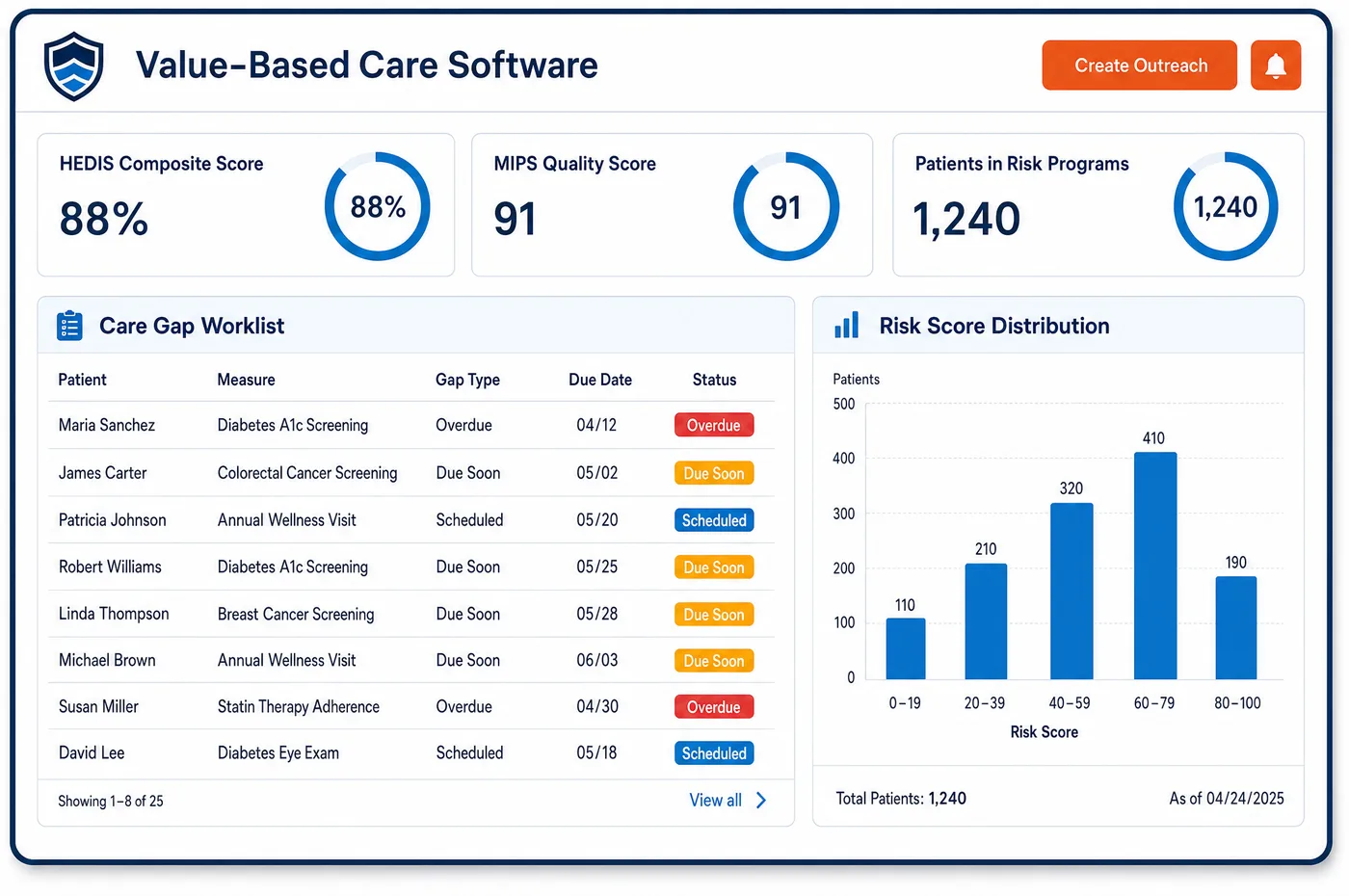
Value-Based Care in a Multi-Specialty Practice
Value-based programs measure a group differently from fee-for-service. A MIPS score covers quality, cost, improvement activities and promoting interoperability. An ACO tracks attributed patients and total cost of care. A commercial contract may set its own measures and a savings or loss share. Value-based care software keeps these programs in one place for the whole group. It lists each program's measures and the clinicians and departments that affect them. It flags charts that lack a required field when the patient is scheduled and not after the visit. It shows attributed patients with their open gaps. It tracks shared savings and downside risk in the same ledger that holds the rest of the group's money. Leaders can then compare reporting as a group, as subgroups or as individuals, with the figures in front of them.
Why Is Value-Based Care Different in Multi-Specialty?
Each department in a multi-specialty group has its own quality measures. Primary care has diabetes and screening measures. Cardiology has blood pressure and statin measures. Orthopedics has functional status. A group-wide score blends all of them, so one department with weak measures can pull down colleagues who are doing well. Leaders need to see each department's effect before they choose how to report.
MIPS rules add structure. A group is one Tax ID with two or more clinicians. Group reporting covers everyone under it, while individual reporting is by clinician, and the highest available score applies to a clinician. MIPS Value Pathways add a rule for multispecialty groups. Starting with the 2026 performance year, those that are not small practices must report an MVP as subgroups or individuals and not as one group.
Contract programs change too. ACO REACH is set to end after performance year 2026, and CMS has announced the LEAD Model to begin in 2027. The Medicare Shared Savings Program continues. A group in several programs must keep each one's attributed patients and measures apart, since a patient counted in one program may not count in another.
What Multi-Specialty Value-Based Care Software Handles
- Group, individual and subgroup MIPS
- CMS defines a group as one Tax ID with two or more clinicians. A subgroup is part of a Tax ID with at least two clinicians, one of them individually eligible. Staff model each option from clinician-level data, because the choice is made before the data is submitted. (CMS Quality Payment Program: Individual, group and subgroup participation)
- MIPS Value Pathways for multispecialty groups
- Beginning with the 2026 performance year, multispecialty groups that are not small practices must report MVPs as subgroups or individuals. Each subgroup picks a pathway for its own specialty, so a cardiology subgroup and a primary care subgroup are scored on different measures. Registration comes first. (CMS Quality Payment Program: MIPS Value Pathways (MVPs))
- Medicare Shared Savings Program
- The Shared Savings Program is a CMS accountable care organization program in which participating practices share in savings or losses against a benchmark. Attributed patients, quality results and cost are tracked by program. Staff keep these records beside the MIPS data, not mixed with it. (CMS: Shared Savings Program)
- ACO REACH and LEAD
- CMS runs ACO REACH for performance years 2023 through 2026. The LEAD Model, a ten-year voluntary model, is set to begin January 1, 2027. A group that joins either needs attributed patient lists and cost data by program year. (CMS: LEAD (Long-term Enhanced ACO Design) Model)
- Risk contract ledgers
- Shared savings and downside-risk terms in commercial contracts are tracked in the same ledger as other revenue, so finance sees contract performance on the same numbers. See healthcare accounting for how those entries reach the general ledger. (CMS: Shared Savings Program)
How Does Multi-Specialty Value-Based Care Software Work?
1. List the programs and measures
Staff write down each program the group is in, its measures, its reporting period and its attributed patients. Each measure gets an owning department.
2. Map measures to departments
Each measure is tied to the clinicians and departments that affect it. A leader can see which specialty pulls a score up or down.
3. Flag gaps at scheduling
Charts missing a required field or an open care gap are flagged when the visit is scheduled. The care team closes the gap during the visit, not in a report afterward.
4. Model the reporting path
Before the choice is due, leaders compare group, subgroup and individual reporting using clinician-level data. This is where reporting and value-based care meet.
5. Track contract performance
Shared savings and downside-risk terms are watched through the year with analytics, so a surprise adjustment does not arrive at settlement.
6. Close out the period
At the end of a program year, staff confirm submitted data, attributed lists and ledger entries match. Differences are explained before payments are accepted.
Multi-Specialty Value-Based Care Software vs. Generic Software
| Area | Generic approach | Unlimited Systems |
|---|---|---|
| Measure ownership | Quality is a group-wide number that nobody owns. | Each measure is tied to a department and its clinicians. |
| Reporting choice | A guess at group or individual reporting. | Group, subgroup and individual results modeled from clinician data. |
| Care gaps | Found in a report after the visit. | Flagged when the patient is scheduled. |
| Several programs | One spreadsheet that mixes attributed patients. | Each program's patients, measures and period kept apart. |
| Contract money | Savings and losses tracked outside the books. | Risk terms tracked in the same ledger as other revenue. |
Who Uses It in a Multi-Specialty Practice
- Quality director: Measure results by department and clinician for every program, with the open gaps listed so outreach starts before the period closes.
- Physician owner: A comparison of group, subgroup and individual reporting so the choice rests on figures and not on habit. See data visualization for how those views are shown.
- Department chair: Own-department measures and the patients with open gaps, so the care team can close them at scheduled visits.
Multi-Specialty Value-Based Care Software FAQs
Value-based care software keeps each program's measures, attributed patients and cost in one place, and ties each measure to the department and clinicians who affect it. Leaders can then see which specialties lift a score and which pull it down. Care gaps are flagged when a patient is scheduled, while there is still time to act.
It depends on the clinicians' own results. Group reporting covers everyone under the Tax ID, and a clinician's highest available score applies. Modeling both from clinician-level data shows which path helps most. For MIPS Value Pathways, larger multispecialty groups must use subgroups or individuals starting in 2026.
A subgroup is a part of a Tax ID, with at least two clinicians, one of whom is individually eligible for MIPS. A clinician can join only one subgroup per Tax ID. Multispecialty groups use subgroups so each specialty can report a pathway that fits its own work, and registration must be done in advance.
ACO REACH runs for performance years 2023 through 2026. CMS announced the LEAD Model, a ten-year voluntary model, to begin January 1, 2027. The Medicare Shared Savings Program continues. A group should check each program's current rules for the year it is joining before it plans its attributed lists.
Shared savings and downside-risk terms from commercial contracts are tracked in the same ledger as the rest of the group's revenue. Finance can then compare contract performance with the same numbers other reports use. This makes a surprise adjustment at settlement less likely and gives leaders time to respond.
A gap found after the visit is a missed chance, since the patient has left. Flagging it when the visit is booked lets the care team close it in the room. For measures that count only once per period, a gap closed late may not count at all.
Related Multi-Specialty Software
Analytics & value-based care
In the revenue cycle
Value-Based Care for related specialties
Sources
GET STARTED
See Unlimited Systems in Action
Whether you're actively evaluating new technology or simply preparing for your next vendor renewal, Unlimited Systems can help you understand where your current workflows may be creating avoidable revenue risk.