

Platform & AI
Cardiology Workflow Software
Work queues with clear owners for cardiology approvals, hospital-read charges, device clinic billing, coding questions and denials.
Cardiology Workflow Software routes each piece of cardiology revenue work to a queue with a clear owner. Imaging approvals, missing hospital-read charges, unbilled device clinic periods, coding questions on caths and stress tests, and denials each get their own queue. Items escalate as deadlines near, so nothing waits unseen.



 6,500+ specialty providers

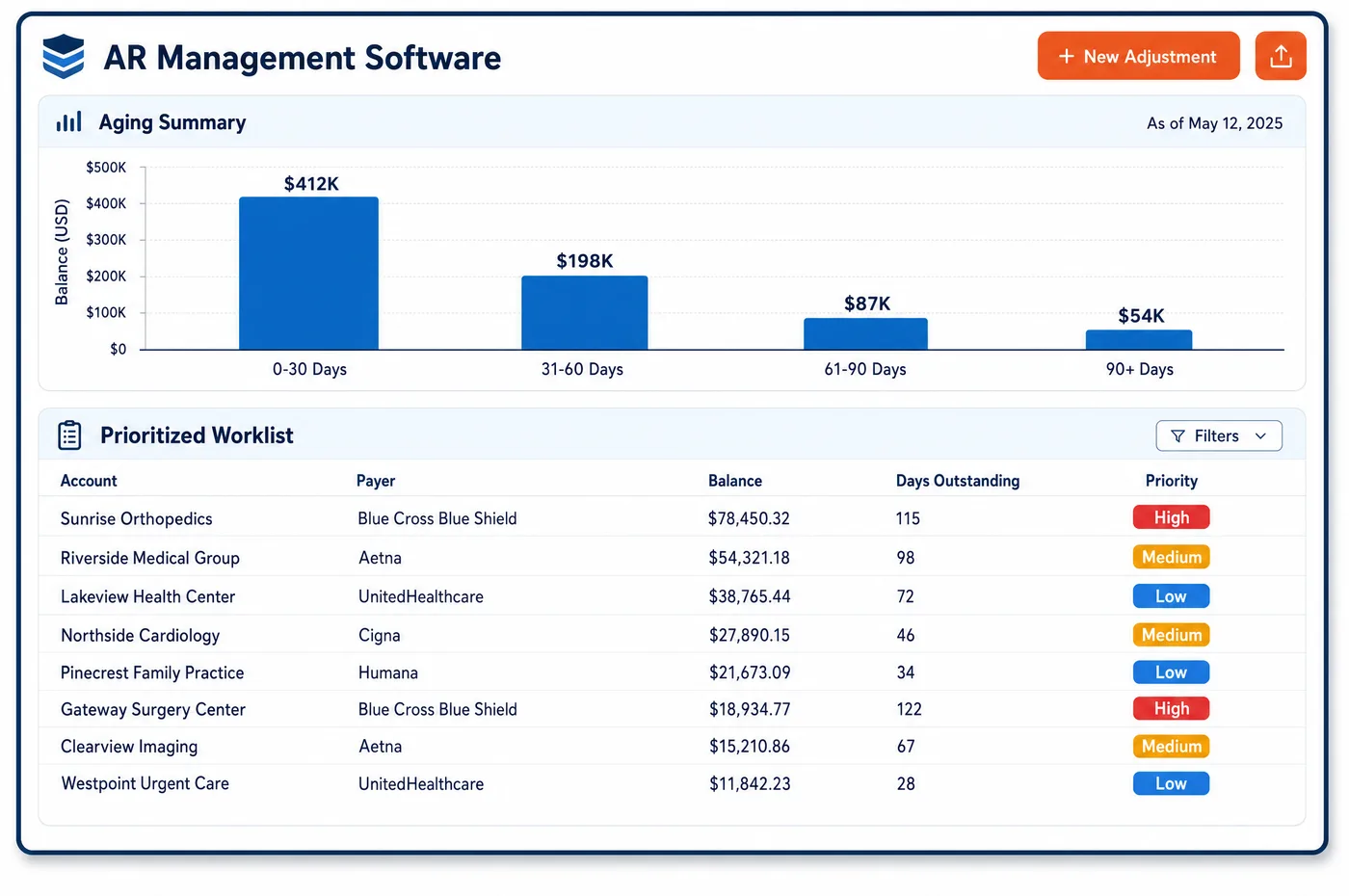
Workflow in a Cardiology Practice
Revenue work in cardiology crosses teams. Scheduling books a nuclear stress test, but the approval team has to secure the approval. A physician reads an echo at the hospital, but billing only learns of it when the charge arrives. The device clinic finishes an interpretation, but the charge has to reach billing for that period. A coder sees an E/M billed on the same day as a stress test and needs the physician to confirm it was separate. Cardiology workflow gives each of these hand-offs a queue, an owner and a due date. Items are created by rules or by staff, and they carry the patient, claim and reason with them. Each person opens a list sorted by priority instead of hunting for the next task. Managers see queue size and age by team. When an item nears a filing or appeal deadline, it moves up and, if needed, to a supervisor. Work that a rule can finish on its own never enters a queue.
Why Is Workflow Different in Cardiology?
Hand-offs are where cardiology revenue slips. The approval team does not own the schedule. Billing does not own the hospital's reading list. The device clinic does not own claims. Each team does its part well, but items fall between them. A workflow that only lives inside one team cannot see that a test was booked without approval or that a read never turned into a charge.
Cardiology also has many small coding questions that need a physician. NCCI says an E/M on the day of a stress test is billed only when it is significant and separately identifiable, with modifier 25. The same applies to cardiac rehab days. Complex caths and ablations raise questions about which codes the report supports. Those questions need to reach the right physician with the note attached, and the answer needs to come back to the coder. Email and sticky notes lose them.
Deadlines make ownership matter. Medicare's filing limit is one calendar year from the date of service, and appeals have their own windows. When an item has no owner, nobody notices it aging. Good cardiology workflow sets an owner for every item, shows its due date and escalates it in time. Routine tasks are left to cardiology automation, and staff time goes to the items that need a decision. Each queue can be seen as a worklist by the person who owns it.
What Cardiology Workflow Software Handles
- Imaging approvals (CARC 197)
- Tests booked without a prior authorization on file create an item for the approval team. If the item is still open close to the test date, it escalates so the test can be moved rather than denied. (X12 Claim Adjustment Reason Codes)
- Hospital-read charges (modifier 26)
- Studies a physician read at a hospital are compared with the charges received. Reads with no charge create an item for the charge team to chase with the hospital. (Medicare Claims Processing Manual, Chapter 12: Physicians/Nonphysician Practitioners (PC/TC indicators))
- Device clinic periods (93294 to 93296)
- When an interpretation is done, a charge item is created for that device and period. A Novitas article for Medicare limits these codes to once every ninety days, so items for an already-billed period are stopped. (CMS Medicare Coverage Database, Billing and Coding Article A56602: Cardiac Rhythm Device Evaluation (Novitas))
- E/M with stress tests or cardiac rehab (modifier 25)
- When an E/M is billed with a stress test or rehab session, a coder item asks the physician to confirm a separate service. NCCI requires the E/M to be significant and separately identifiable. (CMS NCCI Policy Manual for Medicare Services, Chapter XI (Medicine), Cardiovascular Services)
- Timely filing escalation (42 CFR 424.44)
- Items on Medicare claims show the filing deadline. Open items close to it move up the queue and then to a supervisor. (42 CFR 424.44: Time limits for filing claims)
How Does Cardiology Workflow Software Work?
1. Create the item
Rules create items when something needs a person, such as a test without approval or a read with no charge. Staff can also create items by hand.
2. Route to an owner
Each item type goes to a team queue, and each item gets an owner. The item carries the patient, claim, note and reason with it.
3. Work in priority order
Each person opens a list sorted by deadline and value. Physicians get a short list of coding questions with the report attached, via coding hand-offs from charge review.
4. Escalate before deadlines
Items close to a test date, filing limit or appeal window move up. If still open, they go to a supervisor with the history.
5. Watch the queues
Managers see the size and age of each queue by team. Staffing can shift to the queue that is falling behind.
Cardiology Workflow Software vs. Generic Software
| Area | Generic approach | Unlimited Systems |
|---|---|---|
| Next task | Staff decide from email and lists. | Each person opens a queue sorted by priority. |
| Hand-offs | Passed by email between teams. | Items move between queues with their history. |
| Physician questions | Sticky notes and hallway asks. | A short queue with the note attached and the answer returned. |
| Deadlines | Noticed when a claim is already late. | Items escalate as deadlines near. |
| Manager view | Unknown backlog. | Queue size and age by team. |
Who Uses It in a Cardiology Practice
- Billing lead: Queues for approvals, missing charges, device periods and cardiology denials, each with an owner and a due date.
- Cardiologist: A short list of coding questions with the report attached, answered once and sent back to the coder.
- Revenue cycle director: A view of every queue's size and age, so staffing follows the work and nothing ages out unseen.
Cardiology Workflow Software FAQs
Cardiology workflow turns each hand-off into an item with an owner. A test booked without approval becomes an item for the approval team. A hospital read with no charge becomes an item for the charge team. Each item carries the patient, claim and reason, and it moves between queues with its history, so nothing is lost in email.
Studies a physician read at a hospital are compared with the professional charges received. Any read with no charge creates an item for the charge team, who can request it from the hospital or check the interface. Because each read is tracked, the group can see how many reads are still missing charges and how long they have been open.
When a coder needs a physician to confirm something, such as a separate E/M on a stress test day, an item goes to that physician's queue with the note attached. The physician answers in the item, and it returns to the coder. The charge waits on the answer instead of going out wrong.
Items carry the date that matters, such as the test date, filing limit or appeal window. As that date nears, the item moves up the owner's list. If it is still open close to the deadline, it goes to a supervisor with its history so someone can act in time.
Managers see each queue's size and the age of its oldest items, by team and by site. If approvals or device clinic charges start to back up, the trend shows early. Staff can be moved to the queue that needs them before items age out.
Automation finishes tasks that rules can settle, such as posting an ERA or checking status. Workflow handles what is left, the items that need a person to decide. The two work together: automation creates an item when it cannot finish, and the item goes to the right owner with the reason attached.
Related Cardiology Software
Platform & AI
In the revenue cycle
Workflow for related specialties
Sources
- X12 Claim Adjustment Reason Codes
- Medicare Claims Processing Manual, Chapter 12: Physicians/Nonphysician Practitioners (PC/TC indicators)
- CMS Medicare Coverage Database, Billing and Coding Article A56602: Cardiac Rhythm Device Evaluation (Novitas)
- CMS NCCI Policy Manual for Medicare Services, Chapter XI (Medicine), Cardiovascular Services
- 42 CFR 424.44: Time limits for filing claims
GET STARTED
See Unlimited Systems in Action
Whether you're actively evaluating new technology or simply preparing for your next vendor renewal, Unlimited Systems can help you understand where your current workflows may be creating avoidable revenue risk.