
Billing & claims
Chronic Care Charge Validation Software
Check every care management charge against consent, time logs, code pairings and same-month conflicts before it becomes a claim.
Chronic Care Charge Validation Software checks each care management charge before it is billed. It confirms consent and an initiating visit are on file, that logged minutes meet the code and name who did the work, that no minute is counted twice, and that the code doesn't clash with another service billed in the same month.



 6,500+ specialty providers

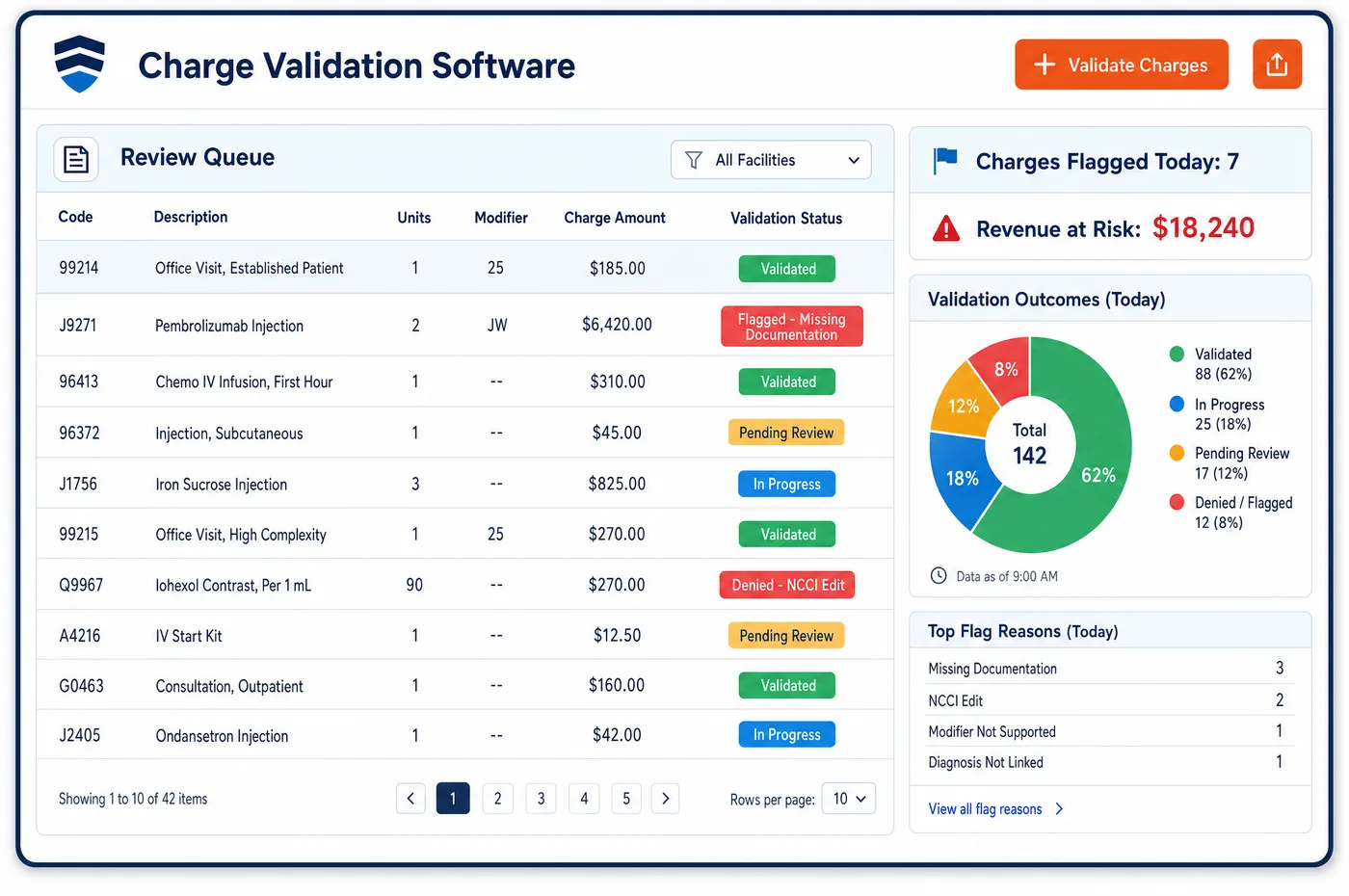
Charge Validation in a Chronic Care Practice
A care management charge can look right and still fail review. The code may match the minutes, but the minutes may include time already used for an office visit. The patient may have consented, but to a different practice. The month may hold practitioner CCM and staff CCM together, which CMS doesn't allow. Validation for care management runs through a set of checks. Is consent documented, with the required talking points? Was there an initiating visit? Is the care plan on file? Do the time entries name the person, the activity and the program, and do they reach the code's threshold? Is any minute also counted toward an E/M visit, remote monitoring or TCM? Does the month hold a service that blocks CCM, such as hospice supervision? Chronic care charge validation software runs these checks on every charge line. Lines that fail are held with the reason attached, so staff can fix them before the month's claims go out.
Why Is Charge Validation Different in Chronic Care?
Time is the main source of risk. Most care management codes depend on minutes, and those minutes come from many short entries by different people. A total that looks complete may include time that belongs to another code, or time logged by someone whose role doesn't fit the code. Charge validation in chronic care has to look past the total to the entries behind it.
Pairing rules are many and easy to forget. A month can't hold practitioner CCM alongside staff or complex CCM. Complex CCM can't share a month with prolonged E/M. CCM can't be billed in the same period as home health or hospice supervision by the practitioner. Remote physiologic and remote therapeutic monitoring can't be billed together. APCM by one practitioner blocks that practitioner's CCM, PCM and TCM for the month.
A failed charge here rarely fails alone. The same setup produces the same charge for many patients each month. A missing consent step at enrollment, or a time template that logs the wrong role, can touch a large share of the panel at once. Finding the pattern, not just the single line, keeps the next month from repeating it.
What Chronic Care Charge Validation Software Handles
- Whose time counts (99490, 99491)
- Codes 99491 and 99437 count only the billing practitioner's own time. Codes 99490, 99439, 99487 and 99489 count clinical staff time and can include practitioner time not used for 99491. Validation checks the role on each entry. (CMS MLN Booklet: Chronic Care Management Services (MLN909188))
- No minute counted twice
- Time counted toward a CCM code can't count toward any other billed code. When a visit and CCM work fall on the same day, validation checks that the visit's time and the CCM time are kept apart. (CMS: Frequently Asked Questions about Billing the Physician Fee Schedule for CCM Services)
- Consent before billing
- CMS requires written or verbal consent before CCM is billed, with the required points explained and recorded. A charge with no consent on file, or consent dated after the work, is held. (CMS MLN Booklet: Chronic Care Management Services (MLN909188))
- Same-period conflicts (G0181, G0182, 90951 to 90970)
- CCM can't be billed in the same service period as home health supervision, hospice supervision or certain ESRD services. Validation looks for those codes in the month and holds the CCM line when one appears. (CMS MLN Booklet: Chronic Care Management Services (MLN909188))
- Non-additive RPM codes (99445, 99454, 99470, 99457)
- Device codes 99445 and 99454 are not billed together for one period, and 99470 and 99457 are not added together. Validation stops a line that pairs them, and checks that 99458 follows 99457. (Federal Register: CY 2026 Physician Fee Schedule final rule (November 5, 2025), remote monitoring and APCM sections)
- APCM add-on rules (G0568, G0569, G0570)
- These behavioral health add-ons are billed only when the same practitioner reports an APCM base code in the same month. Validation checks for the base line before the add-on is released. (Federal Register: CY 2026 Physician Fee Schedule final rule (November 5, 2025), remote monitoring and APCM sections)
- APCM same-practitioner limits
- The practitioner who bills APCM can't bill CCM, PCM or TCM for the patient that month. A different practitioner may, when medically necessary. Validation checks the billing practitioner on each line. (Federal Register: CY 2025 Physician Fee Schedule final rule (December 9, 2024), Advanced Primary Care Management services)
How Does Chronic Care Charge Validation Software Work?
1. Receive the built lines
Charge lines arrive from care management charge assembly with their time entries, program and complexity attached.
2. Check the enrollment facts
Each line is checked for consent, an initiating visit and a current care plan. A missing fact holds the line with a plain reason.
3. Check the time
Entries are checked for role, activity and program, and totals are compared with the code's threshold. Time already used for a visit or for time-based E/M coding is taken out.
4. Check pairings and conflicts
The month's lines are checked against the pairing rules and same-period conflicts. Practitioner CCM with staff CCM, or RPM with remote therapeutic monitoring, is held.
5. Release or route
Lines that pass go to billing. Held lines go to a care management work queue with the reason, and repeat causes are reported to chronic care denial management for root-cause review.
Chronic Care Charge Validation Software vs. Generic Software
| Area | Generic approach | Unlimited Systems |
|---|---|---|
| Time checks | Only the monthly total is checked. | Each entry's role, activity and program is checked. |
| Double counting | Visit time and CCM time overlap without anyone noticing. | Same-day visit time is kept apart from CCM time. |
| Consent | Assumed because the patient is enrolled. | Consent date and talking points checked on every line. |
| Code pairings | Learned from denials. | Pairing rules checked before the claim is built. |
| Repeat errors | Fixed one line at a time. | Patterns reported so the setup is fixed once. |
Who Uses It in a Chronic Care Practice
- Compliance lead: A record for every charge of the consent, time entries and checks it passed, ready for an audit.
- Billing specialist: Held lines with the reason attached, so fixes are quick and claims go out clean.
- Care management director: Reports of time logged under the wrong role or program, so training targets the real problem.
Chronic Care Charge Validation Software FAQs
Charge validation for a CCM line checks that consent and an initiating visit are on file, that a care plan exists, and that logged time meets the code's threshold under the right role. It also checks that no minute is counted toward another code, and that the month holds no conflicting service such as hospice supervision by the same practitioner.
Practitioner time can count toward 99490 and the other staff-time codes, as long as it isn't used to report 99491. Codes 99491 and 99437 count only time the practitioner spends personally, and clinical staff time doesn't count toward them. Since the two families can't share a month, validation makes sure only one is billed.
CCM services are E/M services, and Medicare allows E/M visits in a CCM month. CCM work done on a visit day can count toward CCM if the visit code doesn't also claim that time. Validation compares the visit's time with the CCM entries for that day.
Validation stops a period that bills both 99445 and 99454, since the two device codes aren't additive. It also stops 99470 paired with 99457 in one month. Code 99458 can be added only after 99457. A line for remote physiologic monitoring is also held if remote therapeutic monitoring is billed for the same patient.
A failed charge is held with the reason attached and routed to the staff member who can fix it. Some fixes are quick, such as moving a time entry to the right program. Others, such as missing consent, mean the month can't be billed. Repeat causes are reported so the setup behind them gets fixed.
The APCM behavioral health add-ons G0568, G0569 and G0570 can be billed only when the same practitioner reports an APCM base code in the same month. When billed with APCM, they don't require counting minutes. Validation checks for the base code and the practitioner before releasing the add-on line.
Related Chronic Care Software
Billing & claims
In the revenue cycle
Charge Validation for related specialties
Sources
- CMS MLN Booklet: Chronic Care Management Services (MLN909188)
- CMS: Frequently Asked Questions about Billing the Physician Fee Schedule for CCM Services
- Federal Register: CY 2025 Physician Fee Schedule final rule (December 9, 2024), Advanced Primary Care Management services
- Federal Register: CY 2026 Physician Fee Schedule final rule (November 5, 2025), remote monitoring and APCM sections
- CMS MLN Booklet: Telehealth & Remote Monitoring (MLN901705)
GET STARTED
See Unlimited Systems in Action
Whether you're actively evaluating new technology or simply preparing for your next vendor renewal, Unlimited Systems can help you understand where your current workflows may be creating avoidable revenue risk.