

Billing & claims
Clinical Research Charge Validation Software
Trial-specific edits that check every charge before it reaches a claim, so sponsor-paid work stays off and routine care goes out complete.
Clinical Research Charge Validation Software checks each charge before the claim goes out. Along with normal coding edits, it checks that trial lines carry Q0 or Q1, that Z00.6 and the NCT number are on the claim, and that nothing marked sponsor-paid is headed to an insurer. Lines that fail wait in a work queue.



 6,500+ specialty providers

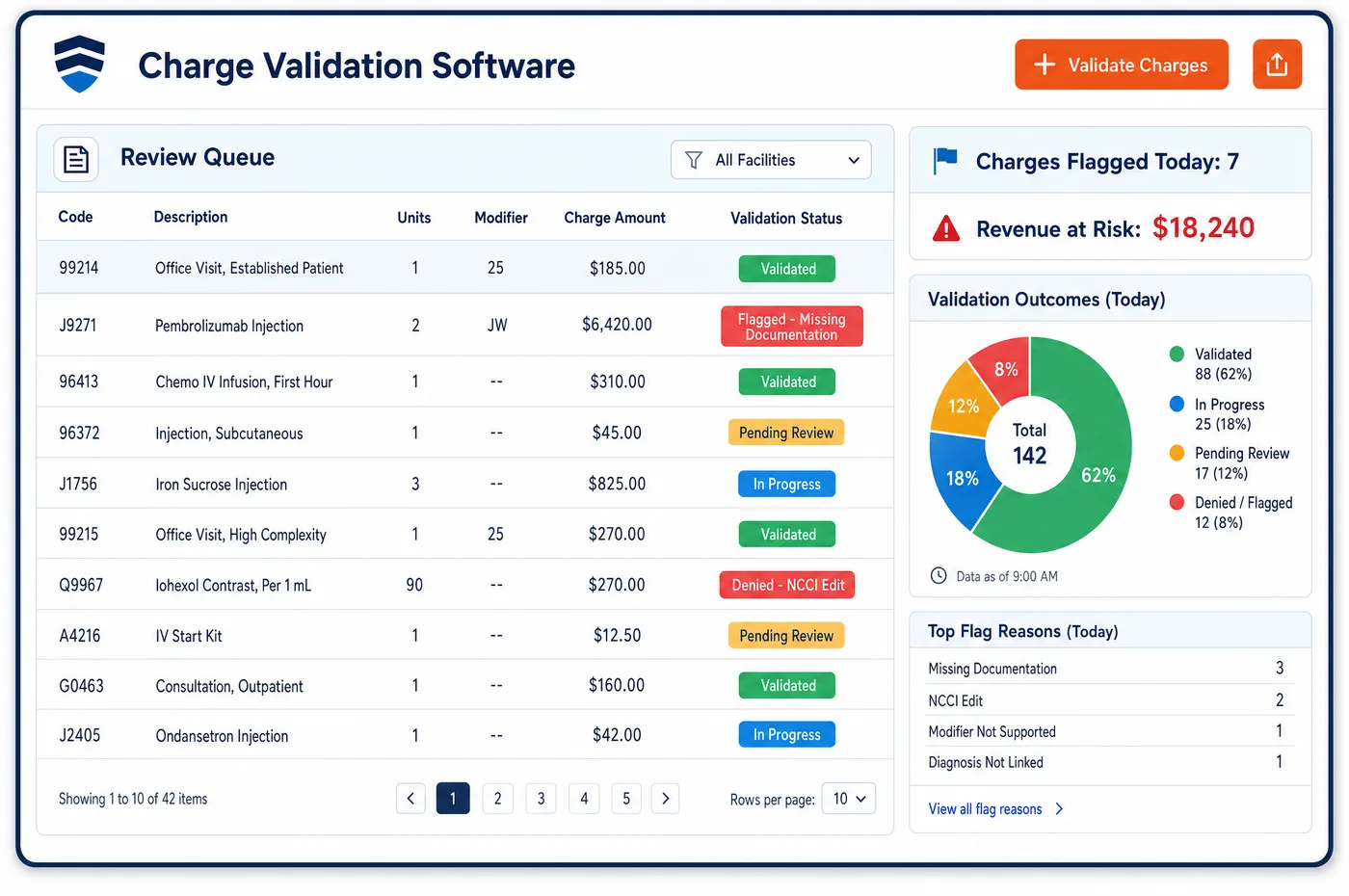
Charge Validation in a Clinical Research Practice
Validation is the last check before a trial charge becomes a claim. It runs the normal edits first: code pairs, units, payer policy and a match to the visit note. Then it runs rules the site sets for research. A Q1 line needs Z00.6 on the claim, or Medicare returns it. A claim with trial lines needs the NCT number for the right study. A line the coverage analysis marked sponsor-paid should never reach an insurer, so it is held. A Category B device line needs its IDE number and Q0, and a Category A device line should not exist at all. For Advantage members, an outpatient institutional claim that mixes trial and unrelated services is held to be split. Each held line goes to a work queue with the reason attached. Clinical research charge validation catches these before the payer does.
Why Is Charge Validation Different in Clinical Research?
Normal edits do not know a patient is in a trial. A scrubber sees a valid CPT code with a valid diagnosis and passes it. It cannot tell that the scan was a study-only test the sponsor is paying for. Research charge validation needs rules that read the study enrollment and the coverage analysis, not just the code set.
The stakes run both ways. A sponsor-paid service on a Medicare claim is billing for something Medicare does not cover. A routine service held back by mistake is revenue the site earned and never collects. Validation has to stop the first without blocking the second, which means each hold needs a clear reason a person can check quickly.
Modifier Q1 carries extra weight. Medicare treats a Q1 line billed with Z00.6, the ICD-10-CM code for a research participant or control, as the provider's statement that the service meets trial coverage rules. Putting Q1 on a line is not just a format step. It is a claim about the service, and validation is where someone confirms it is true before it goes out.
What Clinical Research Charge Validation Software Handles
- Q1 as the provider's attestation
- Medicare treats Q1 billed with Z00.6 as the provider's statement that the service is routine care or complication care in a qualifying trial. Validation checks each Q1 line against the coverage analysis before that statement is sent. (CMS Medicare Claims Processing Manual, Chapter 32, Sections 68.2, 69.6 and 69.9 (IDE devices; routine cost billing; managed care enrollees))
- Q1 without Z00.6
- Claims with Q1 and no Z00.6 are returned as unprocessable with CARC 16 and remark code M76. An edit holds any trial line that lacks the diagnosis. (CMS Medicare Claims Processing Manual, Chapter 32, Sections 68.2, 69.6 and 69.9 (IDE devices; routine cost billing; managed care enrollees))
- Missing or wrong NCT number
- Practitioner claims without a clinical trial number are returned with CARC 16 and remarks MA50 and MA130. An edit checks the number against the participant's enrollment for that study. (CMS Medicare Claims Processing Manual, Chapter 32, Sections 68.2, 69.6 and 69.9 (IDE devices; routine cost billing; managed care enrollees))
- Data-only or sponsor-free lines with Q1
- Items for data collection only, items with no benefit category, and items sponsors give free may not be billed with Q1. An edit holds any such line that reaches a claim. (CMS Medicare Claims Processing Manual, Chapter 32, Sections 68.2, 69.6 and 69.9 (IDE devices; routine cost billing; managed care enrollees))
- IDE device lines
- A Category B device needs its IDE number and Q0, and claims with an invalid IDE number come back with remark MA50. Category A devices are not reported, so an edit stops any Category A device line. (CMS Medicare Claims Processing Manual, Chapter 32, Sections 68.2, 69.6 and 69.9 (IDE devices; routine cost billing; managed care enrollees))
- Advantage mixed claims
- For Advantage members, outpatient trial and unrelated services may not share an institutional claim. An edit holds the claim so staff can split it. (CMS Medicare Claims Processing Manual, Chapter 32, Sections 68.2, 69.6 and 69.9 (IDE devices; routine cost billing; managed care enrollees))
How Does Clinical Research Charge Validation Software Work?
1. Run normal edits
Each line goes through code pair, unit, payer policy and documentation checks. These catch the same errors they would on any claim.
2. Run research rules
Rules the site sets read the enrollment and coverage analysis. They check Q0 and Q1, Z00.6, the NCT number and the payer set for each line.
3. Hold what fails
Lines that fail go on a claim hold with the rule and reason shown. Nothing marked sponsor-paid moves on to an insurer.
4. Work the queue
Coders and coordinators clear held lines, fixing the code, the modifier or the payer. A line built wrong goes back to research charge assembly.
5. Learn from returns
When a payer still returns or denies a trial claim, the cause feeds study denial management. New rules can then catch the same error earlier.
Clinical Research Charge Validation Software vs. Generic Software
| Area | Generic approach | Unlimited Systems |
|---|---|---|
| Trial awareness | Edits see only codes and diagnoses. | Rules read the enrollment and coverage analysis too. |
| Sponsor-paid lines | Pass the scrubber if the code is valid. | Held before they reach an insurer. |
| Trial coding | Missing Z00.6 or NCT found when the claim comes back. | Checked before the claim is sent. |
| Device lines | Billed like any supply. | Checked for IDE number, Q0 and device category. |
| Holds | A flag with no reason. | Each hold shows the rule and what to fix. |
Who Uses It in a Clinical Research Practice
- Coder: A queue of held trial lines, each with the rule it broke and the visit it came from.
- Compliance officer: Proof that every Q1 line was checked against the coverage analysis before it was sent.
- Billing manager: Fewer trial claims returned as unprocessable, and a clear count of what is on hold and why.
Clinical Research Charge Validation Software FAQs
Charge validation runs the normal coding edits and then research rules. It checks that trial lines carry Q0 or Q1, that Z00.6 and the right NCT number are on the claim, and that no sponsor-paid service is headed to an insurer. It also checks IDE device lines and mixed Advantage claims. Any trial line that fails waits in a queue with the broken rule shown.
A normal scrubber checks codes, pairs and diagnoses, which can all be valid on a sponsor-paid service. What makes the line wrong is who agreed to pay for it, and that lives in the coverage analysis for the study. Research rules read that analysis, so a line marked sponsor-paid is held even when its coding is perfect.
Medicare returns the claim as unprocessable with CARC 16 and remark code M76. An unprocessable claim cannot be appealed and has to be fixed and sent again. A validation rule that holds any Q1 line without Z00.6 on the claim stops the return before it happens and saves a second submission.
Q1 is a line-level modifier, but Medicare gives it extra meaning. Billed with Z00.6, it serves as the provider's statement that the service is routine care or care for complications in a qualifying trial. That is why each Q1 line is checked against the coverage analysis rather than added by default.
For a Category B IDE device, the line needs the IDE number and modifier Q0, and Medicare returns claims with an invalid IDE number. Category A devices are not eligible for Medicare payment and are not reported on claims, so any Category A device line is held. Routine care in either kind of study is checked like other trial lines.
Coders clear holds about codes, modifiers and diagnoses. Coordinators or research finance staff clear holds about who pays, since they know the coverage analysis and the trial contract. Each hold shows the rule it broke, so it reaches the right person and can be fixed once, with the reason kept on record.
Related Clinical Research Software
Billing & claims
In the revenue cycle
Charge Validation for related specialties
Sources
GET STARTED
See Unlimited Systems in Action
Whether you're actively evaluating new technology or simply preparing for your next vendor renewal, Unlimited Systems can help you understand where your current workflows may be creating avoidable revenue risk.