

Billing & claims
Clinical Research Charge Assembly Software
Every documented study service turned into a coded charge line with its payer already set: sponsor, insurance or not billable.
Clinical Research Charge Assembly Software turns what was done at a study visit into coded charge lines. Each line carries its code, units and the payer the coverage analysis set for it, so routine care heads to an insurance claim, study-only work heads to the sponsor, and free study items are never charged.



 6,500+ specialty providers

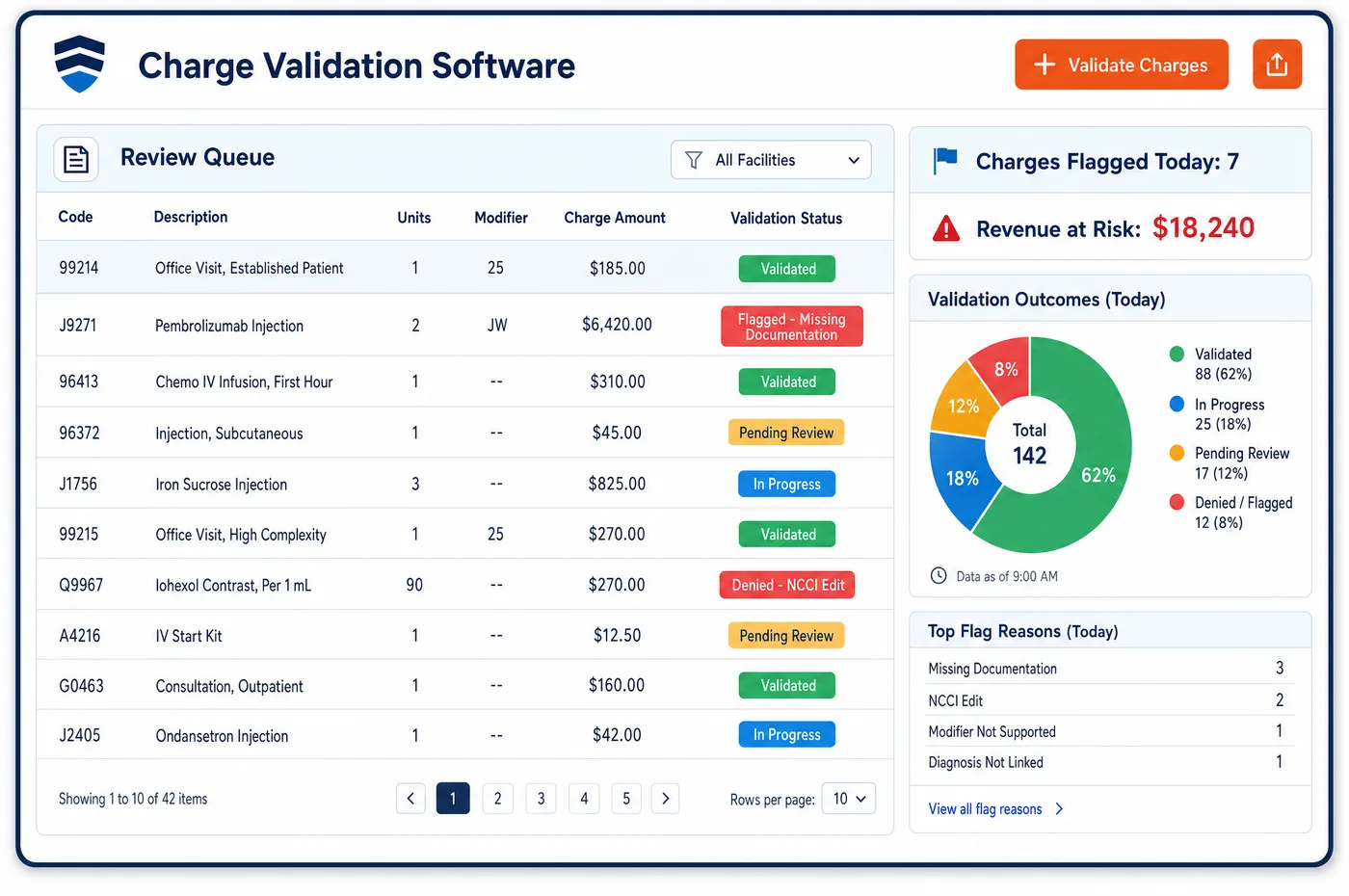
Charge Assembly in a Clinical Research Practice
Charge assembly at a research site starts from two lists. One is what the protocol says should happen at the visit. The other is what was actually documented. Staff match them. A planned CT scan that was done becomes a line. A planned blood draw that was skipped does not. A test added for a side effect becomes a line marked for review. Each line then gets its payer from the coverage analysis. Routine care, the care needed to give the study drug, and care for complications are tagged for insurance with Q1. Tests done only for study data are tagged for the sponsor. The study drug, when the sponsor gives it free, gets no charge, or a non-covered line where the claim needs to show it. Clinical research charge assembly ends with one set of lines per visit, each pointed at a single payer.
Why Is Charge Assembly Different in Clinical Research?
The same code can be billable or not, depending on why it was done. A blood count drawn to manage a person's care is routine care. The same blood count drawn only because the protocol wants the number is study data. Charge assembly has to know the reason for each service, and the reason lives in the coverage analysis, not in the CPT code.
Drugs and devices make it harder. When the sponsor supplies the study drug free, the drug itself is not charged, but giving it may be. Medicare covers the items and services needed to give a study item and watch its effects. A Category B device is charged in full only when the site paid for it. Each of these needs its own rule at the charge level.
Visits also drift from the plan. A participant may skip a test, add an unscheduled visit, or have a complication treated on the same day. Charges built straight from the protocol calendar would bill for work that never happened. Charges built only from notes would miss which payer each one belongs to. Charge capture for trials has to use both.
What Clinical Research Charge Assembly Software Handles
- Giving the study drug as routine care
- Medicare covers items and services needed only to give the study item, watch its effects and prevent complications. A drug administration line can carry Q1 even when the drug itself is sponsor-supplied. (CMS National Coverage Determination 310.1: Routine Costs in Clinical Trials)
- Free study items as non-covered lines
- Items the sponsor provides free generally may not be billed to Medicare. If a claim must show one to get paid for a covered service, such as giving a non-covered drug, the item is entered as non-covered and the person is not held liable. (CMS Medicare Claims Processing Manual, Chapter 32, Sections 68.2 and 69.5 (Category B IDE devices; billing requirements))
- Category B devices the site paid for
- Outpatient institutional claims bill a Category B device as a covered charge when the site paid for it. A free device may need only a token charge where claim edits require it, and an inpatient claim should not bill a free device, so the line depends on how it was obtained. (CMS Medicare Claims Processing Manual, Chapter 32, Sections 68.2 and 69.5 (Category B IDE devices; billing requirements))
- Care for complications
- Medicare covers reasonable and necessary care to diagnose and treat complications from taking part in a trial. Lines from an unscheduled visit for a side effect are tagged for review against that rule and the trial contract. (CMS National Coverage Determination 310.1: Routine Costs in Clinical Trials)
- Services only for data
- Services done only to meet data collection needs, and not used in the person's care, are not covered. These lines are tagged for the sponsor invoice instead of a claim. (CMS National Coverage Determination 310.1: Routine Costs in Clinical Trials)
How Does Clinical Research Charge Assembly Software Work?
1. Load the visit plan
The protocol visit and its coverage analysis set the expected services. The charge description master supplies the code and price for each one.
2. Match to documentation
Staff check each planned service against the visit note and results. Services not done are dropped, and services added are kept for review.
3. Tag each line with a payer
Every line gets its payer from the coverage analysis: insurance with Q1, sponsor, or not billable. Lines for an unscheduled visit wait for a coordinator's call.
4. Handle drugs and devices
Sponsor-supplied drugs get no charge or a non-covered line, while the administration line is kept. Device lines follow the IDE rules for how the device was obtained.
5. Pass lines on
Insurance lines go to charge validation for trial claims. Sponsor lines collect for sponsor invoicing on the trial contract's terms.
Clinical Research Charge Assembly Software vs. Generic Software
| Area | Generic approach | Unlimited Systems |
|---|---|---|
| Starting point | Charges keyed from the protocol, whether or not the work was done. | Planned services matched to what was documented. |
| Payer per line | Decided after the claim denies. | Set on each line from the coverage analysis. |
| Study drug | Billed like any drug in stock. | No charge, or non-covered when the claim must show it. |
| Drug administration | Left off because the drug was free. | Kept as a routine line when it is needed to give the drug. |
| Unscheduled visits | Billed to insurance by default. | Held for review against complication rules and the contract. |
Who Uses It in a Clinical Research Practice
- Research coordinator: A list of each visit's planned services next to what was documented, linked to the study visit schedule, so gaps are clear.
- Charge entry staff: Lines that arrive with their codes and payers set, instead of a protocol binder to read.
- Research finance lead: Sponsor-billable lines collected by study, ready to invoice and match to the budget.
Clinical Research Charge Assembly Software FAQs
Charge assembly gives each line the payer set in the study's coverage analysis. Routine care, the care needed to give the study item, and treatment of complications go to insurance with Q1. Services done only for study data go to the sponsor. Items the sponsor gives free are not charged. Lines that do not fit the plan wait for review.
The same code can go to different payers at different visits. A scan done to manage the person's care is routine care, while the same scan done only for study data belongs to the sponsor. The coverage analysis marks each service on each visit, so the same code is routed by visit, not by code alone.
When the sponsor supplies the study drug free, it is not billed to Medicare. If a claim must show it to get paid for a covered service, such as giving the drug, it goes on as a non-covered line and the person is not held liable. A sponsor needs FDA approval before it can charge for an investigational drug at all.
Planned services that were not documented are dropped, so no one bills for work that did not happen. The coordinator can see the gap, which may also need to be logged as a protocol deviation. Services that were done but were not on the plan are kept as lines for review, not dropped.
Medicare covers care to diagnose and treat complications from taking part in a trial. Lines from a visit for a side effect are held for a coordinator to review. They may bill to insurance as routine care with Q1, or to the sponsor if the trial contract says the sponsor pays for study injuries.
Charge assembly builds the sponsor lines, but it does not send the invoice. Lines marked for the sponsor collect by study and participant, with the visit and the service. The invoicing step then prices them at the budget rate and sends them on the terms in the trial contract.
Related Clinical Research Software
Billing & claims
In the revenue cycle
Charge Assembly for related specialties
Sources
GET STARTED
See Unlimited Systems in Action
Whether you're actively evaluating new technology or simply preparing for your next vendor renewal, Unlimited Systems can help you understand where your current workflows may be creating avoidable revenue risk.