

Billing & claims
Clinical Research Medical Billing Software
Trial claims built with the right modifiers, diagnosis code, condition code and NCT number, then scrubbed and sent like any other claim.
Clinical Research Medical Billing Software builds and sends the insurance claims for routine care given in a clinical trial. Each claim carries the trial coding Medicare requires: Q0 or Q1 on each line, diagnosis code Z00.6, the NCT number, and condition code 30 on institutional claims. Then it is scrubbed and sent like any other claim.



 6,500+ specialty providers

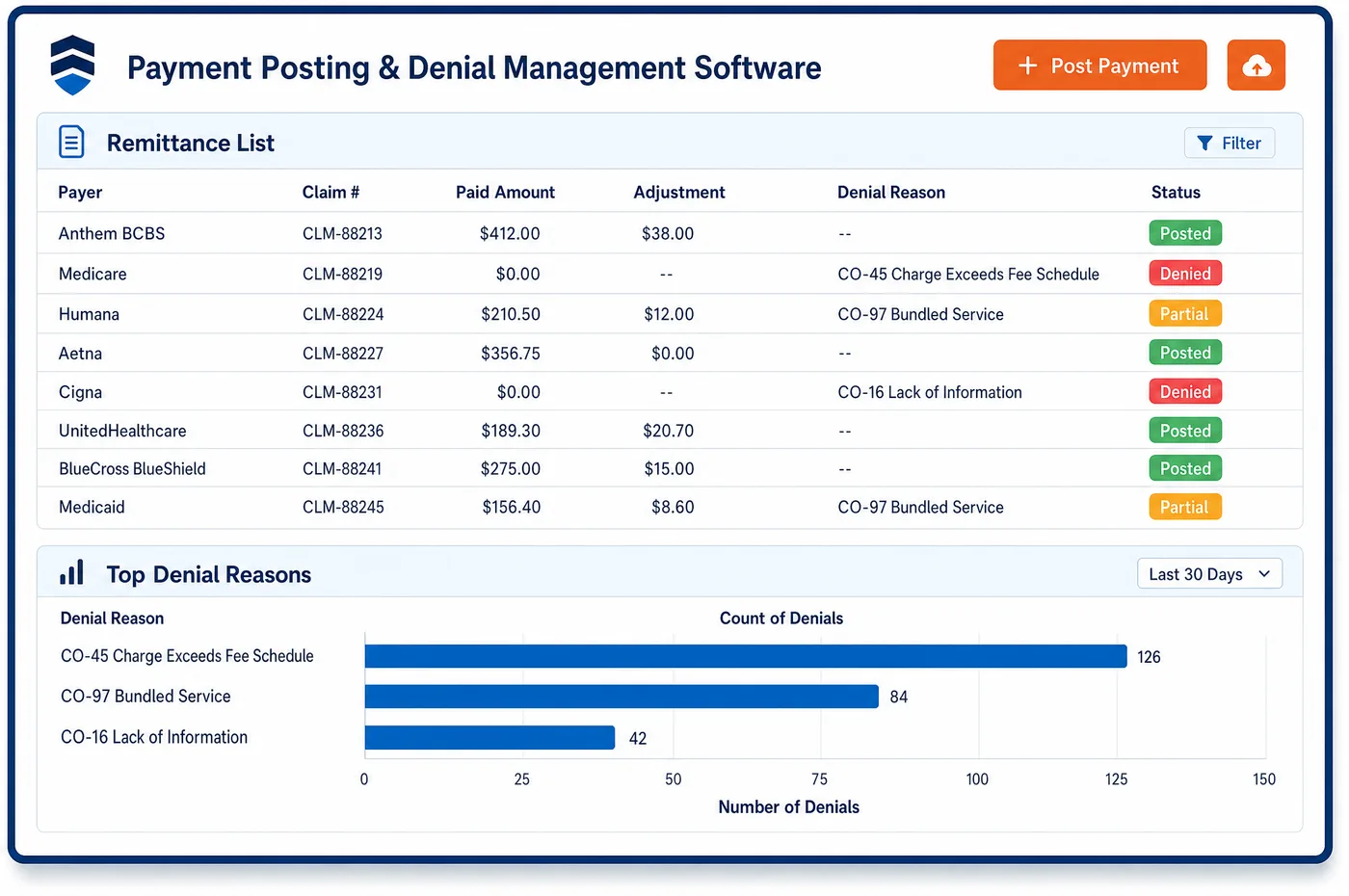
Medical Billing in a Clinical Research Practice
A trial claim looks like a normal claim with a few extra parts, and missing any one of them sends it back. On a professional claim, each line gets Q1 for routine care or Q0 for an investigational service. Diagnosis code Z00.6 goes in the first or second position. The 8-digit NCT number goes in the claim's REF segment with qualifier P4, or in item 19 with the letters CT on a paper form. Institutional outpatient claims add condition code 30 and the same line modifiers. Inpatient claims use Z00.6 and condition code 30 without line modifiers. When a visit has both trial and non-trial services, they go on separate lines, and for Advantage members on separate claims. Clinical research medical billing software puts these parts on the claim from the study enrollment, runs the scrubber, sends the claim through the clearinghouse and tracks its status.
Why Is Medical Billing Different in Clinical Research?
Trial claims fail for small reasons. A Q1 line without Z00.6 is returned as unprocessable. A claim with no NCT number comes back the same way. These are not denials that can be appealed; the claim has to be fixed and sent again. A billing team that adds trial coding by hand, visit by visit, will keep making the same small errors.
The form also changes with the setting. A physician practice bills on the professional claim, a hospital outpatient department on the institutional claim, and an inpatient stay follows its own rules. A research site tied to a hospital may send all three for one participant. Medical billing for trials has to know which parts each claim needs, from the CMS-1500 to the UB-04.
Device studies add one more layer. In a Category B IDE study, the device can be billed with its IDE number and modifier Q0, and an institutional claim puts it on revenue code 0624. In a Category A study, the device is never billed to Medicare, though routine care can be. Getting this wrong looks like a coding slip but bills for something Medicare does not pay.
What Clinical Research Medical Billing Software Handles
- Modifiers Q0 and Q1
- Q1 marks routine care or treatment of complications in a qualifying trial, and Q0 marks an investigational service. Each line gets the right one from the coverage analysis, since Q1 acts as the provider's statement that the service meets coverage rules. (CMS Medicare Claims Processing Manual, Chapter 32, Sections 68 and 69 (IDE studies and qualifying clinical trials))
- Diagnosis code Z00.6
- Z00.6 is the code for an exam of a participant or control in a clinical research program. It goes in the first or second position on every trial claim, and a Q1 line without it is returned as unprocessable. (CMS Medicare Claims Processing Manual, Chapter 32, Sections 68 and 69 (IDE studies and qualifying clinical trials))
- NCT number on the claim
- On the 837P and 837I, the 8-digit number goes in loop 2300, REF02, with REF01 set to P4. On the paper CMS-1500 it goes in item 19 after the letters CT, and on the paper CMS-1450 as value code D4. (CMS Medicare Claims Processing Manual, Chapter 32, Sections 68 and 69 (IDE studies and qualifying clinical trials))
- Condition code 30
- Institutional claims for trial services carry condition code 30 with Z00.6. Inpatient claims use the two without Q0 or Q1, since inpatient claims do not report HCPCS codes. (CMS Medicare Claims Processing Manual, Chapter 32, Sections 68 and 69 (IDE studies and qualifying clinical trials))
- Category B IDE devices
- Institutional claims put the device on a revenue code 0624 line with its IDE number, and practitioners bill it with Q0. The IDE number goes in loop 2300, REF02, with REF01 set to LX. (CMS Medicare Claims Processing Manual, Chapter 32, Sections 68 and 69 (IDE studies and qualifying clinical trials))
- Category A IDE studies
- Category A devices are not eligible for Medicare payment and are not reported on claims. Only routine care in a CMS-approved Category A study is billed, using the normal trial coding. (CMS Medicare Claims Processing Manual, Chapter 32, Sections 68 and 69 (IDE studies and qualifying clinical trials))
How Does Clinical Research Medical Billing Software Work?
1. Pull trial details from the enrollment
The claim picks up the NCT number and study link from the participant's enrollment. Staff do not type it in for each visit.
2. Code each line
Each line gets Q1 or Q0 from the coverage analysis, and Z00.6 is added as a diagnosis. Institutional claims also get condition code 30.
3. Split trial and other services
Trial and non-trial services go on separate lines. For Advantage members, institutional trial services go on their own claim to Original Medicare, while other care bills to the plan.
4. Scrub before sending
Claim scrubbing checks for missing trial parts along with normal edits. Lines held for a coding question go back through study charge validation.
5. Send and track
Clean claims go to the clearinghouse and on to the payer, and their status is tracked. Results feed the wider research RCM view of what is billed and paid.
Clinical Research Medical Billing Software vs. Generic Software
| Area | Generic approach | Unlimited Systems |
|---|---|---|
| Trial coding | Added by hand on each claim. | Pulled from the enrollment and the coverage analysis. |
| NCT number | Typed in, sometimes with the wrong study. | Taken from the participant's enrollment for that study. |
| Mixed visits | Trial and normal services on one line set. | Split into separate lines, or separate claims where required. |
| Device studies | Device billed the same as any supply. | Category B billed with its IDE number; Category A not billed. |
| Returns | Unprocessable claims found much later. | Missing trial parts caught by the scrubber before sending. |
Who Uses It in a Clinical Research Practice
- Billing specialist: Trial claims that already carry Q0 or Q1, Z00.6, condition code 30 where needed and the NCT number, so the work is checking, not typing.
- Hospital research billing lead: The right parts for professional, outpatient and inpatient claims for the same participant.
- Research finance director: Claim status for each study, so trial claims stuck at the payer are seen early.
Clinical Research Medical Billing Software FAQs
Medical billing for clinical trials adds parts that normal claims do not have. Each line needs Q0 or Q1, the claim needs diagnosis code Z00.6, the 8-digit NCT number must be reported, and institutional claims need condition code 30. Trial and non-trial services also go on separate lines. Missing any of these sends the claim back.
On electronic professional and institutional claims, the 8-digit NCT number goes in loop 2300, REF02, with REF01 set to P4. On the paper CMS-1500 it goes in item 19, preceded by CT. On the paper CMS-1450 it is reported as value code D4. Medicare returns claims without the number as unprocessable.
Q0 marks an investigational clinical service in an approved study, such as a Category B IDE device billed with its IDE number. Q1 marks routine care or the treatment of complications in a qualifying trial. Services done only for study data get neither, since they are not billable to Medicare and belong on the sponsor invoice.
Inpatient claims do not report HCPCS codes, so the Q0 and Q1 modifiers do not apply to them. An inpatient trial claim still needs diagnosis code Z00.6 in the first or second position and condition code 30, along with the 8-digit clinical trial number that every institutional trial claim must carry.
For qualifying trials, routine costs for Advantage members bill to Original Medicare under the same trial coding. Institutional providers must not mix outpatient trial services and unrelated services on one claim, so they send the trial services as a separate fee-for-service claim. Unrelated care from the same day bills to the Advantage plan.
If a claim had the correct trial coding and was denied in error, for example for medical necessity, the contractor can adjust it once the error is pointed out. If the services were not coded as trial services, the provider sends a new claim with the right trial coding instead of appealing the old one.
Related Clinical Research Software
Billing & claims
In the revenue cycle
Medical Billing for related specialties
Sources
GET STARTED
See Unlimited Systems in Action
Whether you're actively evaluating new technology or simply preparing for your next vendor renewal, Unlimited Systems can help you understand where your current workflows may be creating avoidable revenue risk.