

Billing & claims
Clinical Research Invoicing Software
Sponsor invoices built from the study budget and the visits actually done, tracked to payment and kept apart from insurance claims.
Clinical Research Invoicing Software builds the bills that go to study sponsors and CROs rather than insurers. It turns completed visits, study-only tests and contract fees into invoice lines at the budget rate, sends them on the contract's terms, and tracks each one to payment, so sponsor revenue is not left uncollected.



 6,500+ specialty providers

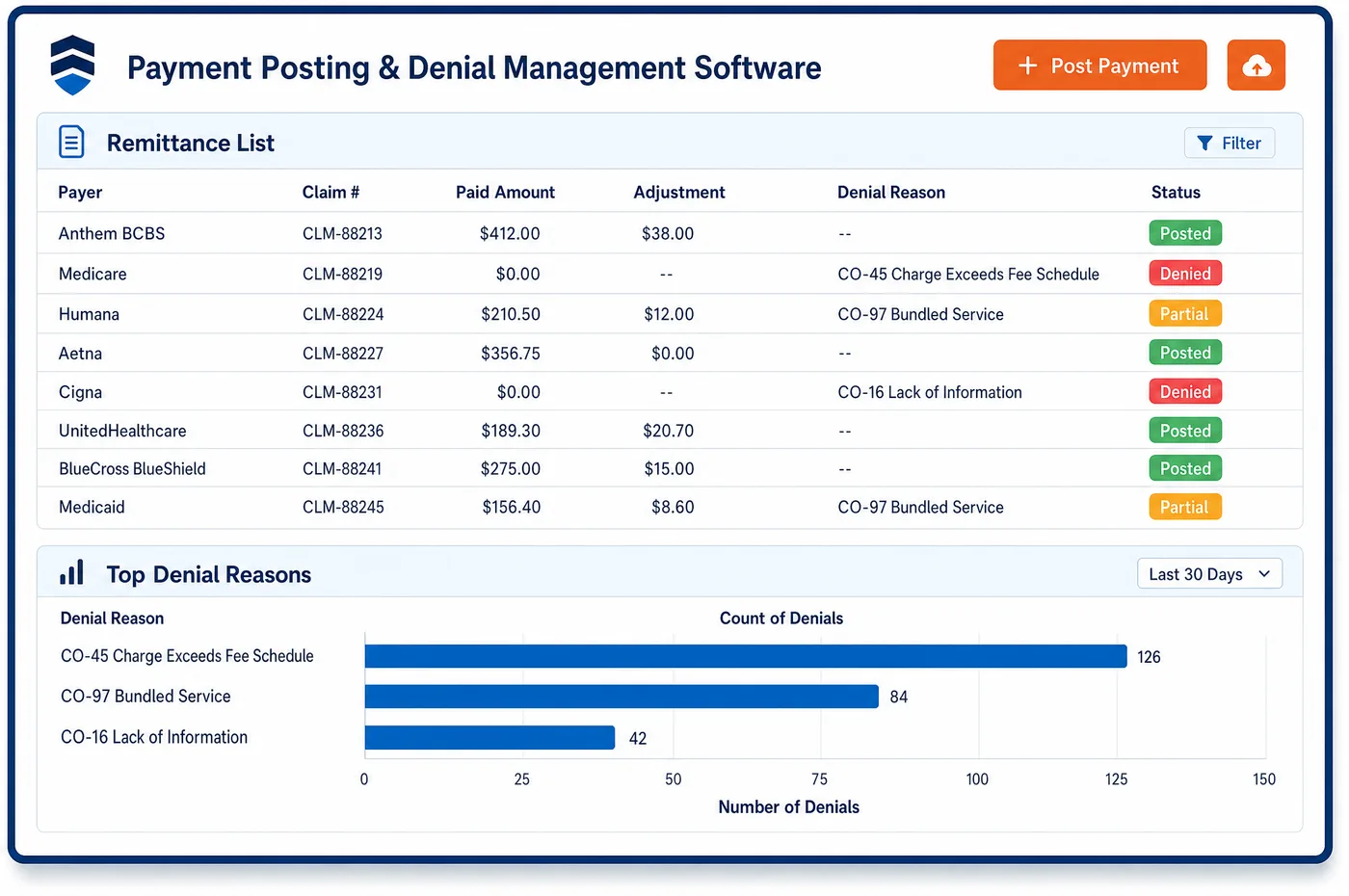
Invoicing in a Clinical Research Practice
Sponsor invoicing follows the trial contract, not a fee schedule. The budget lists what the sponsor pays for: each completed visit, study-only tests, screen failures, and fees such as start-up or pharmacy fees. Some items are paid from the visit data the site enters, and others are paid only when the site sends an invoice. That second group is where money is lost. Research invoicing at the site starts from the same charge lines the claims come from. Lines the coverage analysis marked sponsor-paid collect by study, and staff add contract fees the visit lines do not show. Each invoice lists the protocol number, the subject number and the visit, so the sponsor can match it to their own records. Payments post against each line. Lines still open past the contract's terms go to a follow-up list. A line on a sponsor invoice is held by an edit if it also turns up on a claim.
Why Is Invoicing Different in Clinical Research?
Sponsors do not pay like insurers. There is no 835 remittance, no standard claim form, and each contract sets its own rates, terms and items. Some payments come in without detail on what they cover. Invoicing for research has to work from the budget and the contract, and it has to tie each payment back to the visit or fee it pays for.
Items you can invoice are easy to miss. A screen failure, an unscheduled visit, a repeat test, an amendment fee or a record storage fee may each be payable, but only if the site asks. Coordinators are focused on the participants, and finance staff may not see what happened at each visit. Lines that never reach an invoice are revenue the site earned and never collects.
The invoice also has to agree with the claims. A service the sponsor pays for must not reach an insurer, and a routine service billed to insurance should not appear on the sponsor invoice. When both sides draw from one set of charge lines, each tagged with one payer, the split holds. When they are built separately, the same service can end up on both.
What Clinical Research Invoicing Software Handles
- Study-only services on the sponsor invoice
- Services done only for data collection, and not used in the person's care, are not covered by Medicare. These are the core of most sponsor invoices, so each one is pulled from the charge lines rather than typed again. (CMS National Coverage Determination 310.1: Routine Costs in Clinical Trials)
- Matching invoices to the medical record
- Medicare expects the record to hold the trial name, sponsor and sponsor-assigned protocol number. Sponsor invoices use the same protocol number, so the invoice, the record and any claim point to one study. (CMS Medicare Claims Processing Manual, Chapter 32, Section 69.3 (Medical Records Documentation Requirements))
- Study injury terms from the consent
- For trials above minimal risk, the consent must explain whether compensation or treatment is available after an injury. When the contract says the sponsor pays for study injuries, those services are invoiced to the sponsor instead of billed to insurance. (eCFR: 21 CFR 50.25, Elements of informed consent)
- Bills for Advantage cost-sharing refunds
- An Advantage member gets back any cost-sharing gap by sending the plan proof such as a provider bill, and plans may ask the provider directly. Invoicing produces that bill for the member on request. (CMS Medicare Managed Care Manual, Chapter 4, Section 10.7.1 (Clinical Trials: Payment for Services))
- Stipends and travel reimbursement
- FDA guidance says payment to participants is not a benefit of the study, and its terms belong in the consent. Stipends are tracked apart from patient bills, and the cost is billed to the sponsor only where the contract says so. (FDA Guidance: Payment and Reimbursement to Research Subjects)
How Does Clinical Research Invoicing Software Work?
1. Load the budget
Staff enter the sponsor's rates for visits, study-only tests and fees onto the protocol, beside the coverage analysis. Each rate is tied to a contract line.
2. Collect sponsor lines
Lines marked sponsor-paid during research charge assembly gather by study and participant. Staff add fees, such as screen failures or amendment fees, that no visit shows.
3. Build and send the invoice
Each invoice lists the protocol number, subject numbers, visits and fees at the budget rate. It goes to the sponsor or CRO by email or portal on the contract's schedule.
4. Post payments to lines
When a sponsor pays, staff apply the payment to the invoice lines it covers. Short or unexplained payments are noted for follow-up.
5. Follow up open lines
Lines still open past contract terms move to a worklist for research finance. The totals feed the site's research RCM view.
Clinical Research Invoicing Software vs. Generic Software
| Area | Generic approach | Unlimited Systems |
|---|---|---|
| Source of lines | Built from coordinator notes and memory. | Pulled from the same charge lines the claims use. |
| Contract fees | Remembered at study close-out, if at all. | Added to the invoice when the event happens. |
| Matching | Invoices with no protocol or subject numbers. | Each line shows protocol, subject and visit. |
| Payments | Lump sums posted to the study with no detail. | Applied to the lines they pay for. |
| Overlap with claims | The same test billed to both sponsor and insurer. | Each line has one payer, set by the coverage analysis. |
Who Uses It in a Clinical Research Practice
- Research finance lead: Invoices built from completed work at the budget rate, with open lines listed by study and sponsor.
- Research coordinator: Fewer requests to rebuild what happened at each visit, since invoice lines come from the visit record.
- Billing office: Clear separation between sponsor invoices and each participant's patient statement, so no one is billed for sponsor-paid care.
Clinical Research Invoicing Software FAQs
Invoicing at a research site covers bills that go to sponsors and CROs instead of insurers. That includes completed study visits, study-only tests, screen failures and contract fees such as start-up or amendment fees. Each invoice follows the trial budget and contract, and each line is tracked until the sponsor pays it.
Sponsor invoicing and insurance claims draw from one set of charge lines, and each line has a single payer set by the coverage analysis. Sponsor-paid lines go to the invoice, and routine care goes to the claim. A line marked for the sponsor is held if it ever reaches a claim, which keeps one service from being billed twice.
Items paid only on request are the easiest to miss. These can include screen failures, unscheduled visits, repeat tests, amendment fees, pharmacy fees and record storage fees, depending on the contract. Adding them when the event happens, rather than at close-out, gives the site a better chance of being paid for them.
When a sponsor pays, staff apply the payment to the invoice lines it covers, by visit and fee. If the payment does not say what it covers, staff match it to open lines using the protocol and subject numbers. Anything short or unexplained is noted and followed up with the sponsor or CRO.
Participants are not invoiced for sponsor-paid care. They may get a normal statement for cost-sharing on routine care billed to their plan. For Advantage members, the site can send a bill showing Original Medicare cost-sharing, which the member uses to claim the difference from the plan under Medicare's trial rules.
It depends on the trial contract and the consent. For trials above minimal risk, the consent must explain whether compensation or treatment is available if a participant is hurt. When the contract says the sponsor pays, those services are invoiced to the sponsor. Otherwise they may bill to insurance as care for a complication.
Related Clinical Research Software
Billing & claims
Invoicing for related specialties
Sources
- CMS National Coverage Determination 310.1: Routine Costs in Clinical Trials
- CMS Medicare Claims Processing Manual, Chapter 32, Section 69.3 (Medical Records Documentation Requirements)
- eCFR: 21 CFR 50.25, Elements of informed consent
- CMS Medicare Managed Care Manual, Chapter 4, Section 10.7.1 (Clinical Trials: Payment for Services)
- FDA Guidance: Payment and Reimbursement to Research Subjects
GET STARTED
See Unlimited Systems in Action
Whether you're actively evaluating new technology or simply preparing for your next vendor renewal, Unlimited Systems can help you understand where your current workflows may be creating avoidable revenue risk.