

Front office
Clinical Research Financial Clearance Software
Sort each study service, check the plan and give an estimate before the first study visit, not after the first denial.
Clinical Research Financial Clearance Software checks how each study service will be paid before the visit. It holds the coverage analysis for the protocol. It checks the plan and eligibility of each participant. It notes steps the plan or the contractor needs. And it gives each person an estimate of what they may owe for routine care.



 6,500+ specialty providers

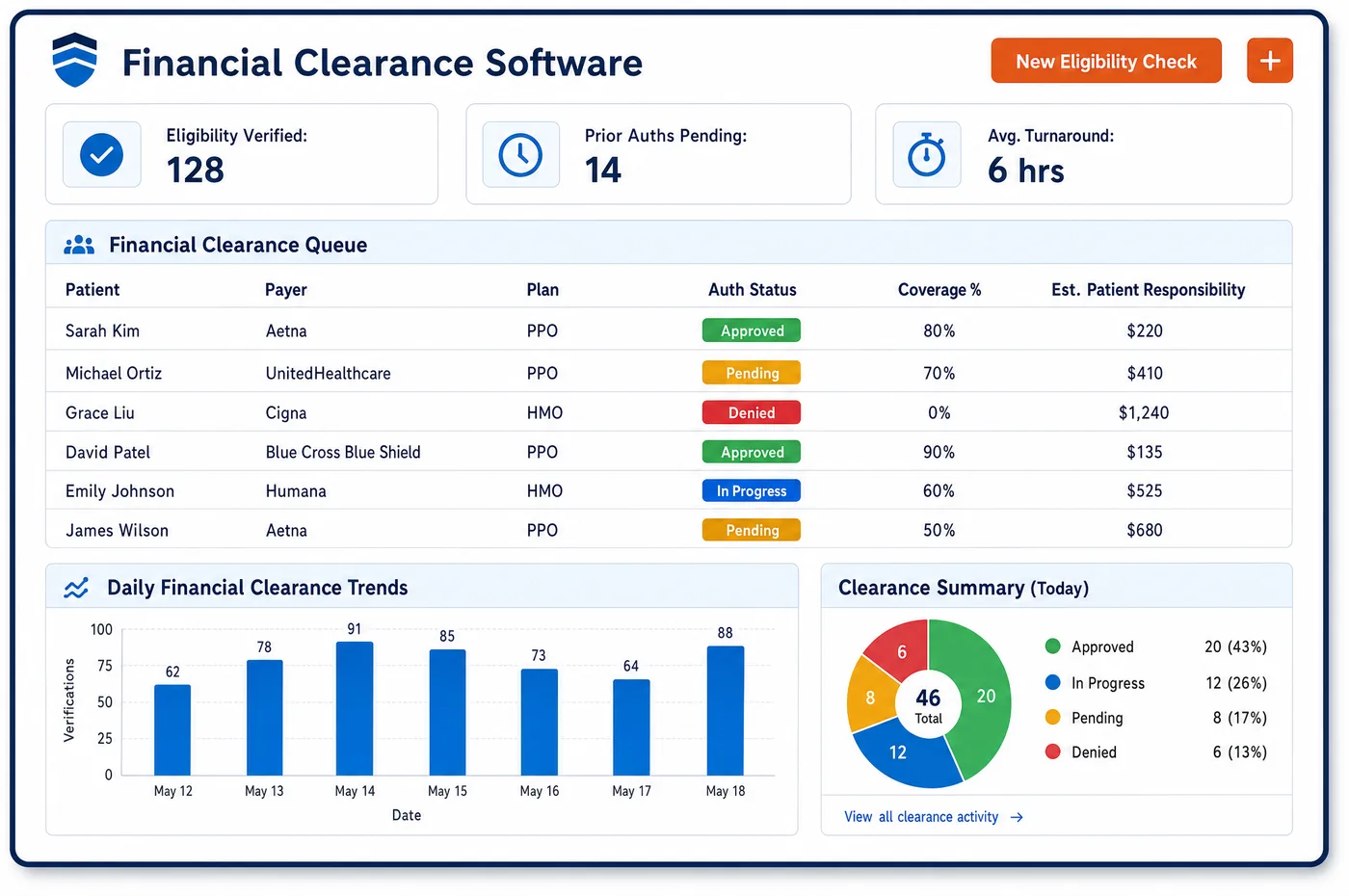
Financial Clearance in a Clinical Research Practice
Clearance at a research site works at two levels. The first is the protocol. Before anyone enrolls, the site runs a coverage analysis. It checks that the trial qualifies under Medicare's trial policy. Then it sorts each service on the study calendar as sponsor-paid or billable routine care. Items the sponsor gives free, the investigational item itself and tests done only for study data cannot be billed to Medicare. The second level is the participant. Staff check eligibility, confirm the plan type and look at what that plan covers. Original Medicare covers routine costs in a qualifying trial, and Medicaid has done so since 2022. Commercial plans must cover them in approved trials for cancer and other life-threatening illness. A device study needs one more check, since the Medicare contractor must be told about the study before claims are sent. Clinical research financial clearance ends with an estimate the participant can read, built from the routine care that will bill to their plan.
Why Is Financial Clearance Different in Clinical Research?
Most practices clear a visit by checking one plan for one service. A research site has to clear a protocol first. Each study visit on the calendar holds a list of services, and each service has to be sorted before anyone is enrolled. If the coverage analysis is wrong, every participant on that study inherits the same billing error.
The sorting follows rules that are easy to state and hard to apply. Medicare's clinical trial coverage policy covers normal care, the care needed to give the study item and watch for its effects, and care for complications. It does not cover the study item, tests done only for data, or anything the sponsor gives for free. A blood draw can be routine care at one visit and a study-only test at the next.
Then each person's plan adds its own layer. In most studies, Medicare Advantage members bill routine trial costs to Original Medicare. In approved device studies, their plan pays. Commercial plans must cover routine costs in approved trials for cancer and other life-threatening illness. Yet they may require an in-network provider. Financial clearance for a trial has to put both layers together before the first study visit.
What Clinical Research Financial Clearance Software Handles
- Qualifying trial check (NCD 310.1)
- A trial qualifies for Medicare routine-cost coverage when it meets the policy, for example when it is funded by NIH, CDC, AHRQ, CMS, DOD or VA, or run under an FDA-reviewed IND. The result is recorded on the protocol before enrollment opens. (CMS National Coverage Determination 310.1: Routine Costs in Clinical Trials)
- Services Medicare will not pay in a trial
- The investigational item, tests done only for data collection, and items sponsors usually give free cannot be billed to Medicare. The coverage analysis marks these as sponsor-paid or not billable so they stay off claims. (CMS National Coverage Determination 310.1: Routine Costs in Clinical Trials)
- Category B IDE notice to the contractor
- Before billing a Category B device or the routine costs of a trial that uses one, providers must first notify their Medicare contractor of the study. Clearance tracks that notice, and claims wait until the contractor confirms it has what it needs. (CMS Medicare Claims Processing Manual, Chapter 32, Section 68.4 (Billing Routine Costs of Clinical Trials Involving a Category B IDE))
- Medicare Advantage cost-sharing difference
- When Original Medicare pays routine trial costs for an Advantage member, the plan owes the member any gap in cost-sharing. The gap is Original Medicare's share minus the plan's own in-network share. The estimate tells the person that this refund exists. (CMS Medicare Managed Care Manual, Chapter 4, Section 10.7 (Clinical Trials))
- Commercial plan network rules
- A group or individual plan may require a qualified person to join the trial through an in-network provider, if one will accept them. Clearance checks the site's network status with the plan before enrollment. (42 U.S.C. 300gg-8 (Public Health Service Act section 2709): Coverage for individuals participating in approved clinical trials)
- Medicaid routine costs
- Medicaid covers routine patient costs in qualifying trials for serious or life-threatening conditions, to the extent the service is covered outside the trial. Staff check the state's process and the managed care plan, if any. (CMS State Medicaid Director Letter SMD #21-005: Mandatory Medicaid Coverage of Routine Patient Costs in Qualifying Clinical Trials)
How Does Clinical Research Financial Clearance Software Work?
1. Run the coverage analysis
For each new protocol, staff review the study calendar against the coverage rules and the sponsor's budget. Each service is marked sponsor-paid, billable routine care or not billable.
2. Store the analysis on the protocol
The sorted calendar is saved on the protocol, so each person on the study gets the same answers. When an amendment changes the calendar, staff update the analysis before the next visit.
3. Check each participant's plan
Staff run an eligibility check and confirm the plan type. Advantage, Medicaid managed care and commercial plans each get the check their rules call for.
4. Estimate what the participant owes
Using the billable services and the plan's cost-sharing, staff build a patient cost estimate for routine care. Sponsor-paid services show as no charge to the participant.
5. Release visits for booking
Once the participant is cleared, study visits can be booked through clinical research patient scheduling. The coverage marks carry forward to charge validation for trial claims.
Clinical Research Financial Clearance Software vs. Generic Software
| Area | Generic approach | Unlimited Systems |
|---|---|---|
| Coverage analysis | Done on paper and filed away after the study opens. | Stored on the protocol and applied to every participant. |
| Amendments | Billing learns about a new calendar after claims deny. | The analysis is updated when the calendar changes. |
| Plan checks | Eligibility is checked like any normal visit. | Plan type and trial rules are checked for each participant. |
| Device studies | Claims are sent before the contractor is told about the study. | Claims wait until the contractor notice is complete. |
| Estimates | People learn their share from a statement. | People get an estimate for routine care before they enroll. |
Who Uses It in a Clinical Research Practice
- Research finance lead: One coverage analysis per protocol, kept current through amendments, that billing and the sponsor budget both work from.
- Financial counselor: An estimate for each person that splits sponsor-paid care from routine care billed to their plan.
- Principal investigator: Peace of mind that no one in the study is billed for care the sponsor already pays for.
Clinical Research Financial Clearance Software FAQs
A coverage analysis is a review the site does before a study opens. It checks that the trial qualifies under Medicare's trial policy. Then it sorts each service on the study calendar: sponsor-paid, billable routine care, or not billable. Financial clearance for each person builds on that review and adds their own plan and share of cost.
Medicare covers routine costs in a qualifying trial. That means normal care, the care needed to give the study drug or device and watch its effects, and care for complications. It does not cover the study item itself unless it is covered outside the trial. It also does not cover tests done only for study data, or items the sponsor usually gives free.
Participants can get an estimate before they enroll. It lists routine care that will bill to their plan with the expected cost-sharing, and shows sponsor-paid services as no charge. Consent forms often need to explain added costs from joining the study, so the estimate helps staff answer those questions with real figures from the plan.
For most qualifying trials, routine costs for Advantage members bill to Original Medicare, and the plan pays the member any cost-sharing difference. In approved device studies, the Advantage plan pays instead. Clearance checks which case applies to the study and tells the participant where their bills will come from and who to call about them.
For a Category B device study, the provider must notify its Medicare contractor about the study before billing the device or the routine costs of the trial. The contractor confirms when it has the information it needs. Clearance tracks that notice so claims are not sent before the study is set up with the contractor.
An amendment can add, drop or move services on the study calendar. Staff update the coverage analysis on the protocol before the next affected visit, and the new marks apply to every participant on that study. Older visits keep the marks that applied on their dates, which helps if a claim is reviewed later.
Related Clinical Research Software
Front office
In the revenue cycle
Financial Clearance for related specialties
Sources
- CMS National Coverage Determination 310.1: Routine Costs in Clinical Trials
- CMS Medicare Claims Processing Manual, Chapter 32, Section 68.4 (Billing Routine Costs of Clinical Trials Involving a Category B IDE)
- CMS Medicare Managed Care Manual, Chapter 4, Section 10.7 (Clinical Trials)
- 42 U.S.C. 300gg-8 (Public Health Service Act section 2709): Coverage for individuals participating in approved clinical trials
- CMS State Medicaid Director Letter SMD #21-005: Mandatory Medicaid Coverage of Routine Patient Costs in Qualifying Clinical Trials
GET STARTED
See Unlimited Systems in Action
Whether you're actively evaluating new technology or simply preparing for your next vendor renewal, Unlimited Systems can help you understand where your current workflows may be creating avoidable revenue risk.