

Front office
Clinical Research Patient Registration Software
Sign-up that captures who the participant is, which plan covers them and which payer each kind of trial care will go to.
Clinical Research Patient Registration Software captures the demographics, insurance and identity of each person who signs up for a study. It records whether they have Original Medicare, Medicare Advantage, Medicaid or a commercial plan, and links their study subject number to the practice record, so trial care can be billed to the right payer later.



 6,500+ specialty providers

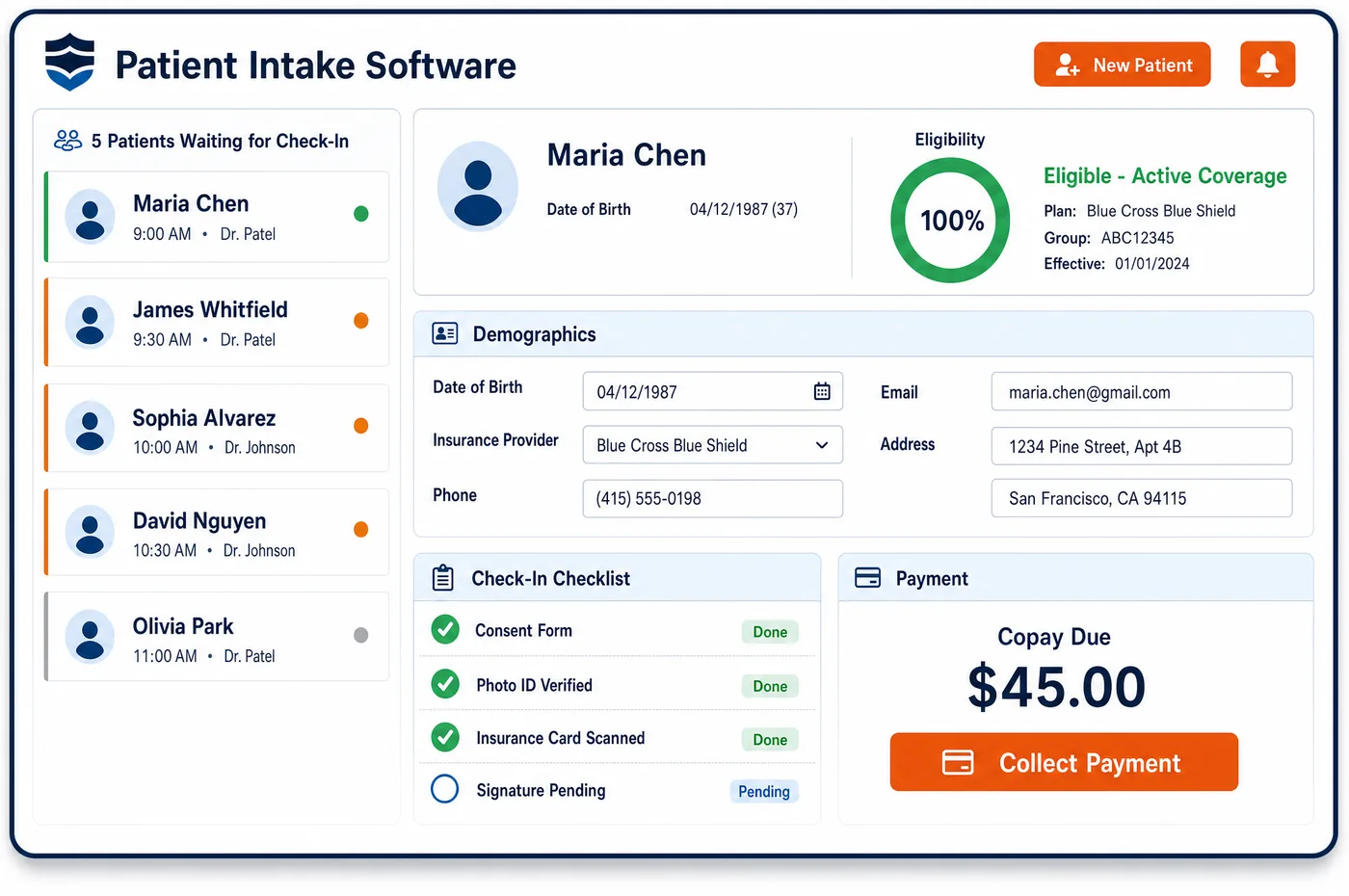
Patient Registration in a Clinical Research Practice
Registration at a research site has two jobs. It has to set up a clean patient record, and it has to find out which payer will see trial claims. Front-desk staff check whether the person is already a patient before creating a record, since many participants are referred from the site's own clinics. They collect the insurance card and confirm the plan type. That step matters most for Medicare members. Original Medicare pays routine trial costs even for people in Medicare Advantage. An Advantage plan, though, pays for care in an approved device (IDE) study. Medicaid and commercial plans have their own rules. Staff also record the sponsor's subject number next to the medical record number, so research and billing staff can match the same person. Clinical research patient registration ends with a record that can carry a study enrollment and a coverage picture that billing can trust.
Why Is Patient Registration Different in Clinical Research?
Many people who join a trial are already patients somewhere in the practice. Others come from outside referrals or advertising and have never been seen. Registration has to tell these groups apart, find the existing chart when there is one, and avoid making a second record. A duplicate chart splits the study history from the care history, and claims then go out with the wrong details.
The plan type decides who gets the claim. For a Medicare member, the first question is whether they are in Original Medicare or a Medicare Advantage plan. Routine costs in a qualifying drug trial go to the Medicare contractor even for Advantage members, but an approved device study bills the Advantage plan. A front desk that records only "Medicare" leaves billing to guess.
Research participants also include people a normal practice would not register as patients. Healthy volunteers may join as a control group in a diagnostic study. Some participants are seen only for study visits and get all other care elsewhere. Clinical research patient registration has to hold these people cleanly too, with the same identity checks and a clear note of why they are there.
What Clinical Research Patient Registration Software Handles
- Original Medicare or Medicare Advantage
- For qualifying trials, Original Medicare pays routine costs for Advantage members too, and the plan pays the member any cost-sharing gap. Staff record the exact plan type at sign-up, not just "Medicare". (CMS Medicare Managed Care Manual, Chapter 4, Section 10.7 (Clinical Trials))
- Approved IDE studies for Advantage members
- Medicare Advantage plans pay for routine care in CMS-approved Category A and B device studies and for approved Category B devices. Registration notes the plan, so device study claims for these members go to the plan. (CMS Medicare Managed Care Manual, Chapter 4, Section 10.7 (Clinical Trials))
- No plan approval to join a qualifying trial
- An Advantage plan may not require prior authorization for a member to join a qualifying trial it does not sponsor. It may ask, but not require, to be told in advance. Staff can note when the member has told the plan. (CMS Medicare Managed Care Manual, Chapter 4, Section 10.7 (Clinical Trials))
- Commercial plan rules for trials
- Group and individual plans may not deny routine patient costs for a qualified person in an approved trial. The trial must be for cancer or another life-threatening condition. A plan may require an in-network provider if one will accept the person, so network status is recorded. (42 U.S.C. 300gg-8 (Public Health Service Act section 2709): Coverage for individuals participating in approved clinical trials)
- Healthy volunteers and controls
- Medicare covers healthy volunteers only in a qualifying diagnostic study that needs a proper control group, not in a therapeutic trial. Registration notes when a participant is a control, which is what diagnosis code Z00.6 describes. (CMS Medicare Claims Processing Manual, Chapter 32, Section 69.6 (Requirements for Billing Routine Costs of Clinical Trials))
- Medicaid participants
- Medicaid covers routine costs in qualifying trials for serious or life-threatening conditions when the service would be covered outside the trial. Staff record the state program and any managed care plan, since how plans handle the benefit varies by state. (CMS State Medicaid Director Letter SMD #21-005: Mandatory Medicaid Coverage of Routine Patient Costs in Qualifying Clinical Trials)
How Does Clinical Research Patient Registration Software Work?
1. Search before creating a record
Staff search by name, birth date and identifiers to find an existing chart. Referred patients keep their chart, and new people get one record that clinical research patient management builds on.
2. Collect identity and demographics
Name, birth date, address and contact details are taken from the participant and an ID. Correct patient demographics keep claims from rejecting later.
3. Capture insurance and plan type
Staff scan the card and record the exact plan type, including Advantage or Medicaid managed care. A real-time eligibility check confirms the plan is active.
4. Add the study subject number
The sponsor's subject number is stored next to the medical record number. Research and billing staff can then find the same person by either one.
5. Hand off to intake
Once the record is set, consent and history forms go out through patient intake for trial participants. The study enrollment is added after consent is signed.
Clinical Research Patient Registration Software vs. Generic Software
| Area | Generic approach | Unlimited Systems |
|---|---|---|
| Duplicate charts | Referred patients get a new chart at the research desk. | Staff search first, and referred patients keep their existing chart. |
| Medicare plan type | Recorded as "Medicare" with no detail. | Original Medicare or the named Advantage plan is recorded. |
| Study subject number | Kept only in the sponsor's system. | Stored next to the medical record number. |
| Network status | Unknown until a commercial claim denies. | Recorded at sign-up for plans that may require an in-network provider. |
| Healthy volunteers | Registered like any new patient with no note. | Marked as controls so billing knows the study role. |
Who Uses It in a Clinical Research Practice
- Front desk: A short sign-up that finds the existing chart, captures the exact plan type and flags study participants clearly.
- Research coordinator: The subject number linked to the medical record, so study visits and the practice chart point to one person.
- Billing manager: Plan details that show up front which payer gets trial claims, which feeds financial clearance for studies.
Clinical Research Patient Registration Software FAQs
Patient registration for a trial participant captures identity, demographics, insurance and the exact plan type, plus the sponsor's subject number linked to the medical record. Staff search for an existing chart first, since many participants are already patients. The result is one record that can carry the study enrollment and tells billing which payer will see trial claims.
The exact Medicare plan type tells billing who pays. For a qualifying drug or treatment trial, Original Medicare pays routine costs even when the participant is in a Medicare Advantage plan. For an approved device study, the Advantage plan pays. Recording only that the person has Medicare leaves the billing team to guess, and guesses lead to denials.
A Medicare Advantage plan may not require prior authorization for a member to join a qualifying trial that the plan does not sponsor, and it may not put up barriers to joining. It may ask the member to tell it in advance, but cannot require it. The member keeps the right to choose which qualifying trials to join.
Under federal law, group and individual health plans may not deny or limit coverage of routine patient costs for a qualified person in an approved trial for cancer or another life-threatening condition. The plan does not have to pay for the investigational item itself or data-only services. It may require the person to use an in-network provider that will accept them.
Healthy volunteers are registered with the same identity and demographic checks as any patient, plus a note that they are study controls. Medicare covers healthy volunteers only in a qualifying diagnostic study that needs a control group. Marking their role at sign-up helps billing apply the right diagnosis code and coverage rules.
The sponsor gives each participant a subject number that appears on study records instead of their name. Storing it next to the medical record number lets research staff and billing staff find the same person, match sponsor reports to the chart, and check that a service listed on a sponsor invoice belongs to the right participant.
Related Clinical Research Software
Front office
In the revenue cycle
Patient Registration for related specialties
Sources
- CMS Medicare Managed Care Manual, Chapter 4, Section 10.7 (Clinical Trials)
- 42 U.S.C. 300gg-8 (Public Health Service Act section 2709): Coverage for individuals participating in approved clinical trials
- CMS Medicare Claims Processing Manual, Chapter 32, Section 69.6 (Requirements for Billing Routine Costs of Clinical Trials)
- CMS State Medicaid Director Letter SMD #21-005: Mandatory Medicaid Coverage of Routine Patient Costs in Qualifying Clinical Trials
- CMS National Coverage Determination 310.1: Routine Costs in Clinical Trials
GET STARTED
See Unlimited Systems in Action
Whether you're actively evaluating new technology or simply preparing for your next vendor renewal, Unlimited Systems can help you understand where your current workflows may be creating avoidable revenue risk.