

Billing & claims
Dermatology Charge Validation Software
Check modifiers, global periods, covered diagnoses and documentation on every skin charge before the claim goes out.
Dermatology Charge Validation Software tests each skin charge against the note, the coding rules and the payer's policy before it reaches a claim. It looks for same-day visit and procedure conflicts, global period overlaps, diagnoses that do not support the procedure, missing lesion counts and cosmetic services that were coded as covered care.



 6,500+ specialty providers

Charge Validation in a Dermatology Practice
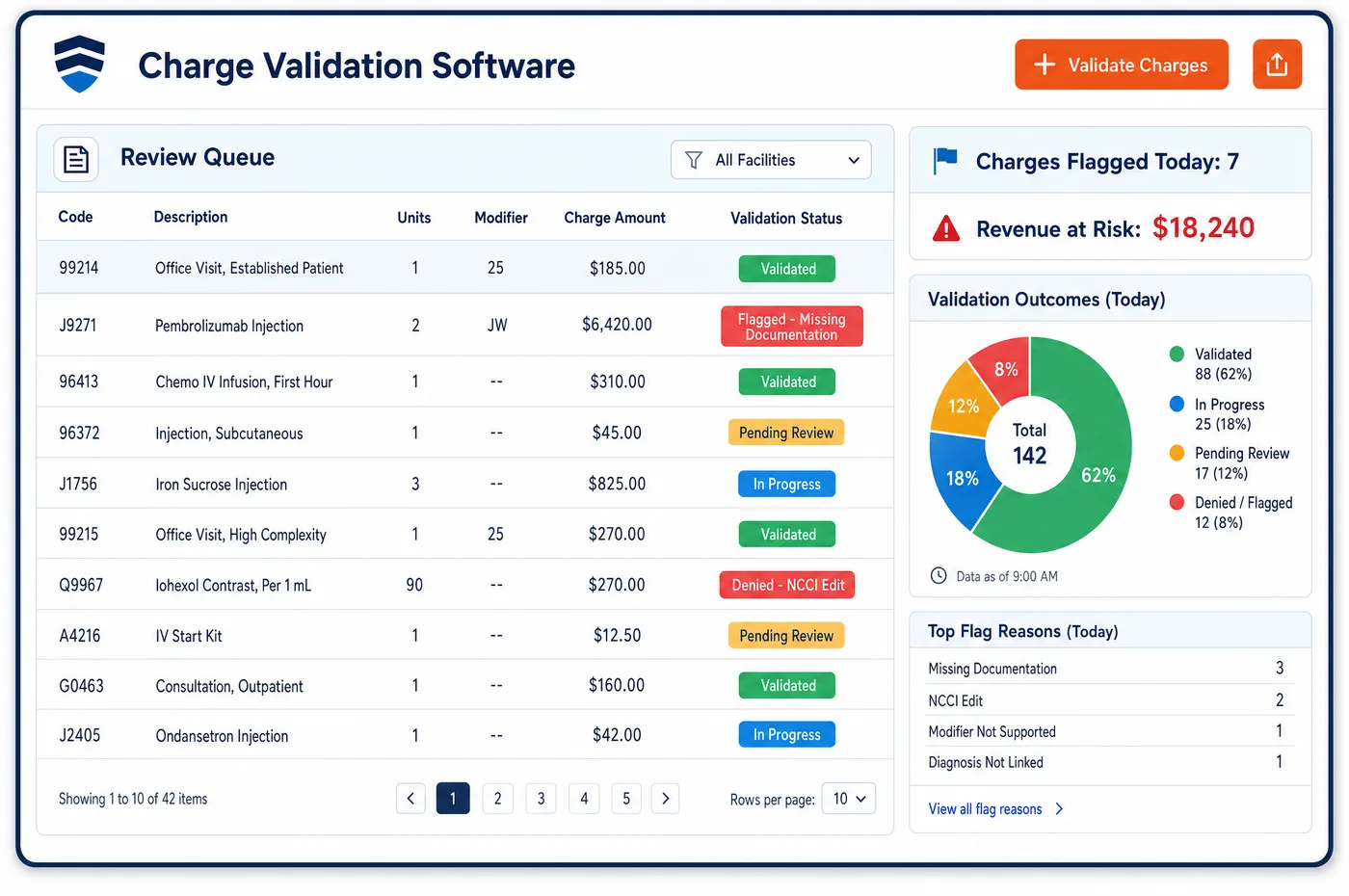
Skin charges fail in predictable ways. A visit is billed on the day of a minor procedure without a reason it stands apart. A wound check is charged inside a global period. A benign lesion is removed and coded with a diagnosis that does not show a symptom. A biopsy add-on is billed with no lesion count in the note. A biologic is billed after its approval has ended. Dermatology charge validation software catches these before submission. The practice sets rules from payer policies, Medicare coverage articles and its own lessons from past denials. Each rule fires on a charge and puts it in a review queue with the reason beside it. A biller or coder reads the note, fixes the line or asks the provider a question, and clears the flag. Because the checks run before the claim exists, errors are fixed once, at the cheapest point, and the claim set that leaves is cleaner. The charge assembly step feeds this queue.
Why Is Charge Validation Different in Dermatology?
Dermatology has a high volume of low-value lines. A short visit with one biopsy is worth little, so a single denial or a single missed modifier takes a large share of the payment. Practices cannot afford to review every line by hand, which is why rules that find the risky charges matter so much for charge validation here.
Each global period and same-day visit is a trap for charge validation. Many skin procedures carry a 000 or 010 global indicator under Medicare, and related recovery visits are paid within the procedure. A visit on the day of a procedure is paid only when it is significant and separately identifiable. Rules that compare the dates and codes catch these before a payer does.
Medical necessity separates covered from cosmetic. Contractors publish what must be documented to support removal of a benign lesion, destruction of actinic keratoses or a Mohs case. A charge that lacks those details will be denied, and a charge that is truly cosmetic must be moved to self-pay before the patient is surprised by a bill.
What Dermatology Charge Validation Software Handles
- Global period overlaps
- Medicare gives each procedure a 000, 010 or 090 global indicator, and related follow-up in that period is not paid separately. Rules flag a visit charge that falls inside an open global period for the same patient and provider. (CMS MLN Booklet MLN907166: Global Surgery)
- Modifier 25 on same-day visits
- A visit on the day of a minor procedure needs modifier 25 and a note that shows a significant, separately identifiable service. The check pairs the visit and procedure lines and lists the note for review. (CMS MLN Booklet MLN907166: Global Surgery)
- Benign lesion removal support
- WPS covers removal of benign lesions when the record shows bleeding, itching, pain, inflammation, a change in appearance or concern for cancer. Charges without a documented reason go to review and may be moved to cosmetic. (CMS Medicare Coverage Database, LCD L35498: Removal of Benign Skin Lesions (WPS))
- Actinic keratosis destruction
- NCD 250.4 covers destruction of actinic keratoses under Medicare without limits based on lesion or patient traits. Rules check that the diagnosis matches the procedure and that the treated lesion count is in the note. (CMS National Coverage Determination 250.4: Treatment of Actinic Keratosis)
- Mohs coding by site and stage
- The CGS article on Mohs surgery sets billing and coding rules for the procedure. Rules check that the site code fits the body area, the stage lines are in order and the surgeon's notes support each stage. (CMS Medicare Coverage Database, Billing and Coding Article A56836: Mohs Micrographic Surgery (CGS))
- Biopsy add-on counts (11102–11107)
- Each biopsy technique has an add-on code for further lesions. Rules compare the add-on units to the lesion count in the note and the specimen list. (Federal Register: CY 2019 Physician Fee Schedule final rule, skin biopsy codes 11102–11107 (83 FR 59452, at 59522))
- Biologic approval match
- UnitedHealthcare approves dupilumab for a set term. Rules compare the date of service to the approval's end date so drug charges after it ends are held. (UnitedHealthcare Pharmacy Clinical Program 2026 P 2116-24: Dupixent (dupilumab) Prior Authorization/Medical Necessity)
- Cosmetic services off claims
- The Medicare benefit manual excludes cosmetic surgery except in narrow repair cases. Rules find cosmetic services that were coded as medical and route them to self-pay. (CMS Medicare Benefit Policy Manual, Chapter 16: General Exclusions from Coverage (section 120, Cosmetic Surgery))
How Does Dermatology Charge Validation Software Work?
1. Receive the draft charges
Charges arrive from assembly with codes, quantities, sites and diagnoses. Rules run on each line and on the set as a whole.
2. Fire the rules
Rules for global periods, modifiers, covered diagnoses, lesion counts and approvals test each charge. A charge that fails is placed in a queue with the reason shown.
3. Review with the note
A biller or coder opens the charge next to the provider's note. They fix the code, add the modifier, ask the provider a question or move the service to self-pay.
4. Clear and release
Once each flag is resolved, the charge is released to the claim. The fix and the reason are logged, so staff can see what changed.
5. Tune the rules
Managers review which rules fire most and which denials still get through. They add or adjust rules, and the next batch of charges is held to the new standard.
Dermatology Charge Validation Software vs. Generic Software
| Area | Generic approach | Unlimited Systems |
|---|---|---|
| Timing of checks | Errors found after denial. | Charges tested before the claim exists. |
| Global periods | Tracked from memory. | Open periods compared to each new visit charge. |
| Modifier use | Added without a review. | Same-day pairs shown with the note. |
| Coverage criteria | Learned one denial at a time. | Documentation rules built from payer and contractor policy. |
| Rule updates | Lists that go stale. | Rules adjusted from denial patterns. |
Who Uses It in a Dermatology Practice
- Coder: A queue of flagged charges with the reason and the note side by side, so review is quick and consistent.
- Billing manager: A report of which rules fire most and which payers deny what, to steer denial prevention work.
- Dermatologist: Targeted questions about specific charges, instead of a long list of coding queries after the claims go out.
Dermatology Charge Validation Software FAQs
Dermatology charge validation checks each skin charge against the note, the coding rules and the payer's policy before the claim is built. It looks at global periods, same-day visit and procedure pairs, covered diagnoses, lesion counts, approvals and cosmetic coding, and puts any charge that fails into a review queue.
Global period conflicts are found by comparing each new visit charge with open global periods for the same patient and provider. Medicare gives procedures a 000, 010 or 090 indicator, and related recovery visits are included in the procedure payment. A flagged visit is reviewed before it reaches a claim.
Modifier 25 is appropriate when a visit on the day of a minor procedure is significant and separately identifiable from the procedure. Under Medicare, a routine pre-procedure assessment is part of the procedure. The check shows the note beside the visit line so a coder can confirm that the visit stands on its own.
Validation handles benign lesion removal by checking that the record documents a reason that payers cover. WPS lists bleeding, itching, pain, inflammation, a change in appearance and concern for cancer. A charge without one of these signs goes to review and may be moved to a cosmetic quote.
Validation can stop a drug charge after an approval ends by comparing the date of service to the approval's end date. Plans such as UnitedHealthcare approve dupilumab for a set term and ask for proof of response at renewal. A charge past the end date is held for staff.
Validating charges before the claim is built means each error is fixed once, at the point where it costs least. Errors found after submission mean a rejection or a denial, a second review and a resubmission. Skin visits are often low in value, so those extra steps can cost more than the claim earns.
Related Dermatology Software
Billing & claims
In the revenue cycle
Charge Validation for related specialties
Sources
- CMS MLN Booklet MLN907166: Global Surgery
- CMS Medicare Coverage Database, LCD L35498: Removal of Benign Skin Lesions (WPS)
- CMS National Coverage Determination 250.4: Treatment of Actinic Keratosis
- CMS Medicare Coverage Database, Billing and Coding Article A56836: Mohs Micrographic Surgery (CGS)
- Federal Register: CY 2019 Physician Fee Schedule final rule, skin biopsy codes 11102–11107 (83 FR 59452, at 59522)
- UnitedHealthcare Pharmacy Clinical Program 2026 P 2116-24: Dupixent (dupilumab) Prior Authorization/Medical Necessity
- CMS Medicare Benefit Policy Manual, Chapter 16: General Exclusions from Coverage (section 120, Cosmetic Surgery)
GET STARTED
See Unlimited Systems in Action
Whether you're actively evaluating new technology or simply preparing for your next vendor renewal, Unlimited Systems can help you understand where your current workflows may be creating avoidable revenue risk.