

Billing & claims
Dermatology Medical Billing Software
Turn skin visits, biopsies, Mohs cases and drug administration into clean claims, and track each one until it is paid.
Dermatology Medical Billing Software builds claims from the services a skin practice documents and sends them to payers electronically. It checks diagnoses, modifiers and procedure codes before submission, holds claims that wait on pathology, tracks each claim after it leaves, and keeps cosmetic services off insurance bills.



 6,500+ specialty providers

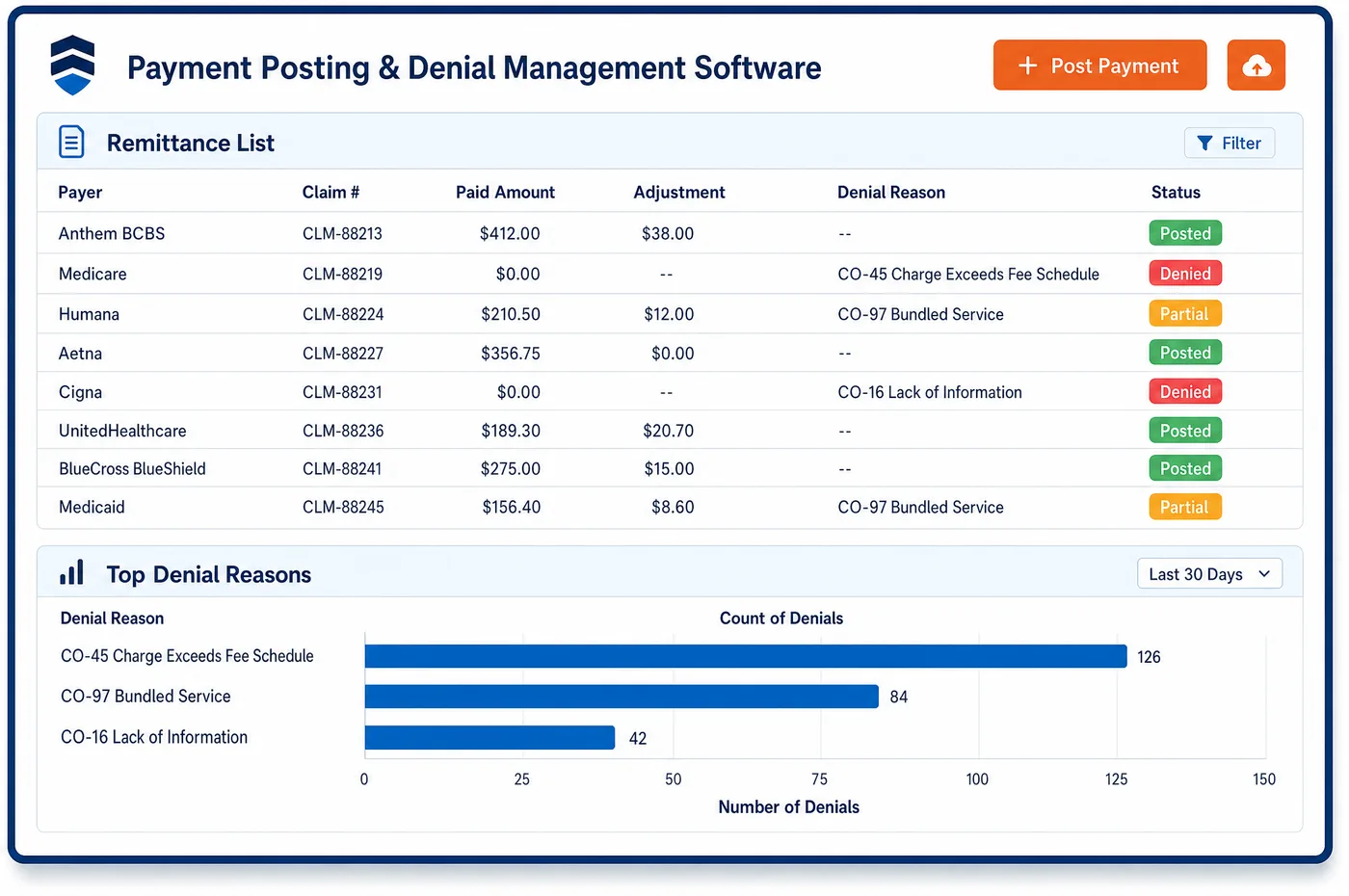
Medical Billing in a Dermatology Practice
Medical billing for a skin practice is claim work with a few sharp edges. A visit and a procedure on the same day need the right modifier. A biopsy claim has to match the pathology report. A Mohs case carries site and stage codes. A lesion removal must show a covered reason. A drug claim must match an approval. Dermatology medical billing software gathers the visit, the procedures and the diagnoses into a claim, runs a claim scrub against payer rules, and sends it through the clearinghouse. Rejections come back to a queue with the reason attached, so staff can fix and resend. Status checks show whether a claim was accepted, is being processed or has been paid. The same ledger feeds the RCM view, so a manager can see which claims are stuck and which payer is slow. Cosmetic services are billed to the patient, never to an insurance carrier.
Why Is Medical Billing Different in Dermatology?
The note drives the claim, and skin notes are dense. One visit may include an exam, a biopsy of two lesions, a destruction of actinic keratoses and a wound check from last week. Billing each piece correctly means separating what is paid on its own from what is included in something else. Medical billing for dermatology depends on staff who can read that note and build the claim to match.
Pathology changes the picture after the visit. The diagnosis a dermatologist writes at the time of a biopsy is a working one. The lab report confirms or replaces it. A claim sent too early may carry a diagnosis that no longer fits, and the payer may question medical necessity. Practices handle this by holding some claims until the report is in, or by correcting the diagnosis when it arrives.
Payers apply different rules to the same service. Medicare contractors publish coverage articles for Mohs surgery and benign lesion removal. Commercial plans publish their own policies for biologics and light therapy. A claim that passes one payer's edits can fail another's, so billing staff need payer-aware checks before submission, not after the denial.
What Dermatology Medical Billing Software Handles
- Modifier 25 on same-day visits
- Under Medicare, an evaluation and management service on the day of a minor procedure is paid only when it is significant and separately identifiable, which is reported with modifier 25. The claim check flags these pairs so staff confirm the note supports both. (CMS MLN Booklet MLN907166: Global Surgery)
- Biopsy base and add-on codes
- Skin biopsy codes are split by technique into tangential, punch and incisional, with add-on codes for each additional lesion. The claim lists the base code once and the add-on for each extra lesion sampled. (Federal Register: CY 2019 Physician Fee Schedule final rule, skin biopsy codes 11102–11107 (83 FR 59452, at 59522))
- Mohs claims by site and stage
- Mohs billing separates the head, neck, hands, feet and genitalia from the trunk, arms and legs, and bills later stages with their own codes. The claim is built from the surgeon's stage notes. (CMS Medicare Coverage Database, Billing and Coding Article A56836: Mohs Micrographic Surgery (CGS))
- Benign lesion removal claims
- WPS covers benign lesion removal when the record shows signs such as bleeding, itching or pain, or a change in appearance. Claims for removals without those signs are held and the patient is told the service is cosmetic. (CMS Medicare Coverage Database, LCD L35498: Removal of Benign Skin Lesions (WPS))
- Actinic keratosis destruction
- NCD 250.4 covers destruction of actinic keratoses under Medicare. The claim lists the diagnosis and the treated lesion count, so the payer can see the service matches the policy. (CMS National Coverage Determination 250.4: Treatment of Actinic Keratosis)
- Clinical trial claims
- Medicare asks that claims for services in a qualifying clinical trial carry the trial's registry number, with modifier Q1 for routine services and Q0 for investigational ones. Staff add these before the claim goes out. (CMS Medicare Claims Processing Manual, Chapter 32, section 69: Qualifying Clinical Trials)
- Claim and status transactions
- HIPAA adopts ASC X12N 837 for claims, 276 and 277 for claim status, and 835 for remittance advice. Staff use these to submit, check and reconcile each claim. (CMS: Adopted Standards and Operating Rules (HIPAA transactions))
How Does Dermatology Medical Billing Software Work?
1. Build the claim from the note
The visit, procedures, diagnoses and specimen list become claim lines. Staff review modifiers and the order of diagnoses against what the provider documented.
2. Run payer-aware checks
Each claim is tested against general rules and the rules the practice has set for its payers. Problems such as a missing modifier or a global period conflict are listed for staff before the claim leaves.
3. Hold or release by pathology
Claims that depend on a lab report wait on a list. When the report arrives, staff confirm the diagnosis and release the claim.
4. Submit through the clearinghouse
Claims go out electronically. Rejections return to a queue with the reason, so staff can correct and resend the same day.
5. Track status to payment
Staff check claim status, post the remittance and move unpaid claims into denial work when a payer refuses them.
Dermatology Medical Billing Software vs. Generic Software
| Area | Generic approach | Unlimited Systems |
|---|---|---|
| Claim building | Charges typed from a paper superbill. | Claims built from the documented visit and procedures. |
| Modifiers | Added by memory. | Same-day pairs flagged for review before submission. |
| Pathology | Claim sent before the report arrives. | Claim held or corrected when results come in. |
| Payer rules | Learned from denials. | Checked before the claim goes out. |
| Cosmetic services | Mixed in with insurance charges. | Billed to the patient and kept off claims. |
Who Uses It in a Dermatology Practice
- Biller: Claims assembled from the note with modifier and global period checks, and a clear list of rejections to fix.
- Billing manager: A view of claims by status, payer and age, so stuck claims are found early and tied back to revenue cycle causes.
- Dermatologist: Fewer questions from billing, because the note is turned into claim lines with the diagnosis and procedure details already matched.
Dermatology Medical Billing Software FAQs
Dermatology medical billing involves turning visits, biopsies, excisions, destructions, Mohs cases and drug administration into claims that match the note and the payer's rules. It includes modifier use, diagnosis matching to pathology, coverage checks for lesion removal and tracking each claim until payment is posted.
Modifier 25 is used when an evaluation and management visit is significant and separately identifiable from a minor procedure on the same day. Under Medicare, the visit is otherwise included in the procedure payment. Staff review these pairs against the note before the claim goes out.
Biopsy claims are built from the technique in the note: tangential, punch or incisional. Each technique has a base code and an add-on for further lesions. The claim carries the diagnosis, and staff update it to match the pathology report when the lab result arrives.
A claim is held for pathology when its diagnosis depends on the lab report. The working diagnosis at the visit may differ from the final one, and a mismatch can trigger a medical necessity denial. Staff keep these claims on a list and release them after confirming the result.
Medical billing handles cosmetic services by keeping them off insurance claims. Medicare excludes cosmetic surgery except in narrow repair cases, so these charges carry a self-pay flag. The patient receives an estimate first and pays on the account, and no claim is sent to a payer.
Medical billing software can track claim status through the HIPAA-adopted 276 and 277 transactions. Staff check whether a claim was received, is in process or was paid, and the remittance is posted when it arrives. Claims that stall are moved to a follow-up list.
Related Dermatology Software
Billing & claims
In the revenue cycle
Medical Billing for related specialties
Sources
- CMS MLN Booklet MLN907166: Global Surgery
- Federal Register: CY 2019 Physician Fee Schedule final rule, skin biopsy codes 11102–11107 (83 FR 59452, at 59522)
- CMS Medicare Coverage Database, Billing and Coding Article A56836: Mohs Micrographic Surgery (CGS)
- CMS Medicare Coverage Database, LCD L35498: Removal of Benign Skin Lesions (WPS)
- CMS National Coverage Determination 250.4: Treatment of Actinic Keratosis
- CMS Medicare Claims Processing Manual, Chapter 32, section 69: Qualifying Clinical Trials
- CMS: Adopted Standards and Operating Rules (HIPAA transactions)
GET STARTED
See Unlimited Systems in Action
Whether you're actively evaluating new technology or simply preparing for your next vendor renewal, Unlimited Systems can help you understand where your current workflows may be creating avoidable revenue risk.