

Billing & claims
Dermatology Charge Assembly Software
Turn procedure notes, specimen lists and treatment logs into coded charge lines for biopsies, destructions, Mohs stages, light therapy and drugs.
Dermatology Charge Assembly Software gathers each documented skin service from a visit into coded charge lines. It pairs the visit with the biopsies, destructions, excisions, Mohs stages, light therapy sessions or drug injections that happened, and passes the set to review with diagnoses, modifiers and quantities attached.



 6,500+ specialty providers

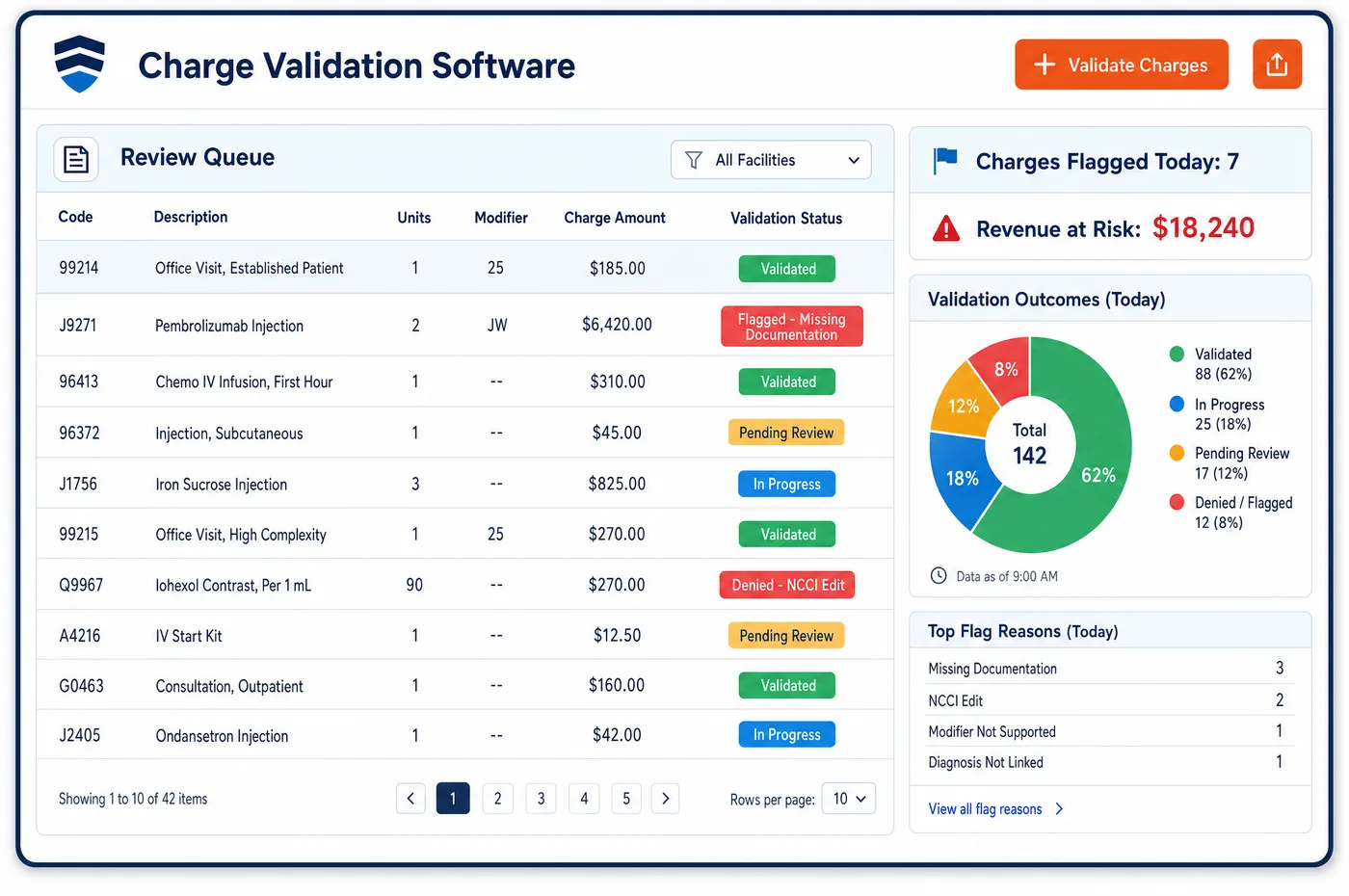
Charge Assembly in a Dermatology Practice
A single skin visit can hold many services. A patient comes in for a full body exam, the dermatologist freezes three actinic keratoses, takes a punch biopsy of one lesion and a tangential biopsy of another, and injects a steroid into a scar. Each of those has a different code, and some carry add-on codes. Dermatology charge assembly software starts from the clinical note and the procedure log and builds the charge lines for the encounter. It counts lesions, picks the technique from the note, attaches the body site, links each line to its diagnosis and lists any specimen sent to pathology. Staff see the draft lines next to the note and can correct a count or a site before anything moves on. The set then goes to charge validation for edits and payer rules. Cosmetic services are kept as self-pay lines. This step is where lost revenue is easiest to prevent, because a service that never becomes a charge is never billed.
Why Is Charge Assembly Different in Dermatology?
Skin notes describe many small services. A dermatologist may treat a dozen lesions in one visit, and the note says only a few words about each. The charge lines depend on counts, sizes and body sites that are easy to leave out. Charge assembly for dermatology has to pull these details from the note and the procedure log, or the claim ends up with the wrong code or no code at all.
Coding in this field turns on specifics. Biopsy codes change with the technique. Destruction codes change with the lesion type and number. Mohs codes change with the body site and the stage. Excision codes change with the size and the margin. A charge built from a one-line summary will often be the wrong code, even if every service was really done.
Drugs and light therapy add another layer. Injected drugs need a product and a quantity. Light therapy needs the type of treatment and the area. And everything cosmetic must be pulled out and kept apart. A charge assembly step that handles all of this lets the biller review a finished draft, not start from a blank claim.
What Dermatology Charge Assembly Software Handles
- Biopsy technique and add-ons (11102–11107)
- Tangential biopsy is 11102 with add-on 11103, punch is 11104 with 11105, and incisional is 11106 with 11107. The draft lines use the technique in the note and add one add-on line for each further lesion. (Federal Register: CY 2019 Physician Fee Schedule final rule, skin biopsy codes 11102–11107 (83 FR 59452, at 59522))
- Mohs charges by site and stage (17311–17314)
- Codes 17311 and 17312 cover the head, neck, hands, feet and genitalia, and 17313 and 17314 cover the trunk, arms and legs. The first stage and later stages are separate lines, built from the surgeon's stage notes. (CMS Medicare Coverage Database, Billing and Coding Article A56836: Mohs Micrographic Surgery (CGS))
- Same-day visit and procedure
- Medicare includes an evaluation and management visit on the day of a minor procedure in the procedure payment, unless the visit is significant and separately identifiable. The draft lists both lines and marks the pair for modifier review. (CMS MLN Booklet MLN907166: Global Surgery)
- Benign lesion removal lines
- WPS covers removal of benign lesions when the record documents signs such as bleeding, pain or a change in appearance. The draft links each removal to the documented reason, or flags it as cosmetic. (CMS Medicare Coverage Database, LCD L35498: Removal of Benign Skin Lesions (WPS))
- Actinic keratosis destruction
- Medicare covers destruction of actinic keratoses under NCD 250.4. Lesion counts and treatment method from the note become the charge lines and their diagnoses. (CMS National Coverage Determination 250.4: Treatment of Actinic Keratosis)
- Light therapy and laser sessions
- Aetna's policies list narrowband UVB under 96900, Goeckerman under 96910, PUVA under 96912, and excimer laser under 96920 to 96922 by area treated. The draft uses the treatment and area from the session log. (Aetna Clinical Policy Bulletin 0205: Phototherapy and Photochemotherapy (PUVA) for Skin Conditions)
- Cosmetic lines kept apart
- The Medicare benefit manual excludes cosmetic surgery except in narrow repair cases. Cosmetic services become self-pay charge lines with their own price from the practice's fee schedule. (CMS Medicare Benefit Policy Manual, Chapter 16: General Exclusions from Coverage (section 120, Cosmetic Surgery))
How Does Dermatology Charge Assembly Software Work?
1. Read the note and the log
The provider's note, the procedure log and the specimen list are the sources. Staff and rules look for each service, its count, its site and its method.
2. Build the draft lines
Each service becomes a charge line with a code, a quantity, a body site and a linked diagnosis. Add-on lines follow their base codes, and the draft keeps lines in a clear order.
3. Separate cosmetic from covered
Services that are cosmetic become self-pay lines with a quoted price. They are kept out of the claim set, so they do not reach a payer.
4. Flag gaps for the provider
When a count, a site or a technique is missing, the draft shows the gap. The provider or an assistant fixes the note, and the lines update. The charge capture step is complete only when no gaps remain.
5. Send to review
The completed set goes to charge review for edits and payer rules. Nothing is billed before that step is done.
Dermatology Charge Assembly Software vs. Generic Software
| Area | Generic approach | Unlimited Systems |
|---|---|---|
| Source of charges | A paper superbill ticked by hand. | Draft lines built from the note and procedure log. |
| Lesion counts | Estimated or left off. | Counted from the note and shown beside each line. |
| Mohs stages | Billed from memory after the case. | Built from the surgeon's stage notes by site. |
| Cosmetic services | Mixed in with covered care. | Self-pay lines kept apart from claims. |
| Missed services | Found weeks later, if at all. | Gaps flagged to the provider the same day. |
Who Uses It in a Dermatology Practice
- Medical assistant or scribe: A draft of charge lines to check against the visit, so counts and sites are fixed while the details are fresh.
- Biller: Charge lines that arrive complete, with each service linked to a diagnosis and a body site before claim work begins.
- Dermatologist: A short list of gaps to clear at the end of the day, rather than coding questions weeks later.
Dermatology Charge Assembly Software FAQs
Charge assembly for a dermatology practice means turning the documented services from a visit into coded charge lines. It covers biopsies, destructions, excisions, Mohs stages, light therapy and drug injections. Each line gets a code, a quantity, a body site and a diagnosis, so the claim reflects what was done.
Charge assembly counts lesions from the note and the procedure log. Biopsy add-on codes depend on how many extra lesions were sampled, and destruction codes depend on the number treated. When the count is missing, the draft flags the gap so the provider can supply it before billing.
Mohs charges are assembled by body site and stage. Codes 17311 and 17312 cover the head, neck, hands, feet and genitalia, while 17313 and 17314 cover the trunk, arms and legs. Later stages carry their own lines, built from the surgeon's notes for each stage of the case.
Cosmetic services can be kept off the claim by building them as self-pay charge lines. Medicare excludes cosmetic surgery from coverage except in narrow repair cases. These lines carry a quoted price and go to the patient account, so no payer receives them.
When a note is missing a detail, the draft shows the gap beside the affected line. A missing lesion count, body site or technique is sent back to the provider or assistant. Once the note is fixed, the lines update, and the set moves on to review.
Charge assembly covers light therapy sessions by using the treatment type and area from the session log. Narrowband UVB, Goeckerman and PUVA have different codes, and excimer laser is coded by the area treated. The line also links to the approval, so sessions beyond the approved count are seen.
Related Dermatology Software
Billing & claims
In the revenue cycle
Charge Assembly for related specialties
Sources
- Federal Register: CY 2019 Physician Fee Schedule final rule, skin biopsy codes 11102–11107 (83 FR 59452, at 59522)
- CMS Medicare Coverage Database, Billing and Coding Article A56836: Mohs Micrographic Surgery (CGS)
- CMS MLN Booklet MLN907166: Global Surgery
- CMS Medicare Coverage Database, LCD L35498: Removal of Benign Skin Lesions (WPS)
- CMS National Coverage Determination 250.4: Treatment of Actinic Keratosis
- Aetna Clinical Policy Bulletin 0205: Phototherapy and Photochemotherapy (PUVA) for Skin Conditions
- Aetna Clinical Policy Bulletin 0577: Laser Treatment for Psoriasis and Other Selected Skin Conditions
- CMS Medicare Benefit Policy Manual, Chapter 16: General Exclusions from Coverage (section 120, Cosmetic Surgery)
GET STARTED
See Unlimited Systems in Action
Whether you're actively evaluating new technology or simply preparing for your next vendor renewal, Unlimited Systems can help you understand where your current workflows may be creating avoidable revenue risk.