

Front office
Dermatology Patient Scheduling Software
Book each skin visit at the length and in the room it needs, from a quick lesion check to a Mohs day or a light therapy course.
Dermatology Patient Scheduling Software books each kind of skin visit with the right time, room and supplies. Full body skin checks, procedure visits, Mohs days, phototherapy sessions and cosmetic treatments each get their own appointment type, so the day runs smoothly and the visit reaches billing with the right setup.



 6,500+ specialty providers
Patient Scheduling in a Dermatology Practice
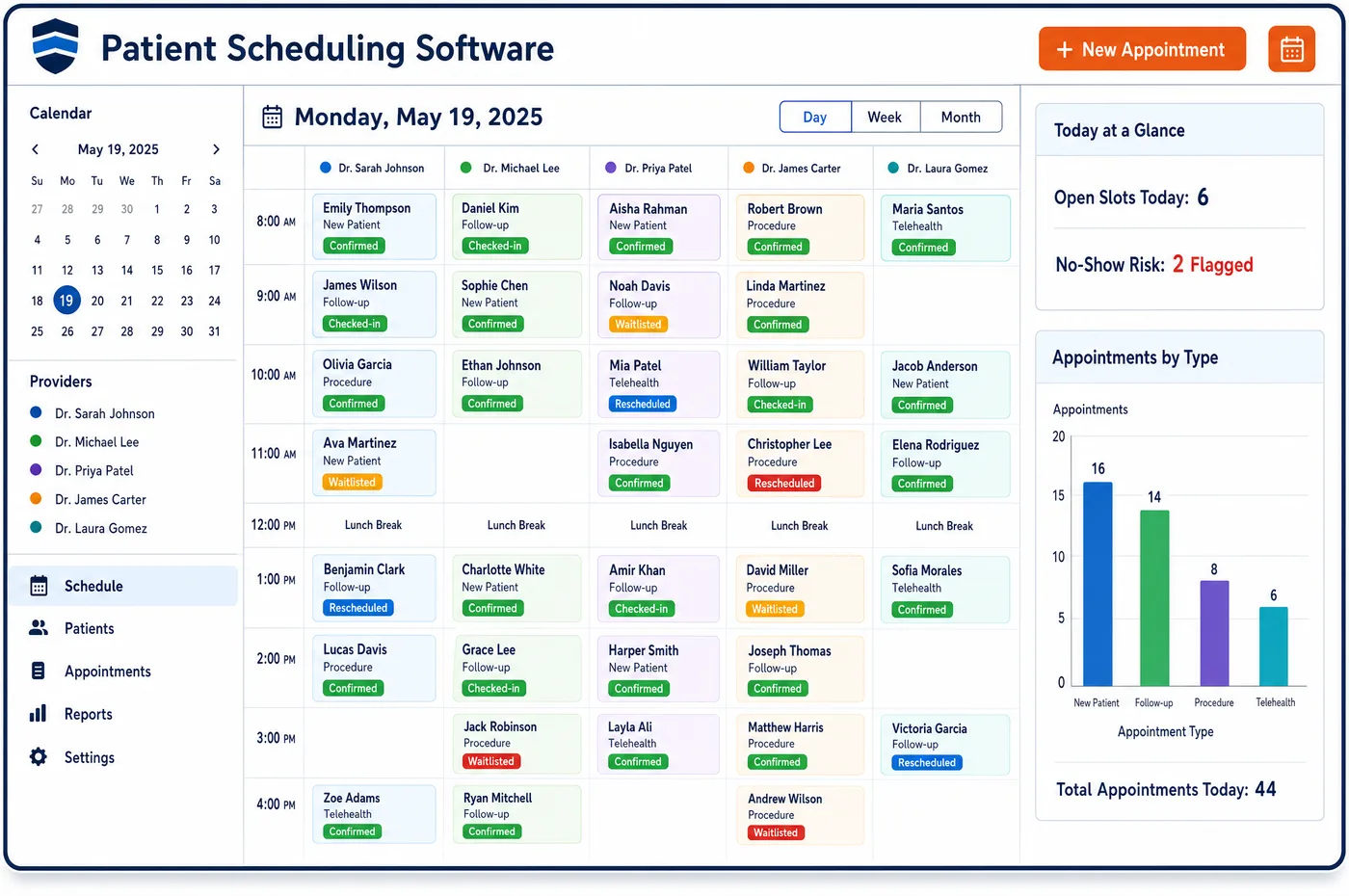
A skin schedule mixes very different work. A quick check on a rash takes a few minutes. A full body skin exam takes longer and may end in several biopsies. A Mohs day holds a surgeon, a lab technician and a patient for hours while tissue is read between stages. A phototherapy course needs a booth and a short slot several times a week. A cosmetic treatment needs a room, a device and a deposit. Dermatology patient scheduling software gives every one of these an appointment type with a default length, a room or device, and a set of rules. Staff can leave a slot open for a biopsy add-on, hold a block for surgery, keep a list of patients who want an earlier date, and see at a glance which visits still lack an approval. Reminders go out by text or email, so fewer slots sit empty.
Why Is Patient Scheduling Different in Dermatology?
Patient scheduling in a skin clinic has to allow for visits that grow in the room.A patient booked for a rash mentions a changing mole, and the dermatologist decides to biopsy it that day. A schedule built on fixed slots has no place for the extra time. Templates that leave short open blocks, and appointment types that allow a procedure to be added, keep the clinic on time without double booking the next patient.
Surgery days are different from clinic days. Mohs surgery is done in stages, and nobody knows at the start how many stages will be needed. The surgeon, the lab technician and the repair all sit in one patient's day. A Mohs surgery block has to be booked with that in mind, with a longer hold and a clear plan for the afternoon if the case runs long.
Treatment courses make the calendar a billing tool. A patient on narrowband UVB comes in many times over the course, and a payer may approve only a fixed count of sessions. Patient scheduling that books the whole course at once, and checks each visit against the approval, protects the practice from giving care that will not be paid.
What Dermatology Patient Scheduling Software Handles
- Biopsy add-on slots (11102–11107)
- Skin biopsies are coded by technique, with add-on codes for each extra lesion sampled. Templates keep short open blocks so a same-visit biopsy fits, and staff pick the visit type that matches the planned technique. (Federal Register: CY 2019 Physician Fee Schedule final rule, skin biopsy codes 11102–11107 (83 FR 59452, at 59522))
- Mohs day blocks (17311–17314)
- Mohs codes differ by body site, and each stage after the first has its own code. The block is booked by site, with the surgeon, lab technician and room held together, and the stage count is recorded after the case. (CMS Medicare Coverage Database, Billing and Coding Article A56836: Mohs Micrographic Surgery (CGS))
- Global period follow-ups
- Medicare sets a 000, 010 or 090 global indicator for each procedure code, and routine follow-up in the global period is not paid on its own. Follow-up wound checks are booked as post-operative visits, not as new patient visits. (CMS MLN Booklet MLN907166: Global Surgery)
- Phototherapy course booking (96900, 96910, 96912)
- Aetna's policy lists narrowband UVB, Goeckerman and PUVA under separate codes and caps treatments per course. The course is booked as a series, and each session is counted against the approval. (Aetna Clinical Policy Bulletin 0205: Phototherapy and Photochemotherapy (PUVA) for Skin Conditions)
- Excimer laser sessions (96920–96922)
- Excimer laser is coded by the area treated, and Aetna limits the number of treatments per course. Staff book sessions on the laser's own schedule and check the count before each one. (Aetna Clinical Policy Bulletin 0577: Laser Treatment for Psoriasis and Other Selected Skin Conditions)
- Isotretinoin follow-up visits
- FDA's iPLEDGE program ties each prescription to a patient visit and to pregnancy test steps for patients who can become pregnant. Monthly follow-up slots are booked so the visit comes before the next prescription window. (U.S. Food and Drug Administration: iPLEDGE Risk Evaluation and Mitigation Strategy (REMS))
How Does Dermatology Patient Scheduling Software Work?
1. Build templates by provider and room
Each dermatologist, physician assistant and room gets a template with clinic blocks, procedure blocks and open time. Staff set the default length for each appointment type, so patient scheduling reflects real work and the patient record shows each booked visit.
2. Pick the appointment type at booking
The scheduler chooses a type such as new rash, skin check, procedure, Mohs day, light therapy or cosmetic. The type sets the length, the room or device and the supplies, and shows whether an approval is needed.
3. Hold visits that lack approval
Visits for biologic starts, light therapy and similar care are checked against clearance before they are confirmed. A visit with no approval stays on hold until it is cleared.
4. Remind and confirm
Text and email reminders go out ahead of each visit. A patient who cancels frees a slot that staff can offer to the next person on the waitlist.
5. Hand off to billing
The appointment type, provider, place and any related global period carry to the visit record. Billing sees whether a visit is a new service, a follow-up inside a global period or a self-pay cosmetic treatment.
Dermatology Patient Scheduling Software vs. Generic Software
| Area | Generic approach | Unlimited Systems |
|---|---|---|
| Slot length | One standard length for every visit. | A default length for each skin visit type. |
| Biopsy add-ons | Run over and push the whole afternoon back. | Short open blocks kept for same-visit procedures. |
| Mohs days | Booked like any surgery with a fixed end time. | Longer holds for surgeon, lab and repair together. |
| Light therapy | One visit booked at a time by the patient. | The full course booked and counted against the approval. |
| Cancellations | Empty slots found at the end of the day. | A waitlist worked as slots open. |
Who Uses It in a Dermatology Practice
- Front desk: Appointment types that set the length and room, with holds for missing approvals and a waitlist to fill gaps from patient outreach.
- Surgical coordinator: Mohs blocks booked by body site with the surgeon, lab technician and room held together, with the site rules for Mohs billing in view.
- Practice manager: A schedule that shows how much time goes to medical, surgical and cosmetic work, and where open slots are lost.
Dermatology Patient Scheduling Software FAQs
A dermatology schedule handles an added biopsy by keeping short open blocks inside clinic sessions. The dermatologist can sample a lesion at the same visit without running late. Biopsy codes depend on the technique used, so staff record the method afterward, and the add-on lesions are counted for the claim.
Mohs days are scheduled as longer blocks that hold the surgeon, the lab technician and the room together. The block is booked by body site, because Mohs codes differ for the head, neck, hands and feet versus the trunk and limbs. Nobody can know how many stages a case needs, so the afternoon plan allows for more.
A whole phototherapy course can be booked at once as a series of short visits on the booth's own schedule. Payers such as Aetna limit the number of treatments in a course, so each session is counted against the approval. This keeps the last few visits from being given without payment.
Scheduling stops wound checks from being billed as new visits by showing when a patient is inside a global period. For Medicare, minor procedures carry a 000 or 010 global indicator. A follow-up in that period is booked as a post-operative visit, which is part of the procedure payment.
Reminders help a skin practice by cutting no-shows and filling slots that cancel. Text and email reminders go out ahead of each visit, and a patient who cancels frees a slot for the waitlist. Staff can also prompt patients for pre-visit items, such as skipping creams before a patch test.
Scheduling helps with isotretinoin care by booking the follow-up before the patient leaves. The iPLEDGE program ties each prescription to a visit and required pregnancy test steps for patients who can become pregnant. Having the next slot already booked keeps the visit ahead of the prescription window.
Related Dermatology Software
Front office
In the revenue cycle
Patient Scheduling for related specialties
Sources
- Federal Register: CY 2019 Physician Fee Schedule final rule, skin biopsy codes 11102–11107 (83 FR 59452, at 59522)
- CMS Medicare Coverage Database, Billing and Coding Article A56836: Mohs Micrographic Surgery (CGS)
- CMS MLN Booklet MLN907166: Global Surgery
- Aetna Clinical Policy Bulletin 0205: Phototherapy and Photochemotherapy (PUVA) for Skin Conditions
- Aetna Clinical Policy Bulletin 0577: Laser Treatment for Psoriasis and Other Selected Skin Conditions
- U.S. Food and Drug Administration: iPLEDGE Risk Evaluation and Mitigation Strategy (REMS)
GET STARTED
See Unlimited Systems in Action
Whether you're actively evaluating new technology or simply preparing for your next vendor renewal, Unlimited Systems can help you understand where your current workflows may be creating avoidable revenue risk.