

Front office
Dermatology Patient Registration Software
Register skin patients once, with medical and pharmacy coverage, the right guarantor and a clear self-pay flag for cosmetic care.
Dermatology Patient Registration Software captures who the patient is and how their care will be paid, before the first skin visit. It records demographics, the medical plan, the pharmacy benefit used for biologics, the guarantor for a child, and whether the visit is insured or self-pay, while checking for a duplicate chart.



 6,500+ specialty providers

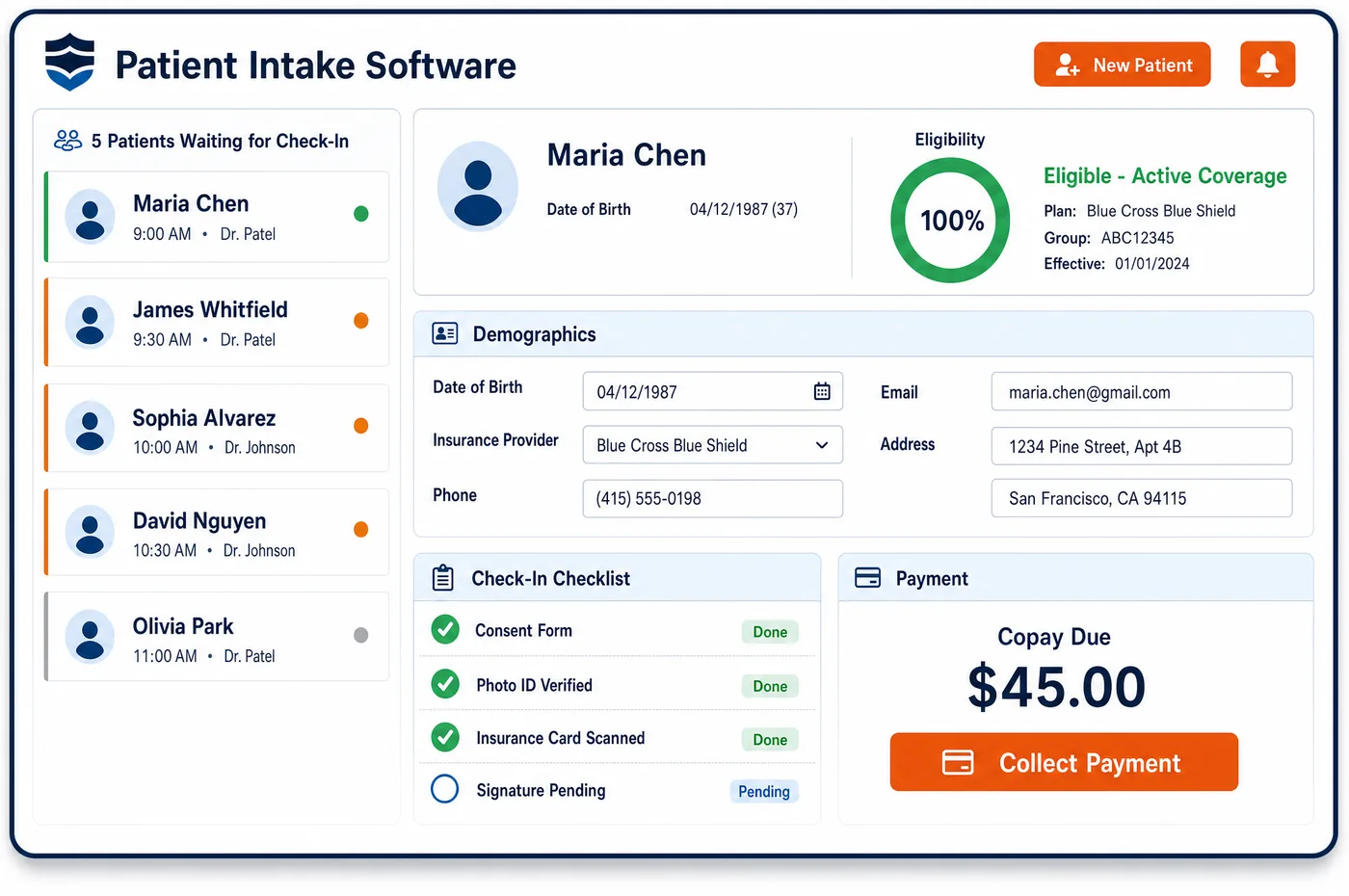
Patient Registration in a Dermatology Practice
Registration in a skin practice has more moving parts than a name and an insurance card. Many patients carry two cards: a medical plan for visits and procedures, and a pharmacy benefit that covers self-injected biologics such as dupilumab. Children with eczema often need a parent recorded as guarantor. Some patients come only for cosmetic work and will never use insurance, so they register as self-pay and are owed a good faith estimate for scheduled care. Others join a drug study, which adds a trial number that later has to reach the claim. Dermatology patient registration software gives each of these a place on the account. As staff type, it compares the new entry with existing records and flags a likely match, so a returning skin cancer patient is not split across two charts. Custom fields hold the details the practice needs, such as the referring doctor.
Why Is Patient Registration Different in Dermatology?
Skin patients often return years apart, for a new lesion or a new cancer. Names change, addresses move and plans switch. If staff create a fresh chart each time, the biopsy history, the Mohs record and the old pathology end up in different places. A dermatologist who cannot see that a patient had melanoma before is working with half the story, and the claim history splits the same way.
Coverage is often split in a skin practice. Office visits, biopsies and excisions go to the medical plan. A self-injected biologic for psoriasis or atopic dermatitis is usually filled through the pharmacy benefit, with its own member ID and its own prior authorization. Registration that keeps only one card leaves the clearance team guessing when a biologic is prescribed.
Self-pay is a normal path here, not an exception. A patient booking a cosmetic treatment may not want insurance billed at all. That patient should be registered as self-pay from the start, so the right estimate rules apply and nothing goes out to a payer by mistake. Patient registration that treats every new patient as insured creates denials and confused patients later.
What Dermatology Patient Registration Software Handles
- Pharmacy benefit for self-injected biologics
- UnitedHealthcare runs its dupilumab approval through a pharmacy clinical program, separate from the medical plan. Registration stores the pharmacy member ID and plan details next to the medical card, so the medical versus pharmacy benefit split is clear when a biologic is ordered. (UnitedHealthcare Pharmacy Clinical Program 2026 P 2116-24: Dupixent (dupilumab) Prior Authorization/Medical Necessity)
- Guarantor for children with eczema
- Dupilumab is labeled for moderate-to-severe atopic dermatitis from the age of six months, so many biologic patients are young children. Registration records the parent or guardian as guarantor and the subscriber on each plan. (UnitedHealthcare Pharmacy Clinical Program 2026 P 2116-24: Dupixent (dupilumab) Prior Authorization/Medical Necessity)
- Self-pay status and good faith estimates
- CMS says patients who are not using insurance should get a good faith estimate when they schedule care far enough ahead. Registering a cosmetic patient as self-pay at sign-up makes sure the estimate step is not skipped. (CMS: Your right to a good faith estimate (No Surprises Act))
- Cosmetic-only patients
- Medicare excludes cosmetic surgery from coverage. A patient who comes only for appearance-focused care is registered without an insurance claim path, so their visits never generate a claim. (CMS Medicare Benefit Policy Manual, Chapter 16: General Exclusions from Coverage (section 120, Cosmetic Surgery))
- Clinical trial participants
- For Medicare, claims for routine costs in a qualifying study must carry the trial number, diagnosis Z00.6 and modifier Q0 or Q1. Registration records the study and its number, so billing has it when the visit is coded. (CMS Medicare Claims Processing Manual, Chapter 32, section 69: Qualifying Clinical Trials)
How Does Dermatology Patient Registration Software Work?
1. Search before creating
Staff search by name, birth date and other details before adding a patient. A likely match is flagged, so the existing chart is opened instead of a new one.
2. Capture both cards
The front and back of the medical card and any pharmacy card are captured. Subscriber, group and member ID details are stored for each plan.
3. Set the guarantor
For a child or a dependent adult, the responsible party is recorded with their own contact details. The guarantor then carries through to the dermatology patient record and to every statement.
4. Mark self-pay and trial status
Cosmetic-only patients are marked self-pay, and study patients are linked to their trial number. Both flags shape how later visits are billed.
5. Hand off to intake
Once the account is complete, forms, history and consent move to skin patient intake. Registration data is not typed in a second time.
Dermatology Patient Registration Software vs. Generic Software
| Area | Generic approach | Unlimited Systems |
|---|---|---|
| Duplicate charts | A new chart for every returning patient. | Likely matches flagged before a second record is made. |
| Pharmacy coverage | Only the medical card on file. | Medical and pharmacy plans stored side by side. |
| Children | Parent details typed into notes. | Guarantor and subscriber recorded as fields. |
| Cosmetic patients | Registered as insured, then billed by mistake. | Marked self-pay at sign-up. |
| Study patients | Trial number found later in a binder. | Trial number stored on the account for billing. |
Who Uses It in a Dermatology Practice
- Front desk: A search that flags likely duplicates and screens that hold both medical and pharmacy cards, with clean patient demographics from the first visit.
- Prior authorization coordinator: The pharmacy member ID already on file when a biologic is prescribed, so the request starts with the right plan.
- Billing manager: Self-pay and trial flags set at sign-up, so cosmetic work stays off claims and study claims carry the right modifiers.
Dermatology Patient Registration Software FAQs
Patient registration for a skin practice captures demographics, the medical plan, any pharmacy benefit used for biologics, the guarantor, and whether the patient is insured or self-pay. It also records study enrollment when a patient joins a drug trial. Getting these right at sign-up keeps later steps, from biologic approvals to cosmetic quotes, from starting with the wrong facts.
The pharmacy benefit belongs on the account because self-injected biologics for psoriasis and eczema are often covered there, not under the medical plan. That plan has its own member ID and its own approval rules. When the card is already stored, the prior authorization request goes to the right place the day the drug is prescribed.
Duplicate charts are prevented by comparing each new entry with existing records as staff type. A likely match is flagged, and staff can open the existing chart instead of starting a new one. That keeps a patient's biopsy history, Mohs record and pathology results together, even when they return years later with a new name or plan.
Cosmetic-only patients should be registered as self-pay from the start. Medicare does not cover cosmetic surgery, so there is no claim to send for that work. Marking them self-pay also triggers the good faith estimate step that CMS describes for patients not using insurance, so the quote they get matches the bill.
The guarantor for a child on a biologic is usually the parent or legal guardian who is responsible for the bill. Registration records that person with their own contact details and links them to each plan as subscriber where needed. Statements and approval letters then reach the adult who can act on them.
Registration tracks clinical trial patients by linking the account to the study and its trial number. For Medicare, routine-cost claims in a qualifying study need that number, diagnosis Z00.6 and modifier Q0 or Q1. Storing it at sign-up means billing does not have to search for it when the visit is coded.
Related Dermatology Software
Front office
In the revenue cycle
Patient Registration for related specialties
Sources
- UnitedHealthcare Pharmacy Clinical Program 2026 P 2116-24: Dupixent (dupilumab) Prior Authorization/Medical Necessity
- CMS: Your right to a good faith estimate (No Surprises Act)
- CMS Medicare Benefit Policy Manual, Chapter 16: General Exclusions from Coverage (section 120, Cosmetic Surgery)
- CMS Medicare Claims Processing Manual, Chapter 32, section 69: Qualifying Clinical Trials
GET STARTED
See Unlimited Systems in Action
Whether you're actively evaluating new technology or simply preparing for your next vendor renewal, Unlimited Systems can help you understand where your current workflows may be creating avoidable revenue risk.