

Front office
Dermatology Financial Clearance Software
Check coverage and clear approvals before each skin visit. Know what the plan covers and what the patient pays.
Dermatology Financial Clearance Software confirms that skin care is covered, approved and priced before it happens. It checks each visit's benefits. It builds approval requests for biologics and light therapy. It sorts covered lesion removals from cosmetic ones. And it gives self-pay patients a price up front, so no one is surprised by the bill.



 6,500+ specialty providers

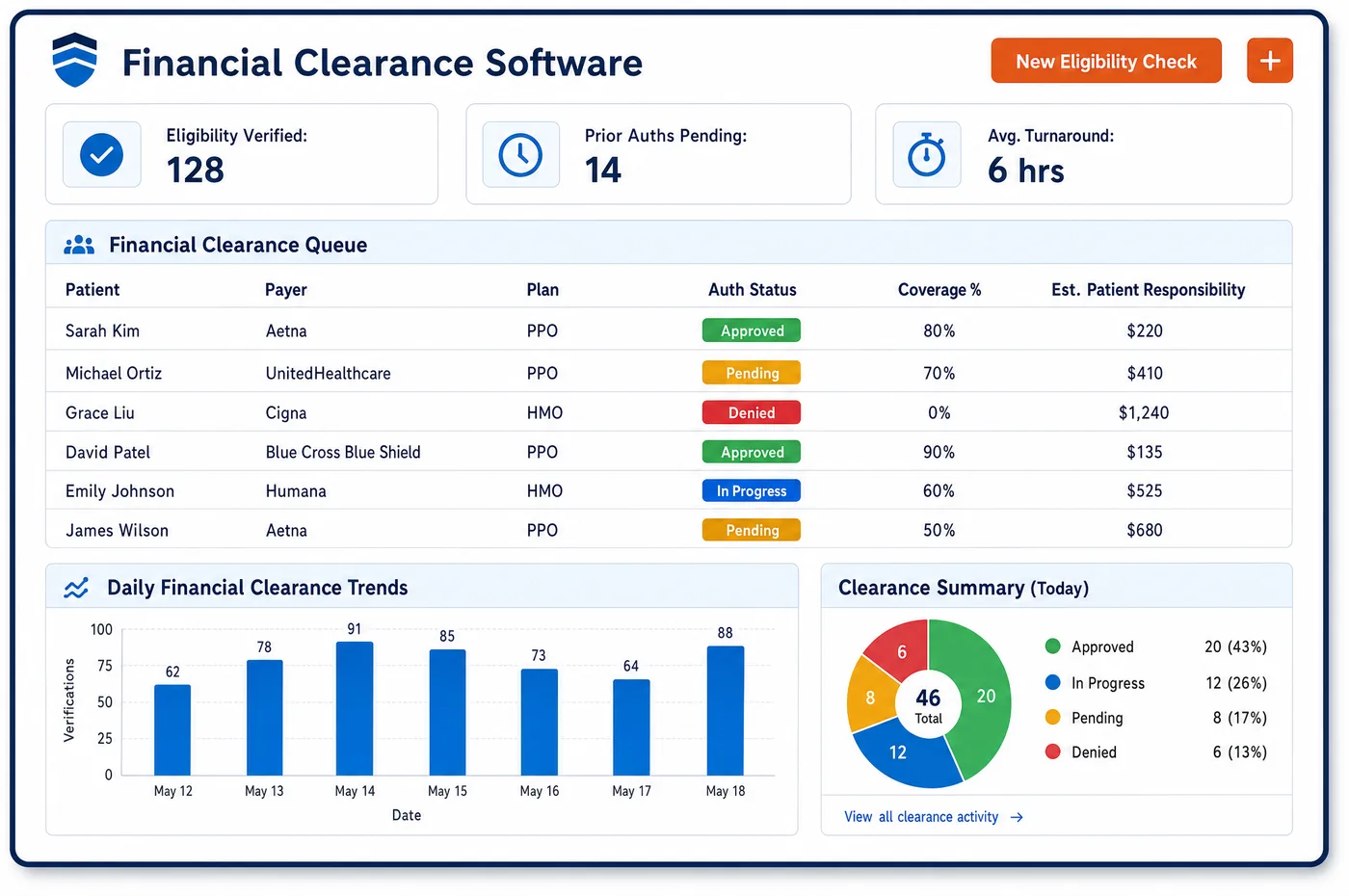
Financial Clearance in a Dermatology Practice
Clearance in a skin practice runs on two tracks. The first is routine: each booked visit gets an eligibility and benefits check, so the copay, deductible and any referral need are known before check-in. The second is where the money is at risk. A biologic for eczema or psoriasis needs prior authorization, often through the pharmacy benefit, with proof of failed topical treatment. An excimer laser course has its own criteria and treatment limits under many policies. A lesion removal may be covered or cosmetic, depending on documented symptoms. And a patient paying out of pocket is owed a good faith estimate when care is booked ahead. Dermatology financial clearance software brings these checks into one queue. Requests are built from chart notes, approvals are tied to the visits they cover, and a visit with a missing approval is held before the patient arrives.
Why Is Financial Clearance Different in Dermatology?
Biologic approvals are detailed and strict. For dupilumab in eczema, UnitedHealthcare asks for moderate-to-severe chronic disease. It also asks for failed trials of two kinds of topical drugs, with names and dates. Only certain specialists may prescribe, and the drug can't be paired with another biologic or a JAK inhibitor. A request missing one item comes back denied, and the patient waits while staff fix it.
Light therapy is cleared by course, not by visit. Payer policies for excimer laser describe the type and extent of psoriasis that qualifies, the topical drugs that must have failed, and how many treatments a course may include. More courses may need proof that the last one worked. Clearance has to count sessions against the approval as they happen, or the last few visits go unpaid.
The line between covered and cosmetic runs through many skin procedures. Medicare and its contractors cover removal of a benign lesion when the record shows symptoms such as bleeding, pain or inflammation. Without them, removal is cosmetic and the patient pays. Financial clearance for these cases means checking the criteria before the procedure and quoting the patient when they are not met.
What Dermatology Financial Clearance Software Handles
- Dupilumab prior authorization
- UnitedHealthcare requires moderate-to-severe chronic atopic dermatitis. The patient must have failed two topical classes: a medium or stronger steroid, a calcineurin inhibitor, or crisaborole. A dermatologist, allergist or immunologist must prescribe. Renewals need a good response, so staff log the response in the request. (UnitedHealthcare Pharmacy Clinical Program 2026 P 2116-24: Dupixent (dupilumab) Prior Authorization/Medical Necessity)
- Excimer laser for psoriasis (96920–96922)
- Aetna's policy bills excimer laser by treated area: 96920 under 250 sq cm, 96921 from 250 to 500 sq cm, and 96922 over 500 sq cm. It requires failed treatment with at least three topical agent types and caps treatments per course, so each session is counted against the approval. (Aetna Clinical Policy Bulletin 0577: Laser Treatment for Psoriasis and Other Selected Skin Conditions)
- Office and home phototherapy (96900, 96910, 96912)
- Aetna lists narrowband UVB under 96900, tar or petrolatum with UVB (Goeckerman) under 96910, and PUVA under 96912. Home UVB units are covered for some patients who can't come in for office therapy. The request names the setting. (Aetna Clinical Policy Bulletin 0205: Phototherapy and Photochemotherapy (PUVA) for Skin Conditions)
- Benign lesion removal criteria
- WPS covers removal when the record shows signs such as bleeding, itching, pain, inflammation, a change in appearance or a realistic concern for cancer. Staff check these against the planned procedure, and lesions that do not qualify are quoted as cosmetic. (CMS Medicare Coverage Database, LCD L35498: Removal of Benign Skin Lesions (WPS))
- Good faith estimates for self-pay care
- Patients not using insurance should get a good faith estimate when they schedule care far enough ahead or ask for one. Cosmetic quotes are built from the practice's fee schedule and sent before the visit. (CMS: Your right to a good faith estimate (No Surprises Act))
- Electronic checks (270/271 and 278)
- HIPAA's adopted standards include ASC X12N 270/271 for eligibility and 278 for authorizations. Eligibility runs when each visit is booked. Approval status is tied to the order it covers. (CMS: Adopted Standards and Operating Rules (HIPAA transactions))
How Does Dermatology Financial Clearance Software Work?
1. Check eligibility at booking
Each visit triggers an eligibility inquiry when it is booked. Copay, deductible and any referral need show on the visit before the patient arrives.
2. Spot what needs approval
Biologics, excimer courses and some procedures are matched to each plan's rules. Visits that need approval are routed to the authorization queue.
3. Build the request from the chart
Prior therapies, dates, disease severity and body area are pulled from chart notes into the request. Staff review it and submit through the payer's electronic channel or portal.
4. Tie approvals to visits
Approved units, sessions and end dates are linked to the booked visits. The dermatology schedule holds any visit whose approval is missing or used up.
5. Quote what is not covered
Lesions that fail coverage criteria and cosmetic services get a written quote. Patients sign before treatment, and copay assistance is screened for eligible biologic patients.
Dermatology Financial Clearance Software vs. Generic Software
| Area | Generic approach | Unlimited Systems |
|---|---|---|
| Biologic requests | Built from memory and missing prior drug dates. | Built from chart notes with each failed therapy listed. |
| Light therapy | Sessions given past the approved count. | Sessions counted against the approval as they happen. |
| Covered or cosmetic | Decided after the claim is denied. | Criteria checked before the procedure. |
| Self-pay estimates | Quoted verbally, if at all. | Written estimate sent before the visit. |
| Eligibility | Checked at the desk while the patient waits. | Checked when the visit is booked. |
Who Uses It in a Dermatology Practice
- Prior authorization coordinator: One queue for biologic, light therapy and procedure approvals. Each request is built from chart notes, with step therapy listed by drug and date.
- Front desk: Copay, deductible and approval status on every visit before the patient arrives.
- Practice manager: Fewer write-offs from treatment given without approval, a clear record of medical necessity for each request, and fewer surprise bills for cosmetic work.
Dermatology Financial Clearance Software FAQs
Financial clearance in a skin practice checks each visit's benefits and clears approvals for biologics and light therapy. It decides whether a lesion removal is covered or cosmetic. It also prices care for self-pay patients. The goal is simple. Each visit is either approved and covered, or quoted and agreed to by the patient, before care is given.
A dupilumab approval for eczema usually needs proof of moderate-to-severe chronic disease and failed topical treatment. UnitedHealthcare, for example, asks for two topical drug classes with names and dates. The prescriber must be a skin or allergy specialist. No other biologic or JAK inhibitor may be used for the same condition. Renewals need a documented good response.
Excimer laser courses are cleared by course, with each session counted against the approval. Policies such as Aetna's describe which psoriasis patients qualify, the topical drugs that must have failed and the number of treatments a course may include. Codes 96920, 96921 and 96922 are chosen by the area treated, which the request should state.
Covered lesion removal is told apart from cosmetic removal by checking the record for signs that qualify. WPS, a Medicare contractor, lists bleeding, itching, pain, inflammation, a change in look and concern for cancer, among others. When none are documented, the removal is cosmetic. The patient is then quoted and signs before the procedure.
Self-pay cosmetic patients get a written estimate before treatment. CMS says patients who are not using insurance should get a good faith estimate when they book care far enough ahead or ask for one. The estimate lists the expected services and prices, and the patient's final invoice is compared with it.
Financial clearance for a biologic patient runs when the drug is first prescribed and again before each renewal. The first request needs the full prior therapy history. The renewal needs proof that the patient responded. Tracking the end date on the account gives staff time to file the renewal before treatment would stop.
Related Dermatology Software
Front office
In the revenue cycle
Financial Clearance for related specialties
Sources
- UnitedHealthcare Pharmacy Clinical Program 2026 P 2116-24: Dupixent (dupilumab) Prior Authorization/Medical Necessity
- Aetna Clinical Policy Bulletin 0577: Laser Treatment for Psoriasis and Other Selected Skin Conditions
- Aetna Clinical Policy Bulletin 0205: Phototherapy and Photochemotherapy (PUVA) for Skin Conditions
- CMS Medicare Coverage Database, LCD L35498: Removal of Benign Skin Lesions (WPS)
- CMS: Your right to a good faith estimate (No Surprises Act)
- CMS: Adopted Standards and Operating Rules (HIPAA transactions)
GET STARTED
See Unlimited Systems in Action
Whether you're actively evaluating new technology or simply preparing for your next vendor renewal, Unlimited Systems can help you understand where your current workflows may be creating avoidable revenue risk.