

Billing & claims
Dermatology RCM Software
Follow every skin visit from scheduling to final payment, with the rules that govern biopsies, Mohs cases, biologics and cosmetic care built into each step.
Dermatology RCM Software, short for revenue cycle management, follows each skin visit from the first booking to the last posted payment. It joins scheduling, clearance, charge entry, claims, payment posting and follow-up in one workflow, so staff can see where money is held up and why, whether the service was a biopsy, a Mohs case, a biologic or cosmetic care.



 6,500+ specialty providers

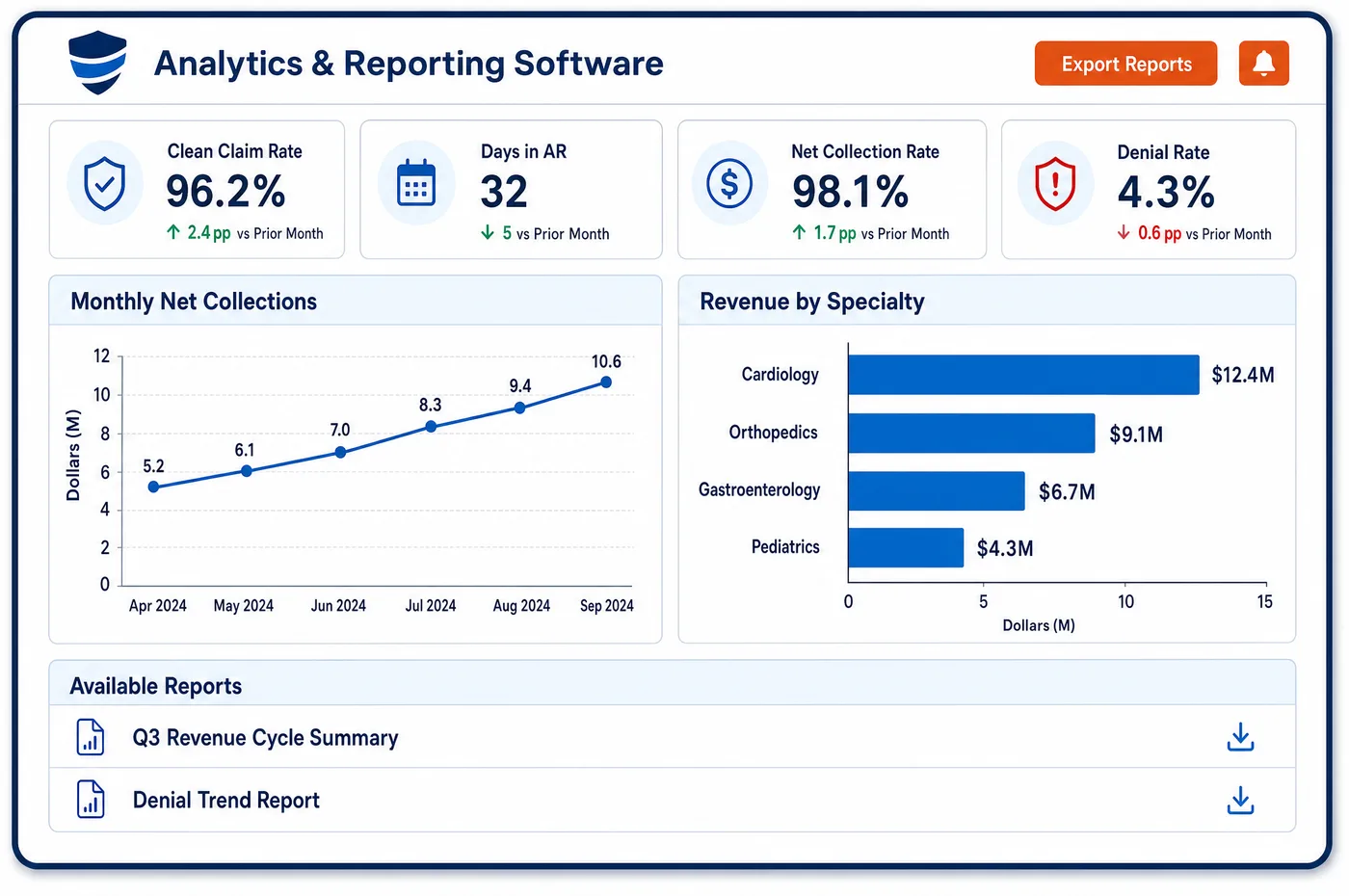
RCM in a Dermatology Practice
Revenue cycle management in a skin practice is a chain, and a weak link anywhere costs real money. Coverage has to be checked before a biologic is started. The note has to support a lesion removal as medically needed, not cosmetic. A biopsy needs the right technique code, and its diagnosis often changes when pathology comes back. A visit inside a global period must not be billed twice. Cosmetic services must stay off claims. Dermatology RCM software ties these steps together. Staff work from queues for approvals, charges that need review, rejected claims, denials and unpaid balances. A manager can see which payer, provider or procedure is behind. Because the same ledger feeds each step, the practice can find the cause of a loss and fix it at the start of the chain, not at the end. The sections below show the skin-specific rules at each step, and the medical billing page covers the claim itself.
Why Is RCM Different in Dermatology?
RCM in a skin practice has to track three different streams at once. Medical visits and procedures go to payers. Drugs and light therapy follow their own approval rules. Cosmetic work is paid by the patient. Each stream has its own failure points, so a single average across all of them hides the real problem. Good RCM shows each stream apart. It also reads the denial code on each rejected payment, since the code names the failed step.
The most costly errors are made early. A biologic given without approval, a lesion removed without documented symptoms, or a wound check booked as a new visit will each be denied later, and appealing them is slower than preventing them. A cycle that checks coverage, medical necessity and global status before the visit is cheaper to run than one that cleans up afterward.
Pathology adds a delay that most specialties do not have. The diagnosis a dermatologist suspects at the visit may not match the report that comes back, and the claim has to match the report. Managing the cycle means knowing which claims are waiting on a lab, which are ready, and which were sent on a working diagnosis that must now be corrected.
What Dermatology RCM Software Handles
- Same-day visit and procedure
- Under Medicare, an evaluation and management visit on the day of a minor procedure is part of the procedure unless it is significant and separately identifiable, which is reported with modifier 25. Staff review these charges against the note before they go out. (CMS MLN Booklet MLN907166: Global Surgery)
- Biopsy coding by technique (11102–11107)
- Tangential, punch and incisional biopsies each have a base code and an add-on for further lesions. Charges are checked so the technique in the note matches the code and each added lesion is counted, in line with CPT coding rules. (Federal Register: CY 2019 Physician Fee Schedule final rule, skin biopsy codes 11102–11107 (83 FR 59452, at 59522))
- Mohs coding by site and stage (17311–17314)
- Mohs codes depend on the body site and on the first or later stage. Charges are reviewed against the surgeon's note and the pathology of each stage. (CMS Medicare Coverage Database, Billing and Coding Article A56836: Mohs Micrographic Surgery (CGS))
- Benign lesion removal criteria
- WPS covers removal of a benign lesion when the record shows signs such as bleeding, pain, itching or a change in appearance. Charges for removals without those signs are held for review and quoted as cosmetic. (CMS Medicare Coverage Database, LCD L35498: Removal of Benign Skin Lesions (WPS))
- Cosmetic services off the claim
- The Medicare benefit manual excludes cosmetic surgery except in narrow repair cases. Cosmetic charges carry a self-pay flag and go to the patient, not to a payer. (CMS Medicare Benefit Policy Manual, Chapter 16: General Exclusions from Coverage (section 120, Cosmetic Surgery))
- Biologic approvals
- UnitedHealthcare approves dupilumab for atopic dermatitis for a set term and asks for proof of response at renewal. Staff track each approval so claims for the drug are not sent after it lapses. (UnitedHealthcare Pharmacy Clinical Program 2026 P 2116-24: Dupixent (dupilumab) Prior Authorization/Medical Necessity)
- HIPAA electronic transactions
- HIPAA adopts ASC X12N standards for claims (837), remittance advice (835) and claim status (276 and 277). These move each claim from submission to payment and show where it is stuck. (CMS: Adopted Standards and Operating Rules (HIPAA transactions))
How Does Dermatology RCM Software Work?
1. Clear before the visit
Eligibility is checked and approvals for biologics and light therapy are requested during clearance. Cosmetic patients get an estimate.
2. Capture the service
The provider's note, the procedure details and the specimen list become charges. Staff review them for modifiers, global periods and covered versus cosmetic status.
3. Send and track the claim
Claims go out electronically, and staff work rejections from a queue. Claims waiting on pathology are listed so they can be released when the report arrives.
4. Post and reconcile
Payments and adjustments from each payer are posted to the ledger. Underpayments and denials drop into a follow-up queue.
5. Learn from the pattern
Managers review denials by payer, provider and procedure. The fix is usually a rule at the front of the cycle, such as a documentation prompt or an approval check.
Dermatology RCM Software vs. Generic Software
| Area | Generic approach | Unlimited Systems |
|---|---|---|
| View of the cycle | One total for all revenue. | Medical, drug, light therapy and cosmetic streams shown apart. |
| Global periods | Found when a claim is denied. | Flagged before the visit is booked. |
| Pathology delay | Claims sent on a guess. | Claims held or corrected when the report arrives. |
| Biologic approvals | Tracked in a binder. | Approval and end date on the account. |
| Denials | Worked one claim at a time. | Grouped by cause so the fix happens upstream. |
Who Uses It in a Dermatology Practice
- Billing director: A single view of where each stream stands, with queues for approvals, charges, rejections, denials and balances.
- Practice administrator: Clear causes for lost revenue by payer, provider and procedure, so decisions rest on facts from the medical billing side.
- Physician owner: RCM reports that show biologics, procedures and cosmetic care are each paid by the right party under the right rules, with RCM staff held to one shared view.
Dermatology RCM Software FAQs
RCM, or revenue cycle management, in a dermatology practice is the full path from booking a visit to posting the final payment. It covers coverage checks, approvals, charge entry, claims, posting and follow-up. In skin care it also has to handle biopsies waiting on pathology, global periods, biologic approvals and cosmetic services that are never billed to insurance.
Dermatology RCM is hard to manage because one practice runs several kinds of billing at once. Insurance pays for visits and procedures, pharmacy and medical benefits split the drug side, and cosmetic care is paid by the patient. Each stream has its own rules, so one average hides where the problems are.
Global periods affect revenue because related recovery visits are included in the procedure payment. Medicare sets 000, 010 and 090 global indicators by procedure code. A wound check billed as a new visit is denied, so the cycle works best when staff can see the global status before the visit is booked.
Pathology affects claims because the diagnosis on a biopsy claim should match the lab report, which may differ from the suspected diagnosis. Staff keep a list of claims waiting on reports and release or correct them when results arrive, so the claim does not go out on a guess.
Cosmetic revenue fits in the cycle as a separate self-pay stream. The Medicare benefit manual excludes cosmetic surgery from coverage apart from narrow repair cases. Cosmetic charges carry a flag, an estimate is sent first, and the payment goes to the patient account rather than to any insurance claim.
A dermatology manager should review claims waiting on pathology, biologic approvals near their end date, denials grouped by cause, and balances left unpaid. Each list points to a rule or a step that can be changed. Reviewing by stream also shows whether medical, drug or cosmetic revenue is the one falling behind.
Related Dermatology Software
Billing & claims
RCM for related specialties
Sources
- CMS MLN Booklet MLN907166: Global Surgery
- Federal Register: CY 2019 Physician Fee Schedule final rule, skin biopsy codes 11102–11107 (83 FR 59452, at 59522)
- CMS Medicare Coverage Database, Billing and Coding Article A56836: Mohs Micrographic Surgery (CGS)
- CMS Medicare Coverage Database, LCD L35498: Removal of Benign Skin Lesions (WPS)
- CMS Medicare Benefit Policy Manual, Chapter 16: General Exclusions from Coverage (section 120, Cosmetic Surgery)
- UnitedHealthcare Pharmacy Clinical Program 2026 P 2116-24: Dupixent (dupilumab) Prior Authorization/Medical Necessity
- CMS: Adopted Standards and Operating Rules (HIPAA transactions)
GET STARTED
See Unlimited Systems in Action
Whether you're actively evaluating new technology or simply preparing for your next vendor renewal, Unlimited Systems can help you understand where your current workflows may be creating avoidable revenue risk.