

Platform & AI
Dermatology Workflow Software
Route every held claim, path report, prior authorization and cosmetic estimate to a named owner, so nothing in a busy skin practice waits without someone on it.
Dermatology Workflow Software organizes a skin practice's billing and front-office work into queues with owners. A claim held for a pathology report, a Mohs case waiting for coding, a biologic prior authorization and a cosmetic estimate each land in the right queue. Staff see what is theirs, how old it is and what to do next.



 6,500+ specialty providers

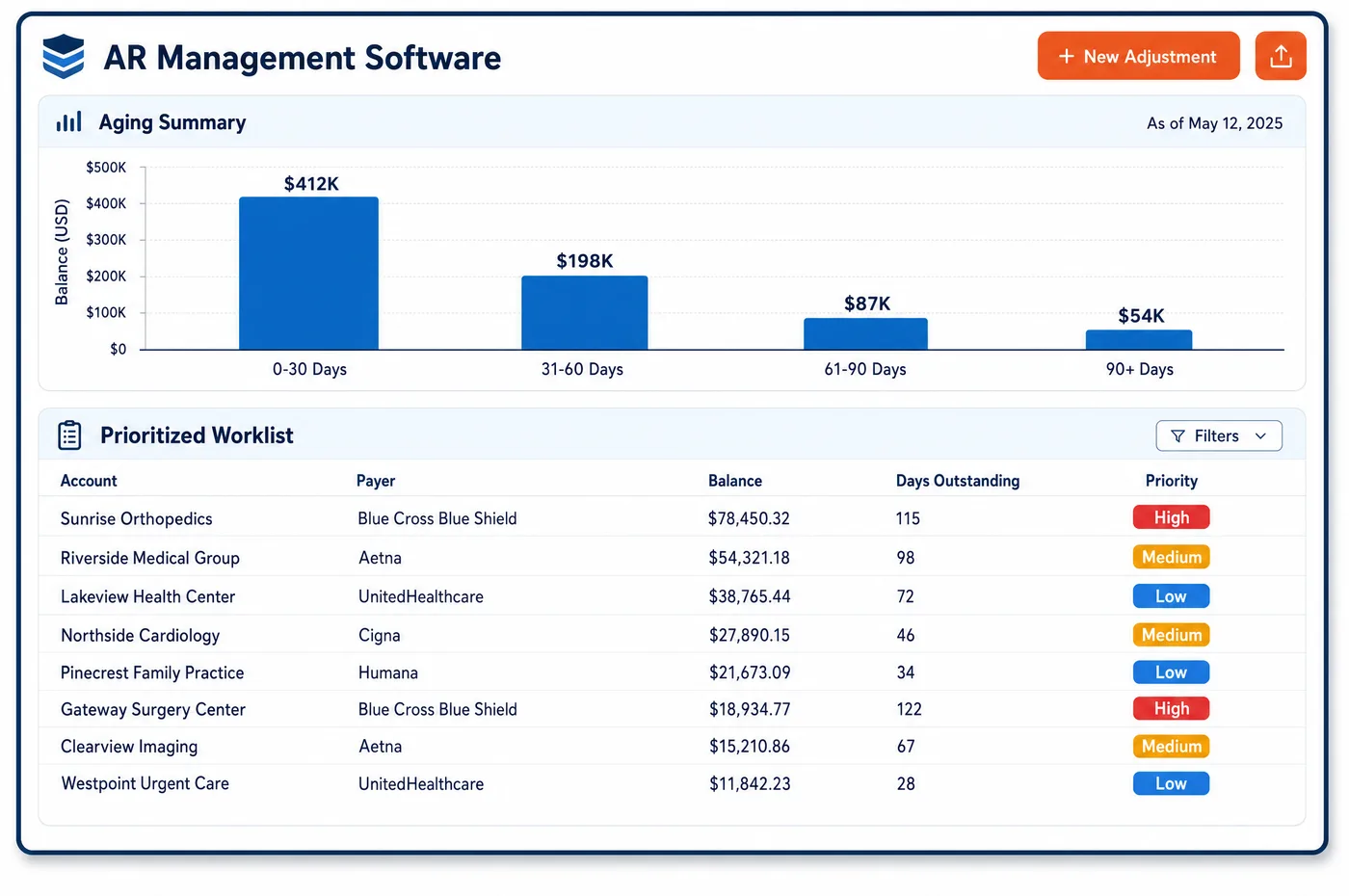
Workflow in a Dermatology Practice
Dermatology workflow arrives in small pieces from many directions. A biopsy leaves the room and the claim must wait for a diagnosis. A Mohs surgeon finishes three stages and a repair, and a coder must finish the lines. A biologic order needs payer approval before the first dose. Unlimited Systems puts each of these in a queue the practice defines. Each item has an owner, an age and a reason. Items can be routed by payer, by provider, by code family or by the type of exception. Managers can reassign a stack when someone is out. When an item sits too long, it moves up to a lead. The aim is plain. Every open item in the practice has one person responsible, and the queue shows whether that person is keeping pace.
Why Is Workflow Different in Dermatology?
Workflow in a skin practice has more waiting states than in most specialties. Many claims cannot go out until a pathologist signs the report. Cosmetic visits need an estimate before the patient pays. Some drug therapies need approval before the visit is booked. Each wait is normal, and each can be forgotten. Without a clear queue, a held claim looks the same as a lost one until the billing deadline is near.
Dermatology workflow also differs by task and by person. A medical assistant tracks specimens. A coder reads the operative note for a Mohs case. A front desk member collects the cosmetic deposit. A poster handles short payments. If everything lands in one shared inbox, the wrong person opens the wrong item and the right person never sees it. Routing by role and by reason keeps each item with the person who can finish it.
A dermatology workflow also carries many small, similar items that follow a pattern. Biopsy-excision bundling, missing symptom notes and unit mismatches on Mohs lines come back again and again. A worklist that groups them by cause lets a coder work through twenty alike in one sitting, then lets the manager see which providers or templates create them. Work gets done faster, and the cause gets fixed once, upstream.
What Dermatology Workflow Software Handles
- Path-pending claim queue
- Excisions are coded from the pathology result, so the claim is held until the report is in. The queue shows each hold with the date of service, the lab and the days waiting, and routes old ones to the person who chases the lab. The report then feeds dermatology automation rules that release the claim. (CMS NCCI Policy Manual for Medicare Services, Chapter III (Surgery: Integumentary System))
- Mohs coding queue
- For Medicare in WPS states, added stages are billed as units on 17312 or 17314. Each completed case goes to a coder who checks the units against the operative note before the claim is released. (CMS Medicare Coverage Database, Billing and Coding Article A57477: Mohs Micrographic Surgery (WPS))
- Biologic authorization queue
- Some commercial policies, such as the UnitedHealthcare Dupixent program, require prior authorization and documented criteria before coverage. Requests are tracked from submission to decision, so the front desk can book the patient once approval is in hand. (UnitedHealthcare Pharmacy Clinical Program 2026 P 2116-24: Dupixent (dupilumab) Prior Authorization/Medical Necessity)
- Cosmetic estimate and consent queue
- A good faith estimate is required for uninsured and self-pay patients under the No Surprises Act. Cosmetic quotes wait in a queue until the estimate is sent and the patient has agreed to the price. (CMS: Your right to a good faith estimate (No Surprises Act))
- Medicare notice queue
- When a Medicare patient may be asked to pay for a service Medicare will not cover, an Advance Beneficiary Notice must be signed first. Visits that need one are flagged for the front desk before check-in. (CMS MLN Booklet: Medicare Advance Written Notices of Non-coverage (MLN006266))
- Timely filing escalation
- Medicare claims must be filed within one calendar year of the date of service under 42 CFR 424.44. Items with a date of service approaching that limit move up to a lead. (eCFR: 42 CFR 424.44, Time limits for filing Medicare claims)
How Does Dermatology Workflow Software Work?
1. Create the queues
The practice defines queues for the items that stall, such as path holds, Mohs coding, biologic approvals and cosmetic estimates. Each queue has a rule for what enters it.
2. Route by reason and role
Items go to the person or team who can finish them. Coding exceptions go to coders, short payments to posters and coverage problems to the front desk.
3. Work oldest first
Each workflow queue sorts by age and priority, with the reason shown on every row. Staff open an item, fix it and close it. The history stays on the account.
4. Escalate stalled items
An item that passes the age set by the practice moves to a lead. Items near the timely filing limit rise first, as part of dermatology AR follow-up.
5. Watch the load
Managers see workflow load by owner and age. They shift work when one person has too much, and bring the counts to dermatology reporting for the monthly review.
Dermatology Workflow Software vs. Generic Software
| Area | Generic approach | Unlimited Systems |
|---|---|---|
| Held claims | A paper list or a shared inbox checked when someone remembers. | A queue with an owner, an age and a reason on every held claim. |
| Prior authorization | Tracked on sticky notes or in the schedule. | A queue from request to decision, tied to the patient's visit. |
| Cosmetic quotes | Handled at the front desk with no record of what was promised. | Estimate and agreement kept on the account. |
| Coding exceptions | Sent back and forth by email. | Grouped by cause and routed to a coder. |
| Workload balance | Found out when someone leaves or a deadline is missed. | Open items counted by owner every day. |
Who Uses It in a Dermatology Practice
- Medical assistant: A clear list of specimens and path reports to chase, with the oldest on top. Each item links back to the patient and the visit, as in the patient record.
- Coder: A queue of Mohs, excision and repair cases to review, grouped by the reason they were held. The queue shows the operative note beside the codes.
- Billing manager: A live count of open items by owner and age, so staffing and escalation choices rest on what is actually waiting.
Dermatology Workflow Software FAQs
A work queue is a list of items that need action, each with an owner, an age and a reason. In a skin practice, typical queues cover claims held for pathology, Mohs coding, biologic prior authorizations and cosmetic estimates. Staff open the oldest item, resolve it and move on, and managers see the whole list.
Each held claim sits in a path-pending queue with its date of service, the lab and its age. Anything older than the limit the practice sets moves to a lead. The claim is released once the report is in and the diagnosis can be coded, so no claim is lost behind the wait.
The practice decides, but most put them with the front desk or a cosmetic coordinator. A queue shows each quote still waiting for the patient's agreement. For uninsured and self-pay patients, a good faith estimate under the No Surprises Act must be given, and the queue records that it was sent.
A manager can move any item or a whole stack to another person or role. Items keep their age and history when they move. Coverage on a vacation or a sick day takes minutes, and the queue counts by owner show who has room to take more work.
Queues can sort by date of service, so claims close to a payer's filing limit rise to the top. Medicare claims have one calendar year from the date of service under 42 CFR 424.44. Leads see those items first and can work or escalate them before the limit passes.
A queue does not decide how to code or appeal anything. It routes each item to the person who can, with the reason and the age shown. Staff still read the note, make the call and close the item. The queue's job is to make sure nothing is left without an owner.
Related Dermatology Software
Platform & AI
In the revenue cycle
Workflow for related specialties
Sources
- CMS NCCI Policy Manual for Medicare Services, Chapter III (Surgery: Integumentary System)
- CMS Medicare Coverage Database, Billing and Coding Article A57477: Mohs Micrographic Surgery (WPS)
- UnitedHealthcare Pharmacy Clinical Program 2026 P 2116-24: Dupixent (dupilumab) Prior Authorization/Medical Necessity
- CMS: Your right to a good faith estimate (No Surprises Act)
- CMS MLN Booklet: Medicare Advance Written Notices of Non-coverage (MLN006266)
- eCFR: 42 CFR 424.44, Time limits for filing Medicare claims
GET STARTED
See Unlimited Systems in Action
Whether you're actively evaluating new technology or simply preparing for your next vendor renewal, Unlimited Systems can help you understand where your current workflows may be creating avoidable revenue risk.