

Analytics & value-based care
Dermatology Reporting Software
Run and send the reports a dermatology group lives on, from Mohs and pathology production to MIPS measures, payer yield and site-by-site results for owners.
Dermatology Reporting Software produces the financial, operational and quality reports a skin practice runs on. Production and collections by provider and site, Mohs and pathology volume, payer yield, denial reports and MIPS measure data are built from live records. Reports run on a schedule and reach managers, physicians and owners without anyone exporting a spreadsheet.



 6,500+ specialty providers

Reporting in a Dermatology Practice
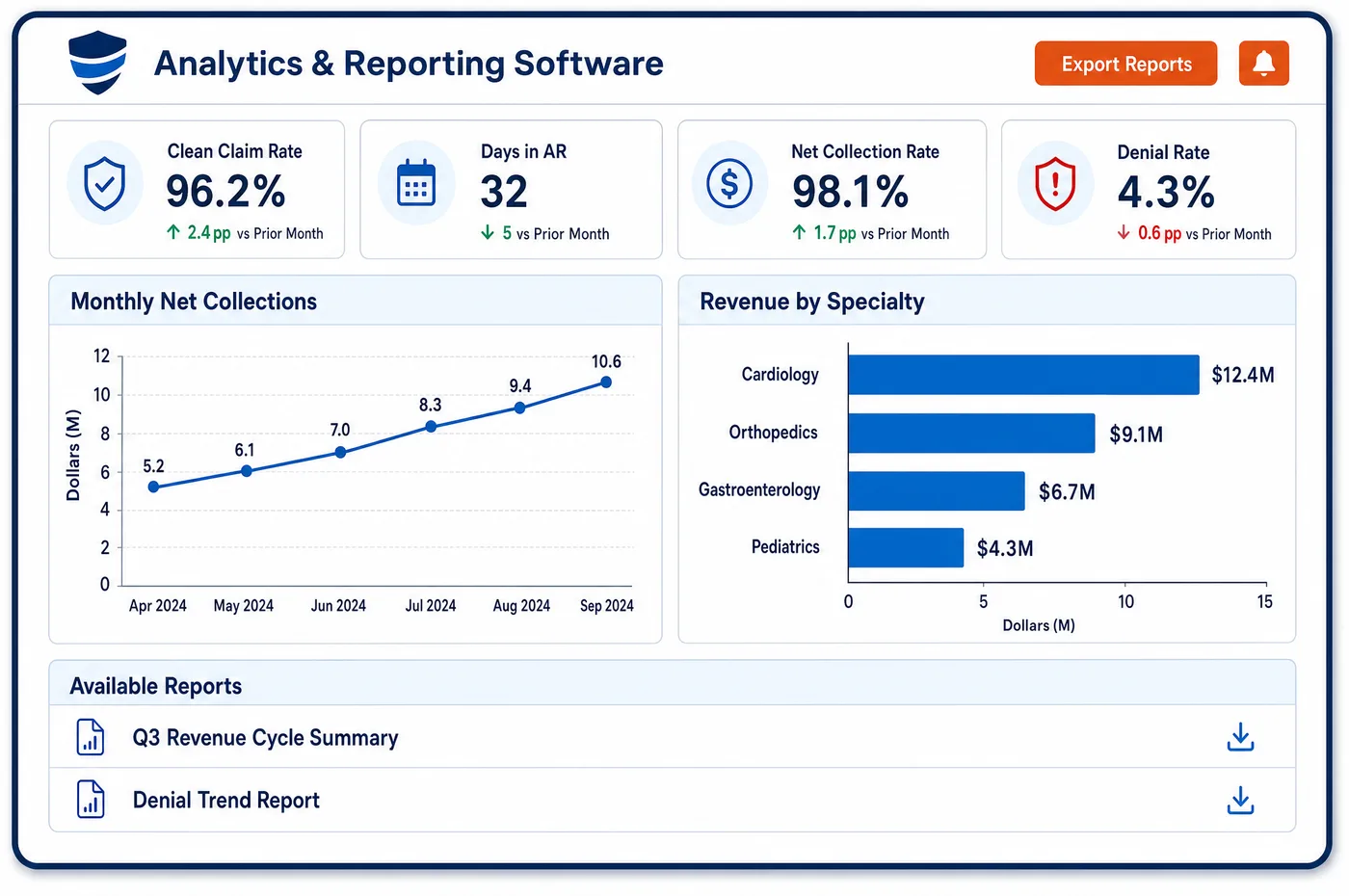
Reporting in a dermatology group serves several audiences at once. Physicians want their own production, including Mohs cases and stages. The lab manager wants specimen volume and how fast results go back to clinicians. The billing team wants denials by payer and reason. Owners and investors want collections, days in AR and margin by site and entity. Unlimited Systems builds these reports from the same records staff work in, so every site reports on the same definitions. A report designer lets administrators pick fields, filters and groupings without writing code. Reports can be scheduled as PDF or CSV and sent to the people who need them, with access controls on each one. Quality reporting draws on the same data, so measures such as melanoma pathology reporting or biopsy reporting time can be counted during the year. For groups with a data warehouse, the data can also sync to Snowflake, Azure Synapse or Amazon Redshift.
Why Is Reporting Different in Dermatology?
Dermatology groups often run many sites with different service mixes. One site may do Mohs every day, another may be mostly medical, and a third may have a cosmetic suite. A group-level report that blends them hides which site is slipping. Reports have to run the same way at every site, then roll up, so a regional manager can compare like with like.
Quality reporting in dermatology has its own detail. The 2026 Dermatological Care MVP includes measures that depend on pathology reports, biopsy timing, melanoma follow-up and psoriasis response. Some are counted on the claim through quality data codes, and others through a registry. A practice that only looks at its quality data at year end has no time to fix a gap. Reporting needs to show measure status during the year.
Owners also need different reports than clinicians. Many dermatology groups answer to a board, a management company or private equity investors. They want consistent monthly packs: collections, payer yield, days in AR, provider production and service-line margin. Building those by hand each month is slow and error-prone, and two people rarely build them the same way. Scheduled reporting from one source removes both problems.
What Dermatology Reporting Software Handles
- Melanoma reporting (Q397)
- Measure 397 counts pathology reports for primary cutaneous melanoma that include the pT category, thickness, ulceration, mitotic rate, margin status and microsatellitosis for invasive tumors. Practices with an in-house dermpath lab can track it from their report data. (CMS 2026 MIPS CQM specification, Quality ID 397: Melanoma Reporting (hosted by the College of American Pathologists))
- Biopsy reporting time (Q440)
- Measure 440 counts skin cancer biopsies where the pathologist sends results to the clinician within seven days of receiving the specimen. Lab turnaround is reported by pathologist and site, so slow weeks show up early. (CMS 2026 MIPS CQM specification, Quality ID 440: Skin Cancer Biopsy Reporting Time, Pathologist to Clinician (hosted by the College of American Pathologists))
- Dermatological Care MVP reporting
- For 2026, MVP reporting means choosing four quality measures from the MVP, with at least one outcome measure. Measure status is reported during the year, so the group can pick the measures it performs best on, using MIPS Value Pathways rules. (CMS Quality Payment Program: 2026 Finalized MIPS Value Pathways (Dermatological Care MVP))
- AAD QCDR measures
- The AAD lists QCDR measures for 2026 such as AAD 6, biopsy reporting time from clinician to patient, and AAD 12, melanoma surgical margins. Report fields can be set up to count the data these measures need. (American Academy of Dermatology: 2026 quality measures for MIPS reporting)
- DataDerm registry submission
- DataDerm is the AAD's clinical data registry, and it offers a 2026 MIPS reporting module. Practices that report through it can use internal reports to check measure data before it is submitted. (American Academy of Dermatology: DataDerm clinical data registry)
How Does Dermatology Reporting Software Work?
1. Define the reports once
Administrators build reports in the report designer, picking fields, filters and groupings. Definitions are shared, so every site reports production and collections the same way.
2. Schedule and send
Reports run on a set schedule and go to the right people as PDF or CSV files. Access controls make sure a site manager sees only their sites and an owner sees the whole group.
3. Report quality during the year
Measure data for MIPS and the Dermatological Care MVP are counted as care happens. Gaps show while there is still time to act, and value-based care in dermatology works from the same counts.
4. Roll up across sites and entities
Each site and entity reports on the same definitions, then rolls up for the group. Owners see payer yield, days in AR and margin for each site next to the total.
5. Investigate and visualize
When a report shows a problem, staff move to dermatology trend analysis to find the cause, or to live dermatology dashboards to watch it day by day.
Dermatology Reporting Software vs. Generic Software
| Area | Generic approach | Unlimited Systems |
|---|---|---|
| Monthly owner packs | Rebuilt by hand from exports each month. | Scheduled from live data on shared definitions. |
| Site comparisons | Each site reports its own way. | Same definitions at every site, then rolled up. |
| Quality measures | Counted at year end. | Counted as care happens, with gaps shown during the year. |
| Lab turnaround | Unknown until a clinician complains. | Reported by pathologist and site. |
| Distribution | Files sent by email by hand. | Reports sent on a schedule as PDF or CSV, limited to approved users. |
Who Uses It in a Dermatology Practice
- Practice administrator: A standard set of reports for every site, sent on schedule, with one definition of production, collections and days in AR.
- Lab manager or dermatopathologist: Specimen volume and biopsy reporting time by pathologist, with melanoma report completeness for the quality measure.
- Owners and board: A consistent monthly pack with payer yield and margin by site and entity, built from the same data the practice works in.
Dermatology Reporting Software FAQs
Dermatology reporting covers production and collections by provider and site, Mohs and pathology volume, denials by payer and reason, payer yield, and days in AR. It also covers quality measures for MIPS. Owners and investors need a consistent monthly pack, and site managers need the same reports for their own sites.
Reports can be scheduled and sent as PDF or CSV files to the people who need them. Each report has access controls, so a site manager sees only their sites. Owners and boards get the same pack each month without anyone exporting data and building it by hand.
The 2026 Dermatological Care MVP includes melanoma reporting (Q397), biopsy reporting time from pathologist to clinician (Q440), melanoma recurrence tracking (Q509), TB screening before a first biologic (Q176), and psoriasis response (Q410), among others. The AAD also offers QCDR measures. Practices can track measure status during the year.
Reports for an in-house lab show specimen volume, reads by pathologist and how fast results go back to clinicians. That supports the biopsy reporting time measure. The lab's revenue and costs can also be reported together, so owners can see whether the lab pays for itself.
Groups that run their own data warehouse can sync data to Snowflake, Azure Synapse or Amazon Redshift. That lets a corporate finance or analytics team combine practice data with other sources, while the practice keeps its standard reports in the platform. Data moves over private, encrypted links.
Report definitions are built once and shared across sites. Production, collections, denial rate and days in AR mean the same thing everywhere. When a new site joins the group, it reports on those same definitions from day one, so the group's roll-up compares like with like.
Related Dermatology Software
Analytics & value-based care
In the revenue cycle
Reporting for related specialties
Sources
- CMS 2026 MIPS CQM specification, Quality ID 397: Melanoma Reporting (hosted by the College of American Pathologists)
- CMS 2026 MIPS CQM specification, Quality ID 440: Skin Cancer Biopsy Reporting Time, Pathologist to Clinician (hosted by the College of American Pathologists)
- CMS Quality Payment Program: 2026 Finalized MIPS Value Pathways (Dermatological Care MVP)
- American Academy of Dermatology: 2026 quality measures for MIPS reporting
- American Academy of Dermatology: DataDerm clinical data registry
GET STARTED
See Unlimited Systems in Action
Whether you're actively evaluating new technology or simply preparing for your next vendor renewal, Unlimited Systems can help you understand where your current workflows may be creating avoidable revenue risk.