

Payments & AR
Dermatology AR Management Software
Work open dermatology claims by value and deadline, from Mohs cases and path-pending excisions to lesion removals a payer called cosmetic.
Dermatology AR Management Software ranks every unpaid skin claim by value, payer and filing deadline. Mohs cases, excisions waiting on pathology, biopsy and dermpath claims, and lesion removals denied as cosmetic each sit in a worklist with an owner. Claim status checks run in bulk, so collectors call only when a payer's answer needs a person.



 6,500+ specialty providers

AR Management in a Dermatology Practice
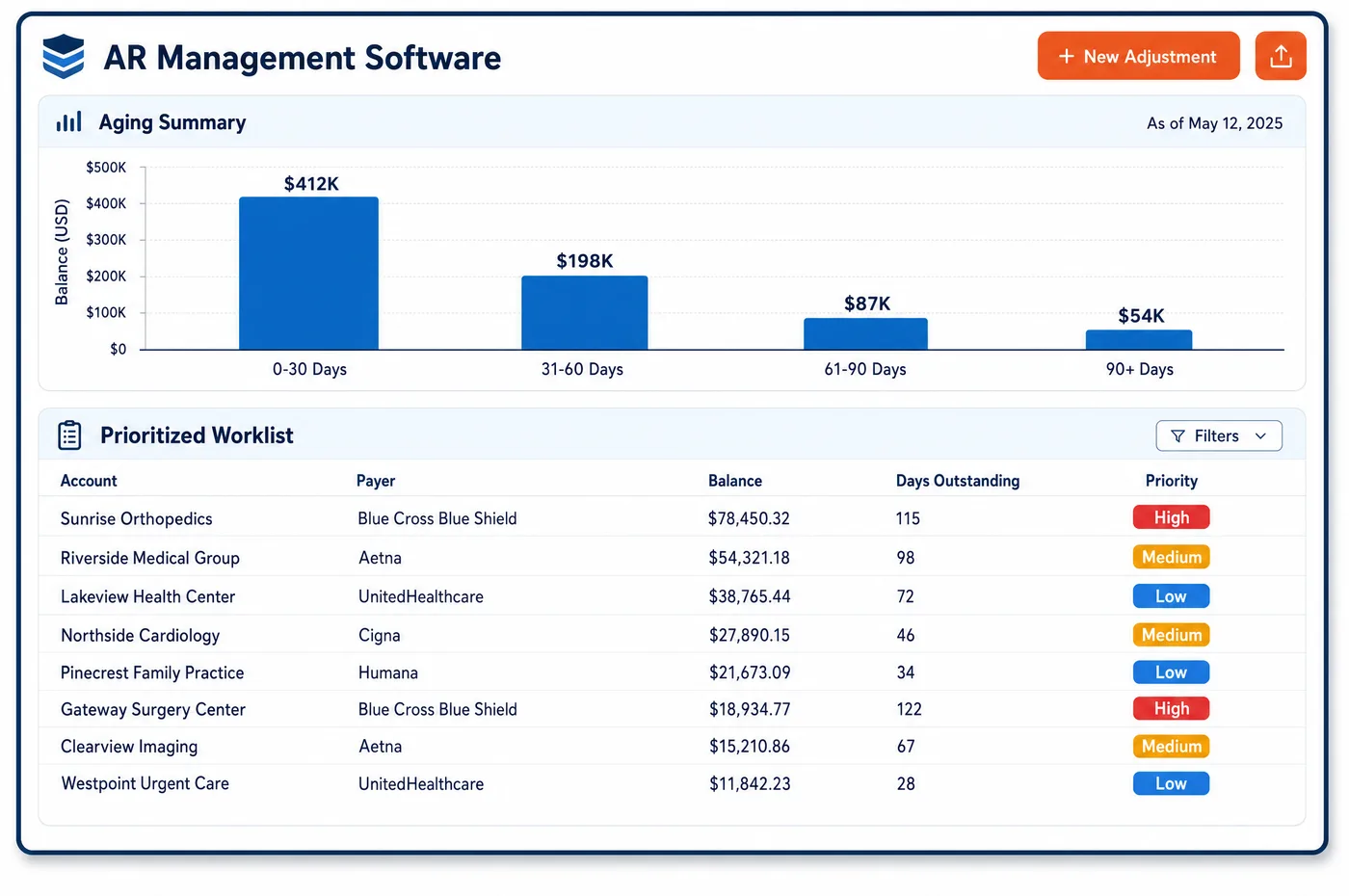
Open dermatology AR has a long tail and a heavy head. Many small visit, biopsy and destruction claims sit next to a few Mohs and reconstruction claims that are worth far more. Unlimited Systems builds worklists that rank each claim by balance, aging bucket and the payer's filing limit, so a large Mohs claim near its deadline is worked before a small one that just went out. Status requests go out in bulk over X12 276, and 277 answers flag claims that are pending, denied or missing. Claims held for a pathology report are tracked as their own list, since they aren't billed yet but still count as earned revenue. When a primary payer pays, the secondary claim is built and sent. Denials for documentation or cosmetic reasons go to staff with the note, photos and LCD criteria they need to answer them.
Why Is AR Management Different in Dermatology?
Pathology timing shapes dermatology AR more than most specialties. The code for an excision depends on whether the lesion was benign or malignant, and that answer comes from the path report. Many practices hold those claims until the report is back. A hold that is never released turns into a claim that is never filed, so held claims need their own aging and an owner.
Mohs claims are fewer but much larger. A single Mohs case with a repair is often worth more than many routine visits. Payers that question a Mohs claim usually want the operative note, the map, and the number of stages and blocks. AR management in a Mohs practice means working those claims first and sending the full record with the first reply, not the third.
Cosmetic denials are their own category. Payers often deny the removal of a seborrheic keratosis, skin tag or cyst as cosmetic. Some of those denials are right, and the balance should move to the patient. Others are wrong, because the chart shows bleeding, itching or inflammation. Collectors need to tell the two apart quickly, before the appeal window or the patient's patience runs out.
What Dermatology AR Management Software Handles
- Medicare filing limit
- A Medicare claim must be filed within one calendar year following the date of service. Worklists track each claim's limit, so a path-pending excision or a corrected Mohs claim isn't lost to timely filing. (eCFR: 42 CFR 424.44, Time limits for filing Medicare claims)
- Mohs documentation requests
- For Medicare in WPS states, the Mohs note must show lesion location, number and size, the stages done and the specimens per stage. Records requests on Mohs claims are routed with that note and the map attached. (CMS Medicare Coverage Database, Billing and Coding Article A57477: Mohs Micrographic Surgery (WPS))
- Benign lesion removal criteria
- The WPS LCD covers removal when the record shows signs such as bleeding, itching, pain, inflammation or recent change. Cosmetic denials are checked against the chart before staff appeal or bill the patient. (CMS Medicare Coverage Database, LCD L35498: Removal of Benign Skin Lesions (WPS))
- Benign vs. malignant excision codes
- Benign excisions (11400 to 11471) and malignant excisions (11600 to 11646) are separate code families. Claims held for the path report sit on a claim hold list with their own aging. (CMS NCCI Policy Manual for Medicare Services, Chapter III (Surgery: Integumentary System))
- X12 276 and 277 status checks
- Claim status requests go to payers in bulk, and 277 replies show which claims are pending, paid or denied. Collectors start with that answer instead of a phone call. (X12 transaction sets: 276/277 claim status, 835 and 837)
How Does Dermatology AR Management Software Work?
1. Build priority worklists
Each morning, open claims are sorted by balance, aging bucket and payer deadline. Mohs and reconstruction claims rise to the top, and small balances are grouped so they can be worked in batches.
2. Release path-pending claims
Claims held for a pathology report are listed by date of service. When the report comes back, coding finishes the claim and it goes out, so no excision waits on a hold no one is watching.
3. Check status in bulk
276 requests go out for claims past the payer's normal pay window. The 277 answers sort them into paid, pending and denied, and only the last two need a person.
4. Answer documentation and cosmetic denials
Records requests and cosmetic denials go to the team that handles dermatology denial management, with the note, photos and LCD criteria attached. Valid cosmetic denials move to the patient instead.
5. File secondaries and close out
When the primary payment posts through dermatology payment posting, the secondary claim is built and sent. Small leftover balances follow the practice's write-off policy, with a reason code on each one.
Dermatology AR Management Software vs. Generic Software
| Area | Generic approach | Unlimited Systems |
|---|---|---|
| Work order | Oldest claim first, no matter its size. | Sorted by balance, aging and filing deadline. |
| Path-pending excisions | Held in a folder and forgotten. | Tracked as a held list with its own aging and owner. |
| Mohs records requests | Note sent first, map and stage count sent later. | Full Mohs record sent with the first reply. |
| Cosmetic denials | All written off or all billed to the patient. | Checked against LCD criteria and the chart first. |
| Claim status | Payer phone calls and portal logins. | Bulk 276 requests with 277 replies sorted for staff. |
Who Uses It in a Dermatology Practice
- AR collector: One priority list each day, with the Mohs claims and near-deadline claims at the top and the record attached to each denial.
- Billing manager: Days in AR and aging buckets by payer, provider and location, plus a count of claims still waiting on pathology.
- Practice owner: Confidence that large surgical claims and held excisions are being worked, and that write-offs are a choice, not an accident.
Dermatology AR Management Software FAQs
AR management for dermatology should track every unpaid claim by balance, payer, age and filing deadline. It should also track claims held for pathology, since they are earned but not billed. Mohs and reconstruction claims need close watch because of their size, and cosmetic denials need their own list because some are valid and some should be appealed.
An excision code depends on whether the lesion was benign or malignant, and the path report decides that. Many practices hold the claim until the report comes back. That hold is normal, but it needs an owner and its own aging. Otherwise a missing report can push the claim past the payer's filing limit.
Mohs records requests are routed to staff with the operative note, the map, and the stage and block counts already attached. For Medicare in WPS states, the billing article lists what the note must show. Sending the full record with the first reply avoids a second request and shortens the time the claim sits open.
A cosmetic denial should not always go to the patient. If the chart shows signs the payer's policy accepts, such as bleeding, itching, pain or inflammation, the denial can be appealed. If it doesn't, the patient is usually liable. Checking the chart against the payer's criteria first protects both the practice's revenue and the patient's trust.
Bulk claim status sends X12 276 requests to payers for claims past their normal pay window. The 277 replies show which claims are paid, pending or denied. Collectors skip the calls for claims that are already moving and spend their time on the ones that are stuck or denied.
Secondary claims are built and sent once the primary payment posts. The amount left after the primary's payment and adjustments becomes the secondary claim. This matters for the many Medicare patients with supplemental plans who come in for skin cancer care. The secondary then moves through the same worklists as any other claim.
Related Dermatology Software
Payments & AR
In the revenue cycle
AR Management for related specialties
Sources
- eCFR: 42 CFR 424.44, Time limits for filing Medicare claims
- CMS Medicare Coverage Database, Billing and Coding Article A57477: Mohs Micrographic Surgery (WPS)
- CMS Medicare Coverage Database, LCD L35498: Removal of Benign Skin Lesions (WPS)
- CMS NCCI Policy Manual for Medicare Services, Chapter III (Surgery: Integumentary System)
- X12 transaction sets: 276/277 claim status, 835 and 837
GET STARTED
See Unlimited Systems in Action
Whether you're actively evaluating new technology or simply preparing for your next vendor renewal, Unlimited Systems can help you understand where your current workflows may be creating avoidable revenue risk.