

Payments & AR
Dermatology Payment Posting Software
Post Mohs stages, excisions, repairs, dermpath components and cosmetic self-pay to one ledger, with every cut tied to its reason code.
Dermatology Payment Posting Software applies 835 remittances and patient payments to every line of a skin claim. Mohs stage units, excision and repair lines, and pathology components each post on their own. Reduction codes stay on the line they hit, cosmetic self-pay posts to the same account, and every batch ties back to a bank deposit.



 6,500+ specialty providers

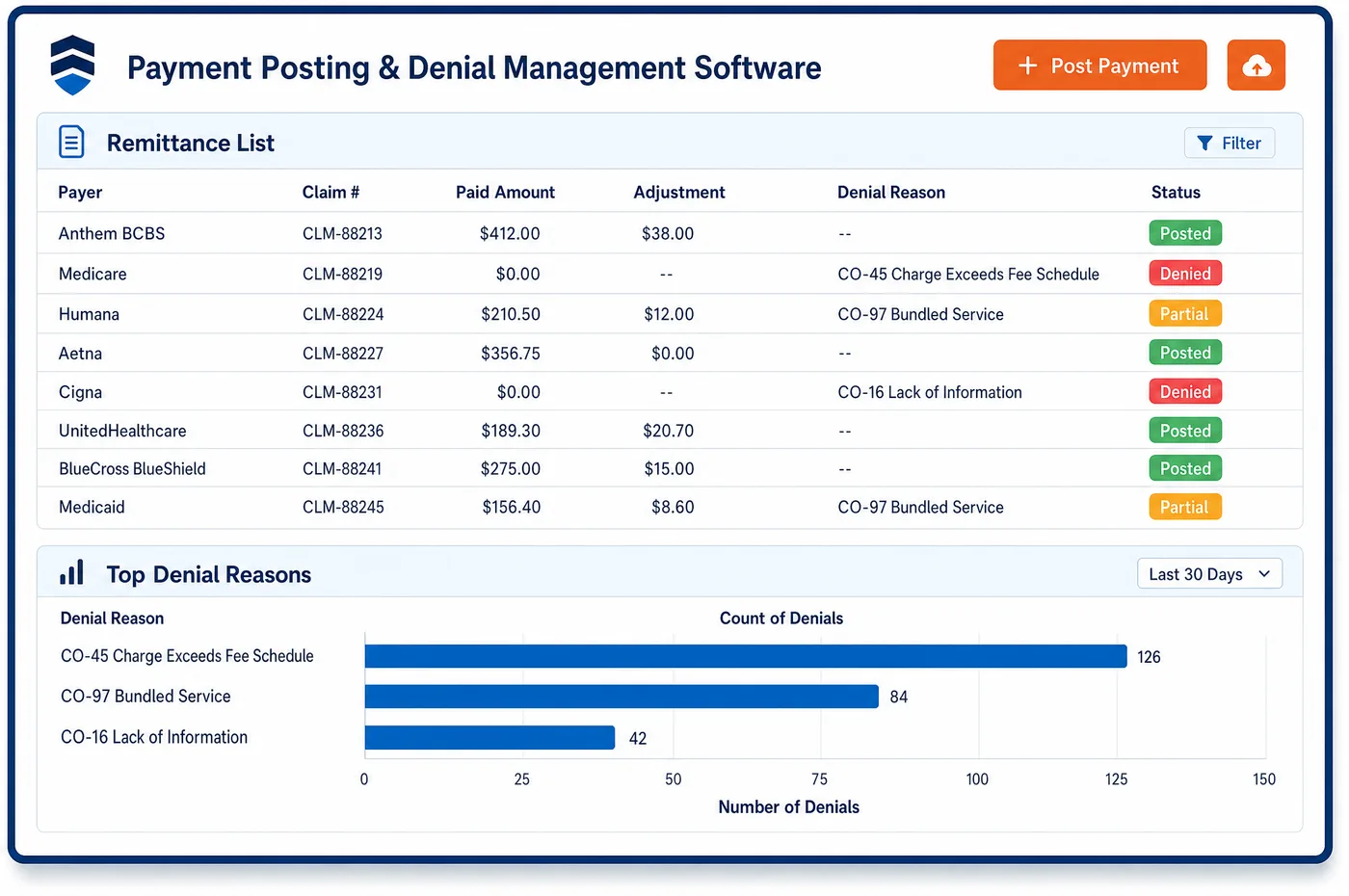
Payment Posting in a Dermatology Practice
A busy dermatology day produces many small claims and a few large ones. A skin check with two biopsies, a Mohs case with three stages and a flap repair, and a patient paying for a cosmetic peel can all land on one deposit. Each electronic remittance is imported and tied to its claim by claim number and line. For each code, the paid amount, contractual adjustment and patient share are posted. When a payer pays fewer Mohs stage units than billed, or reduces a repair under multiple procedure rules, the cut shows on that line with its reason code. Pathology lines post by component, so a global 88305 payment and a technical-only payment look different on the ledger. Copays and cosmetic payments post to the same patient account as insurance. Posted totals are matched to deposits and lockbox files, so the ledger and the bank agree.
Why Is Payment Posting Different in Dermatology?
Dermatology remittances mix units, reductions and bundling on almost every claim. Mohs stages after the first are billed as units of an add-on code, so a short payment can hide in a unit count. Excisions done with repairs on the same day are often paid at a reduced rate for the second procedure. Payment posting has to keep each of those adjustments visible, line by line, instead of netting them into a visit total.
Pathology adds another layer. Some practices run their own dermpath lab, some send every specimen to a reference lab, and many do both. A global 88305 pays for the slide preparation and the read together. A technical or professional component pays for only one part. If posting treats them as the same thing, a practice can't tell a fair payment from a short one, or notice when a payer paid the wrong component.
Cosmetic and medical money also meet at the same front desk. A patient may pay a copay for a skin check and then pay in full for a filler or a chemical peel. Medicare excludes cosmetic surgery from coverage, so those dollars come from the patient, not a remittance. Posting both to one account keeps balances correct and stops a cosmetic payment from being applied to an insurance balance by mistake.
What Dermatology Payment Posting Software Handles
- Mohs stage units (17311 to 17315)
- For Medicare in WPS states, added stages are billed as units on one 17312 or 17314 line, and 17315 counts each block past the first five in a stage. Paid units are checked against billed units, and any cut goes to review with its reason code. (CMS Medicare Coverage Database, Billing and Coding Article A57477: Mohs Micrographic Surgery (WPS))
- CARC 59 on excision and repair claims
- CARC 59 means the line was paid under multiple or concurrent procedure rules. The code stays on the reduced line, so staff can tell an expected reduction from a true underpayment and send the second kind to dermatology AR follow-up. (X12 Claim Adjustment Reason Codes)
- Global, technical and professional 88305 lines
- Medicare pays the professional and technical parts of surgical pathology under separate rules. Posting keeps global, TC and modifier 26 lines apart, so an in-house read and a slide-only payment are never mixed up. (CMS Medicare Claims Processing Manual, Chapter 12: Physicians/Nonphysician Practitioners (multiple surgery and pathology payment))
- CARC 97 on biopsy and excision of one lesion
- Under NCCI, a biopsy of the same lesion that is then removed is part of the removal code. A CARC 97 on that biopsy line is posted as bundled and flagged, so coders can fix the pattern at the source. (CMS NCCI Policy Manual for Medicare Services, Chapter III (Surgery: Integumentary System))
- GY lines for cosmetic services
- When a Medicare patient asks for a claim on a cosmetic service, the GY modifier marks it as statutorily excluded. The denial posts with its reason code and the balance moves to the patient, who was liable from the start. (CMS MLN Booklet: Medicare Advance Written Notices of Non-coverage (MLN006266))
How Does Dermatology Payment Posting Software Work?
1. Import the 835
Each remittance is pulled in as it arrives from the payer or clearinghouse. It is matched to the claim by claim number and then line by line, from E/M codes to Mohs stage lines.
2. Post every code line
Paid amounts, adjustments and patient shares post to each line. A multiple procedure reduction on a repair shows on the repair line, not as a loss on the whole visit.
3. Compare with the contract
Every paid line is compared with what that payer should pay for that code. Short payments on Mohs units or pathology components go to a review queue with the reason code attached.
4. Route denials and takebacks
Zero-pay lines and recoupments are sent to owners by reason code. Bundling and modifier denials go to coding, and coverage denials go to the team that works open claims.
5. Apply copays and self-pay
Copays, coinsurance and cosmetic payments post to the same account as insurance. What remains moves on to dermatology patient statements.
6. Balance to the bank
Deposits and lockbox files are matched to posted payments. Cash, adjustments and recoveries then post as double-entry lines for dermatology accounting.
Dermatology Payment Posting Software vs. Generic Software
| Area | Generic approach | Unlimited Systems |
|---|---|---|
| Mohs payments | A stage-unit cut lost inside the claim total. | Paid units compared with billed units on each Mohs line. |
| Excision with repair | Reduced repair lines written off without review. | CARC 59 kept on the line and checked against the contract. |
| Pathology components | Global, TC and 26 payments posted as one code. | Each component posts on its own line and is checked on its own. |
| Cosmetic payments | Kept in a separate spa or retail system. | Posted to the same patient ledger as insurance payments. |
| Deposits | Matched by hand at month end. | Payments tied out to bank deposits and lockbox files. |
Who Uses It in a Dermatology Practice
- Payment poster: Remittances that post on their own, with only short-paid, bundled or denied lines left to review. Mohs unit cuts show on the line where they happened.
- Billing manager: A clear view of reductions by code and payer, so contract problems on repairs or pathology are raised with the payer instead of written off.
- Practice owner: Cash from medical, surgical, pathology and cosmetic work posted to one ledger and tied to the bank, ready for the month-end close.
Dermatology Payment Posting Software FAQs
Payment posting for a Mohs claim applies each line from the 835 on its own. The first-stage code, the added-stage units and any block units post separately, and the paid units are compared with what was billed. When a payer cuts units, the reason code stays on that line, so staff can appeal a cut that the operative note supports.
Excisions and repairs done in one session are usually paid under multiple procedure rules. The highest-valued procedure pays in full and others are reduced. The 835 marks this with CARC 59. Posting keeps that code on the repair line, so a reduction the contract allows is not mixed up with an underpayment that should be worked.
Pathology payments post by component. A global 88305 line covers both the slide work and the read. A line with TC or modifier 26 covers only one part. When the practice's own lab and an outside pathologist split the work, each payment lands on the right line, and short payments for either component go to review.
Medicare does not cover cosmetic surgery. If a patient asks for a claim anyway, the line carries the GY modifier and comes back denied. Posting records the denial with its reason code and moves the balance to the patient. Most cosmetic work is simply paid at the visit and posted as self-pay without any claim.
Cosmetic payments post to the same patient account as copays and insurance payments. Staff see one balance for the patient, split by what insurance owes and what the patient owes. That stops a cosmetic payment from being applied to a medical balance by mistake, and it keeps self-pay revenue visible in the same reports.
Each posted batch is matched to the deposit or lockbox file it came from. Card payments taken at the desk are matched too. When a deposit and the posted total don't agree, the gap is flagged for the poster. The ledger then carries cash and adjustments into the general ledger as double-entry lines.
Related Dermatology Software
Payments & AR
In the revenue cycle
Payment Posting for related specialties
Sources
- CMS Medicare Coverage Database, Billing and Coding Article A57477: Mohs Micrographic Surgery (WPS)
- X12 Claim Adjustment Reason Codes
- CMS Medicare Claims Processing Manual, Chapter 12: Physicians/Nonphysician Practitioners (multiple surgery and pathology payment)
- CMS NCCI Policy Manual for Medicare Services, Chapter III (Surgery: Integumentary System)
- CMS MLN Booklet: Medicare Advance Written Notices of Non-coverage (MLN006266)
GET STARTED
See Unlimited Systems in Action
Whether you're actively evaluating new technology or simply preparing for your next vendor renewal, Unlimited Systems can help you understand where your current workflows may be creating avoidable revenue risk.