

Analytics & value-based care
Dermatology Analytics Software
See why dermatology numbers move: Mohs stages per case, phototherapy and biologic volume, cosmetic mix, and the denials behind each payer's results.
Dermatology Analytics Software shows how a skin practice performs and why its numbers change. It tracks Mohs cases and stages, biopsy and pathology volume, phototherapy sessions, biologic patients and cosmetic revenue next to collections, denials and days in AR. Each figure can be traced to the payer, provider, location and claim behind it.



 6,500+ specialty providers

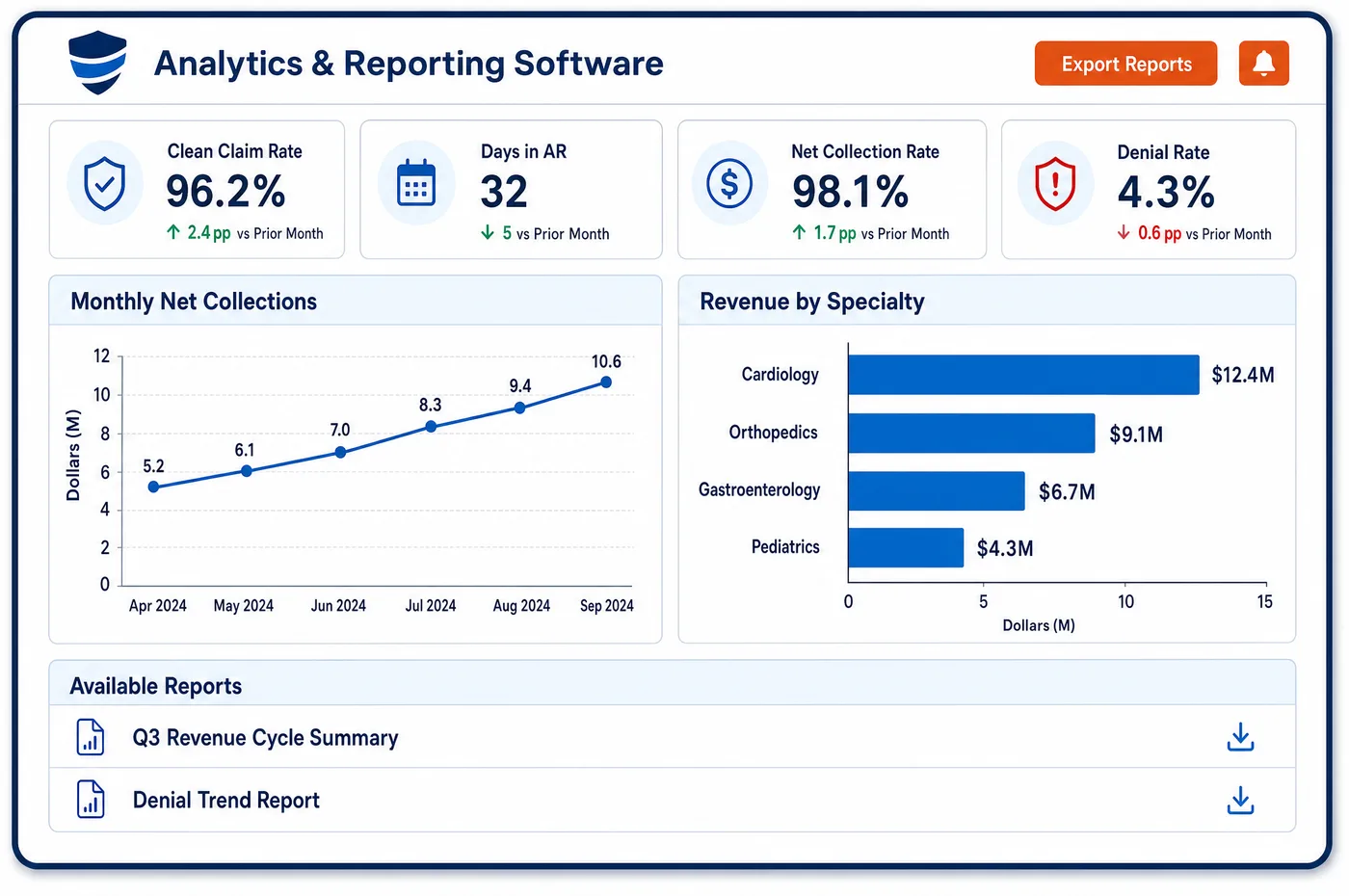
Analytics in a Dermatology Practice
Dermatology results come from several service lines that move for different reasons. Mohs revenue depends on case count and on how many stages and repairs each case needs. Pathology revenue depends on whether slides are read in-house or sent out. Phototherapy depends on session counts and on payer limits. Cosmetic revenue rises and falls with demand, not with payer rules. Unlimited Systems brings clinical, scheduling and billing data onto one foundation, so analytics can explain a change instead of just showing it. A drop in Mohs collections can be traced to fewer cases, fewer stages per case, or more stage units cut by one payer. A rise in denials can be traced to a single modifier, such as 25 on same-day visits. Results can be compared with the practice's own history and with regional and national specialty benchmarks, so leaders know whether a number is a problem or normal.
Why Is Analytics Different in Dermatology?
Totals hide most of what matters in dermatology. A practice-wide collection figure blends a high-volume medical line, a surgical line with large claims, a lab line, and a self-pay cosmetic line. Any one of them can drop while the total holds steady. Useful analytics split results by service line first, then by provider and location, and only then roll back up.
Volume drivers also differ by line. For Mohs, the questions are cases per surgeon day, stages per case and how often a repair or flap follows. For phototherapy, they are sessions per patient and how many patients reach their payer's limit. For biologic care, they are the number of active patients, open prior authorizations and required screenings. Analytics that count only visits miss all of these.
Denial patterns in dermatology tend to cluster around a few modifiers and policies. Same-day E/M with a procedure leans on modifier 25. A diagnostic biopsy before Mohs leans on modifier 59, XS or 58. Benign lesion removals lean on LCD symptom criteria. Seeing which of these is driving denials, by payer and by provider, tells a practice where to spend its coding education time.
What Dermatology Analytics Software Handles
- Mohs stages and blocks per case
- For Medicare in WPS states, added stages bill as units of 17312 or 17314, and 17315 counts each block past five in a stage. Units per case are trended by surgeon and site, so changes in case mix show up early. (CMS Medicare Coverage Database, Billing and Coding Article A57477: Mohs Micrographic Surgery (WPS))
- Phototherapy and excimer volume
- Sessions are counted by code, from 96900 and 96910 to 96912 and the excimer codes 96920 to 96922, which are set by total treated area. Volume is shown by payer, since many plans set their own session limits. (Medica Coverage Policy: Light Treatment and Laser Therapies for Benign Dermatologic Conditions (codes 96900 to 96922))
- PUVA coverage for Medicare
- Medicare's national coverage decision covers PUVA for intractable, disabling psoriasis after conventional treatment has failed. PUVA patients are tracked so the practice can see which ones have that history documented. (CMS National Coverage Determination 250.1: Treatment of Psoriasis)
- Diagnostic biopsy before Mohs
- Under NCCI, a biopsy and frozen section done to diagnose a skin cancer before Mohs can be billed with modifier 59, XS, XU or 58. Denials on those lines are trended by payer, apart from Mohs denials. (CMS NCCI Policy Manual for Medicare Services, Chapter III (Surgery: Integumentary System))
- Biologic patient measures (Q176 and Q410)
- The 2026 Dermatological Care MVP includes TB screening before a first biologic (Q176) and psoriasis response to systemic drugs (Q410). Active biologic patients are counted against both, so gaps show before year end. (CMS Quality Payment Program: 2026 Finalized MIPS Value Pathways (Dermatological Care MVP))
How Does Dermatology Analytics Software Work?
1. Bring the data together
Clinical, scheduling and billing data are joined on one foundation. Mohs stages, phototherapy sessions and cosmetic sales count from the same records staff work in every day.
2. Split by service line
Results are split into medical, Mohs and surgical, pathology, phototherapy, biologic and cosmetic lines. Each line has its own volume, payer mix and collections.
3. Find the cause
When a number moves, users drill from the KPI to the payer, provider and claim. A rise in denials can be traced to one modifier, such as modifier 25 on same-day visits.
4. Compare with benchmarks
Results are compared with the practice's own history and with regional and national specialty averages. Leaders see which gaps are real and which are normal for dermatology.
5. Share and act
Findings go out as scheduled reports through dermatology reporting and as live views in dermatology dashboards. Denial causes feed back into claim rules, so the fix reaches the next claim.
Dermatology Analytics Software vs. Generic Software
| Area | Generic approach | Unlimited Systems |
|---|---|---|
| Service lines | One collection total for the practice. | Medical, Mohs, pathology, phototherapy, biologic and cosmetic split apart. |
| Mohs volume | Case counts only. | Stages, blocks and repairs per case by surgeon. |
| Denial causes | Denial rate by payer. | Denials traced to the modifier or policy behind them. |
| Benchmarks | No outside comparison. | Regional and national specialty averages. |
| Data source | Exports merged by hand each week. | One data foundation shared with daily work. |
Who Uses It in a Dermatology Practice
- Practice administrator: Service-line results by location and provider, with the reason behind each change one click away.
- Mohs surgeon or medical director: Stages per case, repair mix and payer cuts for the surgical line, plus biologic and phototherapy panels for value-based care in dermatology.
- Billing manager: Denial trends by modifier, payer and provider, plus key performance indicators such as clean-claim rate and days in AR.
Dermatology Analytics Software FAQs
The analytics that matter most in dermatology split results by service line. Mohs needs cases, stages and repairs per case. Pathology needs in-house and sent-out volume. Phototherapy and biologic care need session counts, active patients and payer limits. Cosmetic needs self-pay revenue. Collections, denials and days in AR then sit next to each line.
Mohs revenue can fall because there were fewer cases, fewer stages per case, fewer repairs, or more stage units cut by a payer. Drilling from the Mohs total to surgeon, payer and claim shows which one it was. Each answer points to a different fix, from scheduling to coding to a payer dispute.
Phototherapy sessions can be counted by code and by payer. That shows how many sessions each patient has had, which payers set limits, and how close patients are to them. Practices use that view to plan light-box and excimer schedules and to start renewal requests before a patient's course is cut off.
Benchmarks show whether a number is a problem or simply normal for dermatology. Results are compared with the practice's own history and with regional and national specialty averages. A denial rate or days in AR figure that looks high may turn out to be typical, while a quieter metric may show a real gap.
Biologic patients can be counted and followed in analytics. The view shows active patients by drug and payer, open prior authorizations, and whether the TB screening the quality measure needs was done. The same panel supports the psoriasis response measure, so gaps are found while there is still time to close them.
Cosmetic and medical results are always shown apart. Cosmetic revenue is self-pay and moves with demand, while medical revenue follows payer rules and contracts. Blending them hides trends in both. Splitting them lets leaders see, for example, that cosmetic growth is covering a drop in insured Mohs collections.
Related Dermatology Software
Analytics & value-based care
In the revenue cycle
Analytics for related specialties
Sources
- CMS Medicare Coverage Database, Billing and Coding Article A57477: Mohs Micrographic Surgery (WPS)
- Medica Coverage Policy: Light Treatment and Laser Therapies for Benign Dermatologic Conditions (codes 96900 to 96922)
- CMS National Coverage Determination 250.1: Treatment of Psoriasis
- CMS NCCI Policy Manual for Medicare Services, Chapter III (Surgery: Integumentary System)
- CMS Quality Payment Program: 2026 Finalized MIPS Value Pathways (Dermatological Care MVP)
GET STARTED
See Unlimited Systems in Action
Whether you're actively evaluating new technology or simply preparing for your next vendor renewal, Unlimited Systems can help you understand where your current workflows may be creating avoidable revenue risk.