

Platform & AI
Orthopedics Platform System Design
A cloud platform shaped around how orthopedic groups are built: many clinics, an ASC, ancillaries, injury cases and one patient record.
Orthopedics Platform System Design is the cloud architecture under Unlimited Systems' orthopedic workflows. It models a group with many clinics, an ASC and ancillary businesses as separate entities on one platform. It keeps one patient record across all of them, tracks injury cases apart from routine care, and secures every record under HIPAA.



 6,500+ specialty providers

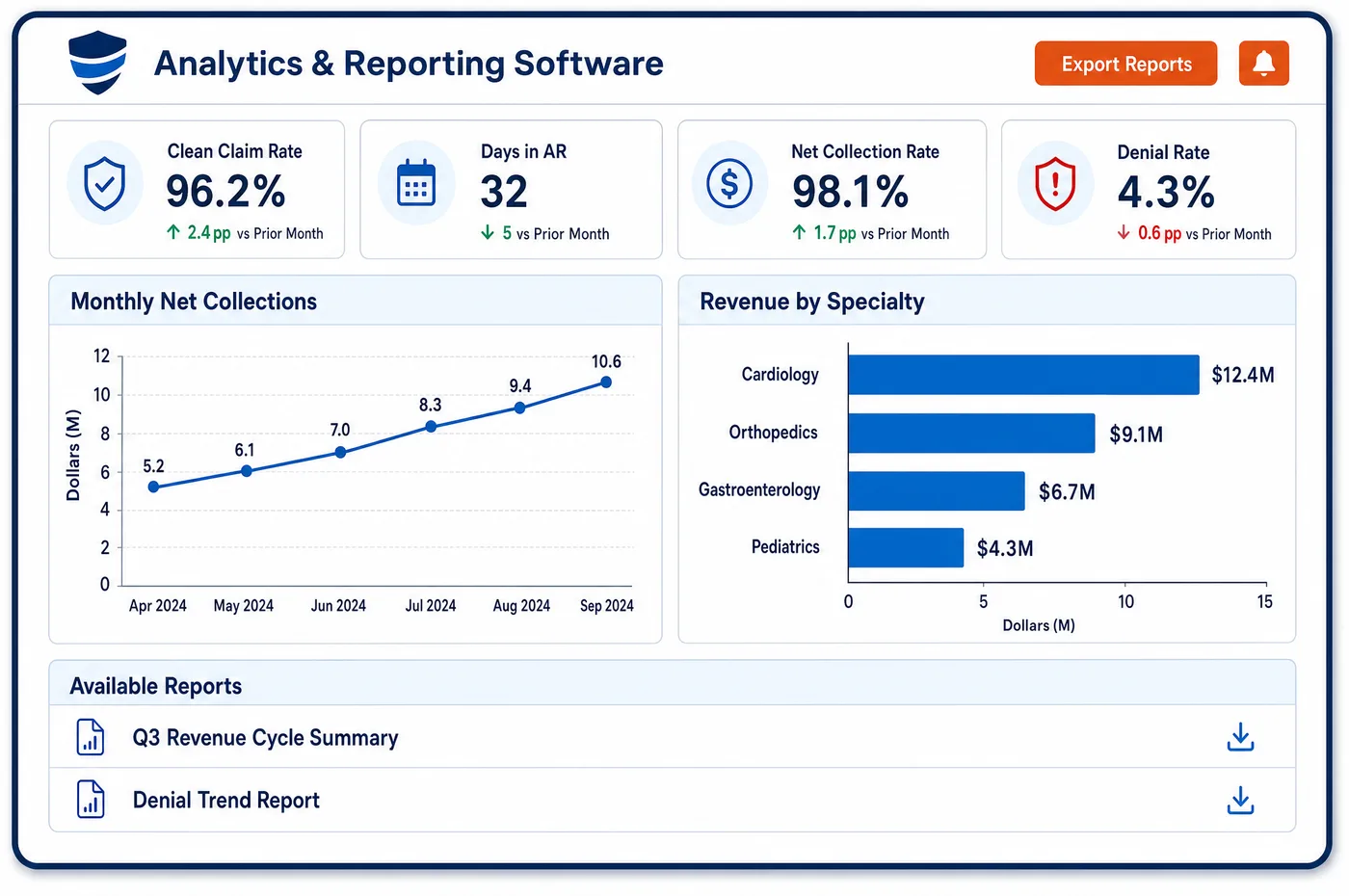
Platform System Design in a Orthopedics Practice
Orthopedic groups grow by adding sites and businesses. A group may start with two clinics, then add an ASC, an MRI suite, physical therapy and a DME line. Each may have its own tax ID, its own Type 2 NPI and its own payer contracts. The platform system design treats each as its own entity with its own ledger, fee schedules and claim settings. The patient record stays shared, so a patient seen at the clinic, scanned at the MRI suite and treated at the ASC has one chart and one balance view. The data model also allows one patient to have several open cases at once, such as a work injury to the left shoulder and a health plan claim for the right knee. Each case keeps its own payer, laterality, dates and documents. The system runs in a HIPAA-compliant cloud with redundant, offsite backups, so every site works in a browser on live data.
Why Is Platform System Design Different in Orthopedics?
Most billing systems assume one practice, one tax ID and one kind of claim. Orthopedic groups break that model. The surgeons bill professional claims under the group's NPI. The ASC bills facility claims under its own Type 2 NPI. Imaging may bill global, professional or technical components. Each entity needs its own contracts and books, yet owners want to see the whole group. A design that bolts entities together later forces staff to log in to several systems and reconcile them by hand.
Injury care adds a second dimension. A patient can be a health plan patient for one problem and a work injury patient for another, at the same time and at the same site. Workers' compensation cases follow the rules of the state where the injury happened. Auto cases may involve a no-fault carrier and an attorney. If the data model stores payer at the patient level, every one of these cases is a workaround. Storing it at the case level fixes that at the root.
Scale and security finish the picture. A large group may run dozens of clinics and several ASCs, with staff who should see only their own sites. Access must follow the HIPAA minimum necessary standard, every action must be logged, and the system must stay up during clinic hours at every site. Those choices are made in the architecture, long before any screen is built. Ledger design feeds orthopedic accounting, and outside exchange runs through orthopedic interoperability.
What Orthopedics Platform System Design Handles
- Type 1 and Type 2 NPIs by entity
- Each surgeon's Type 1 NPI and each entity's Type 2 NPI are stored once and used on the right claims. Professional and ASC claims never borrow each other's IDs. (CMS National Plan and Provider Enumeration System (NPPES))
- ASC facility claims
- ASC claims are set up as their own entity with the ASC payment rules and covered procedure list. Facility and professional revenue for one case stay linked but are booked apart. (CMS Ambulatory Surgical Center (ASC) Payment)
- HIPAA Security Rule safeguards
- The Security Rule requires administrative, physical and technical safeguards, including access controls, audit controls and encryption safeguards for electronic health data. The platform meets them with access controls, audit logs, backups and its own choice of AES-256 encryption. (45 CFR Part 164 Subpart C: HIPAA Security Standards)
- Minimum necessary access
- Staff see only the sites, entities and records their roles need. That supports the HIPAA Privacy Rule's minimum necessary standard across a large group. (45 CFR Part 164 Subpart E: HIPAA Privacy of Individually Identifiable Health Information)
- Security program framework
- The NIST Cybersecurity Framework gives groups a common way to judge a vendor's threat monitoring, response and recovery. In a security review, the platform's monitoring and backups can be mapped to it. (NIST Cybersecurity Framework)
How Does Orthopedics Platform System Design Work?
1. Set up the entities
Each clinic group, ASC and ancillary business is set up with its tax ID, NPI, fee schedules and bank accounts. Owners choose how the entities roll up.
2. Share the patient record
One patient record serves every site and entity. Demographics and insurance are entered once.
3. Open cases, not just visits
Each injury or episode opens a case with its own payer, laterality and dates. Visits, claims and documents attach to the case.
4. Control access
Roles set which sites, entities and records each user can see. Every view and change is logged.
5. Run and protect
The platform runs in a HIPAA-compliant cloud with redundant backups and threat monitoring. Sites work in a browser, with no local servers to keep.
6. Grow without rebuilding
New clinics, ASCs or service lines are added as entities on the same platform. Their data joins the group's reports from the first day.
Orthopedics Platform System Design vs. Generic Software
| Area | Generic approach | Unlimited Systems |
|---|---|---|
| Entities | One practice per database, joined by exports. | Many entities on one platform with their own ledgers. |
| Payer data | Stored at the patient level. | Stored at the case level, so injury cases stay separate. |
| Access | Everyone sees every site. | Roles limit users to the sites and records they need. |
| Hosting | Servers in a back office closet. | HIPAA-compliant cloud with offsite backups. |
| Growth | Each new site means a new system. | New sites added as entities on the same platform. |
Who Uses It in a Orthopedics Practice
- Physician owners: One view of the whole group, with each clinic, ASC and ancillary business still keeping its own books.
- IT and security lead: Encryption, audit logs, role-based access and backups designed in, plus a BAA that covers the platform.
- Operations director: New clinics and service lines added without a new system, so staff use the same tools at every site.
Orthopedics Platform System Design FAQs
Platform system design is how the software is built underneath the screens. For an orthopedic group, that means many entities, such as clinics, an ASC and ancillaries, on one platform with their own ledgers. It also means one shared patient record, injury cases kept apart from routine care, role-based access and a secure, always-on cloud.
The ASC and the physician group are set up as separate entities, each with its own tax ID, NPI, fee schedules and ledger. A surgical case links the surgeon's professional claim and the ASC's facility claim, so the full case is visible. Revenue is booked to each entity on its own, and owners can roll both up.
The data model stores payer and case details at the case level, not the patient level. One patient can have a work injury case for the left shoulder and a health plan case for the right knee at the same time. Each case keeps its own payer, dates, laterality and documents, and each bills correctly.
Data is encrypted in transit and at rest with AES-256. Role-based access limits each user to the sites and records they need, and every view and change is logged. The platform runs in a HIPAA-compliant cloud with redundant offsite backups and threat monitoring. A business associate agreement covers the platform.
A new clinic or ASC is added as an entity on the same platform. It gets its own tax ID, NPI, fee schedules and bank accounts, while sharing the patient record and tools with the rest of the group. Staff do not learn a new system, and the new site's data appears in group reports right away.
No local servers are needed. Each site works in a web browser on the same live data, hosted in a HIPAA-compliant cloud. Backups are redundant and kept offsite. That lets a group add sites without buying hardware, and it keeps a problem at one clinic from taking down the others.
Related Orthopedics Software
Platform & AI
In the revenue cycle
Platform System Design for related specialties
Sources
GET STARTED
See Unlimited Systems in Action
Whether you're actively evaluating new technology or simply preparing for your next vendor renewal, Unlimited Systems can help you understand where your current workflows may be creating avoidable revenue risk.