

Analytics & value-based care
Orthopedics Value-Based Care Software
Track joint replacement episodes, MIPS joint measures and patient-reported outcomes in the same system that bills the case.
Orthopedics Value-Based Care Software gives an orthopedic group the data it needs for quality programs and episode contracts. It captures functional status and shared decision-making for MIPS joint measures, tracks the cost and events of each joint replacement episode, and keeps shared savings and risk terms in the ledger beside the claims.



 6,500+ specialty providers

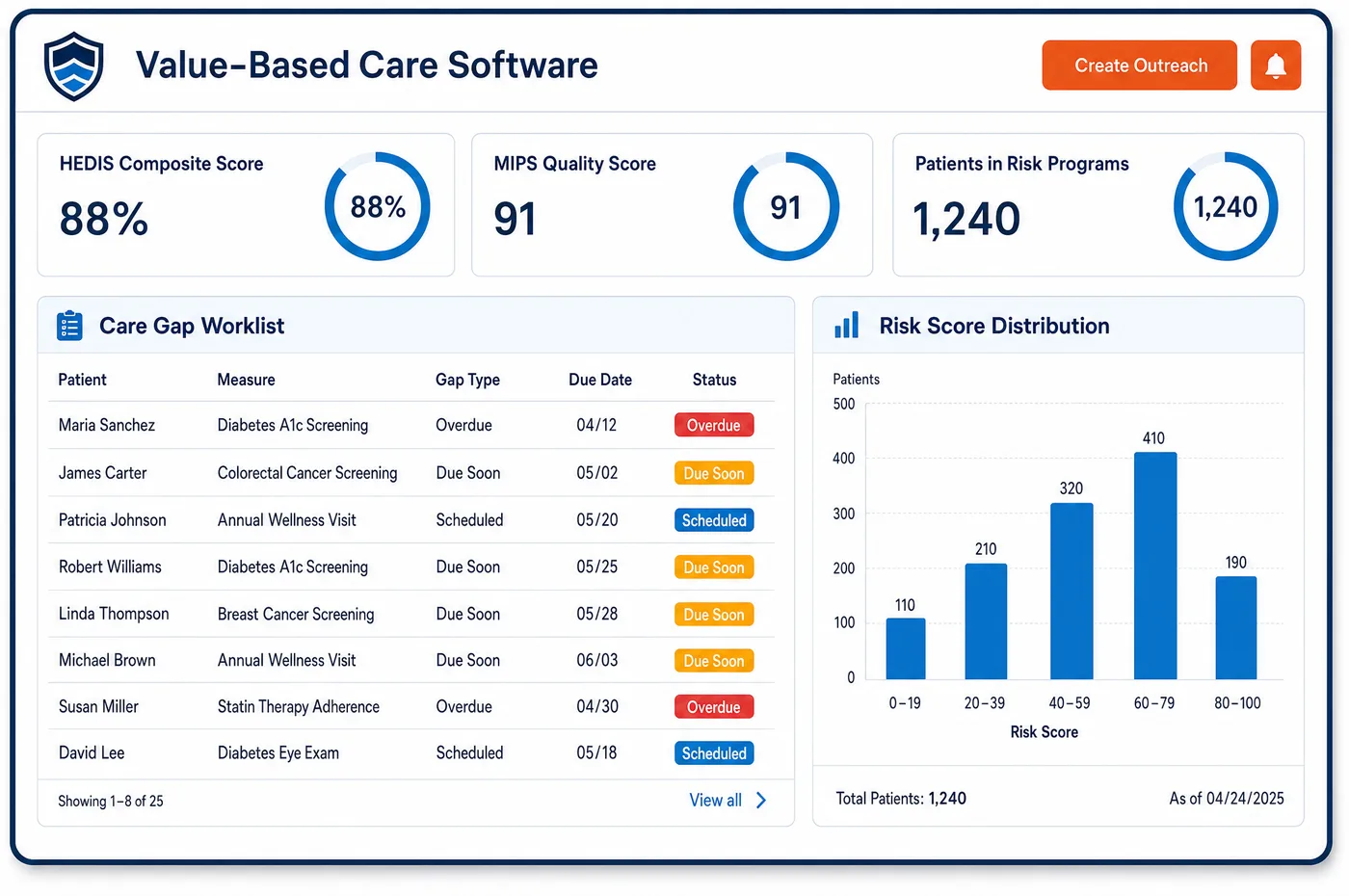
Value-Based Care in a Orthopedics Practice
Joint replacement has been the test case for Medicare bundles. The CJR model ran through the end of 2024, and BPCI Advanced ended at the close of 2025. In 2026 CMS started TEAM, a mandatory model in which selected hospitals are held to a target price for lower extremity joint replacement, hip and femur fracture surgery, spinal fusion and other procedures. Surgeons are not TEAM participants, but hospitals look to them to manage the episode. On the physician side, the joint repair MIPS Value Pathway scores quality, cost and improvement activities. Value-based care software brings those needs together. It collects functional status before and after surgery, flags missing shared decision-making notes while the visit is open, and follows each episode from surgery through discharge and post-acute care. Cost and quality results then sit in one place for the group and its hospital partners.
Why Is Value-Based Care Different in Orthopedics?
Orthopedics faces more bundled payments than most specialties. Hip and knee replacement are high-volume, high-cost and fairly standard, which makes them easy to price as an episode. Hospitals in TEAM and payers with their own bundles want surgeons to keep costs down and outcomes up. The surgeon's choices, such as the implant used, the site of surgery and the discharge plan, drive much of the episode cost.
Quality data for orthopedic programs is easy to miss. MIPS measures for total joints ask whether a trial of conservative therapy was discussed, whether risk was checked, and how function changed after surgery. That data has to be captured at the right visit. If a functional status survey was not done before surgery, it cannot be done later. Value-based care software has to prompt for the data while the patient is still in the clinic.
Episode costs also run past the practice. Each episode of care includes the hospital or ASC stay, physical therapy, home health or a skilled nursing stay, and any readmission. Groups that see those costs during the episode can act on them. Groups that wait for a year-end reconciliation can only explain them. Value-based care feeds the same data to orthopedic analytics and to pre-op and post-op outreach through patient engagement.
What Orthopedics Value-Based Care Software Handles
- TEAM episodes for joint replacement
- Joint replacement, hip fracture and spinal fusion cases at TEAM hospitals are flagged at scheduling. The group can follow each episode the hospital is accountable for and bring its own data to the table. (CMS Transforming Episode Accountability Model (TEAM))
- Lower extremity joint repair MVP (G0058)
- Measures such as Quality ID 350, 351, 376 and 470 are prompted at the visits where their data is captured. Missing items are flagged before the encounter closes. (CMS: CY 2026 Finalized MIPS Value Pathways (MVPs) Guide)
- MIPS cost measures for hip and knee arthroplasty
- The Elective Primary Hip Arthroplasty and Knee Arthroplasty cost measures are tracked beside the cases they score. Surgeons see which choices push episode cost up. (CMS: CY 2026 Finalized MIPS Value Pathways (MVPs) Guide)
- CJR lessons for episode tracking
- CJR held hospitals accountable for joint replacement episode cost and quality for eight performance years. Its episode logic still shapes how groups track post-acute use and readmissions. (CMS Comprehensive Care for Joint Replacement Model)
- BPCI Advanced clinical episodes
- Groups that took part in BPCI Advanced kept episode data for major joint and spine episodes. That history helps set fair baselines for new payer contracts. (CMS BPCI Advanced)
How Does Orthopedics Value-Based Care Software Work?
1. Flag the episode
Cases that fall under TEAM or a payer bundle are flagged when surgery is scheduled. The episode record opens with the surgeon, site and implant plan.
2. Capture baseline data
Functional status surveys and shared decision-making notes are prompted at the pre-op visit. The visit cannot close until missing items are dealt with.
3. Follow the episode
Hospital or ASC stay, discharge plan, therapy and any readmission are tracked as they happen. Post-acute use is visible while the episode is open.
4. Collect outcomes
Follow-up surveys go out after surgery at the points each measure requires. Results flow back into the patient record.
5. Report and reconcile
Quality data is prepared for MIPS submission. Episode costs and shared savings terms are tracked in the ledger against each contract.
Orthopedics Value-Based Care Software vs. Generic Software
| Area | Generic approach | Unlimited Systems |
|---|---|---|
| Quality data | Found missing at submission time. | Prompted at the visit where it must be captured. |
| Episode costs | Seen only in the year-end reconciliation. | Tracked while the episode is still open. |
| Outcome surveys | Paper forms, collected unevenly. | Sent electronically before and after surgery. |
| Contract terms | Kept in a spreadsheet by the finance team. | Shared savings and risk tracked in the ledger. |
| Hospital partners | Data shared only when asked. | Episode data kept in one place for talks with partner hospitals. |
Who Uses It in a Orthopedics Practice
- Surgeon: Episode cost and outcome data for their own cases, including the measures that shape their MIPS score.
- Quality coordinator: A list of open joint cases with missing survey or decision-making data, while the visit can still be fixed.
- Physician owner or CFO: A view of shared savings and risk under each bundle, tracked in the ledger beside the claims.
Orthopedics Value-Based Care Software FAQs
Value-based care for orthopedics now centers on joint replacement episodes and MIPS. CMS ended CJR and BPCI Advanced and started TEAM, a mandatory hospital model that includes joint replacement, hip fracture surgery and spinal fusion. Surgeons also report through the joint repair MIPS Value Pathway. Groups need episode data and quality data from the same system.
TEAM participants are the selected acute care hospitals, not surgeons. The hospital is held to a target price for each episode, which covers the surgery and care after discharge. Hospitals depend on their surgeons to manage that cost, so orthopedic groups that track episode data are better placed to work with a TEAM hospital.
The joint repair MIPS Value Pathway includes quality measures such as Quality ID 350 on a trial of conservative therapy, 351 on risk evaluation, 376 on hip function and 470 on knee function after surgery. It also includes cost measures for elective hip arthroplasty and knee arthroplasty. The software prompts for each measure's data at the right visit.
Functional status surveys go to the patient before surgery and again at the follow-up points each measure requires. Patients can complete them on a phone or in the clinic. Results flow into the patient record. If a pre-op survey is missing, the surgeon is prompted before the visit closes, since it cannot be done after surgery.
Episode events, such as the hospital or ASC stay, therapy, skilled nursing and readmissions, are tracked as they happen. The group can see which episodes are running high while there is still time to act. That is far more useful than learning the result in a year-end reconciliation report.
Shared savings and downside risk terms for each contract are tracked in the ledger beside the claims for the episodes they cover. Finance can see expected gains or losses as episodes close. That helps avoid surprises when the payer or hospital sends its reconciliation.
Related Orthopedics Software
Analytics & value-based care
In the revenue cycle
Value-Based Care for related specialties
Sources
GET STARTED
See Unlimited Systems in Action
Whether you're actively evaluating new technology or simply preparing for your next vendor renewal, Unlimited Systems can help you understand where your current workflows may be creating avoidable revenue risk.