

Billing & claims
Addiction Medicine Charge Validation Software
Check drug testing orders, injection diagnoses, telehealth modifiers, lab certificates and frequency limits before an addiction claim goes out.
Addiction Medicine Charge Validation Software checks each charge line against payer rules and the record before it becomes a claim. It checks drug tests against coverage policy and confirms the diagnosis and dose behind each injection. It also checks telehealth modifiers on OTP add-ons and the lab's certificate.



 6,500+ specialty providers

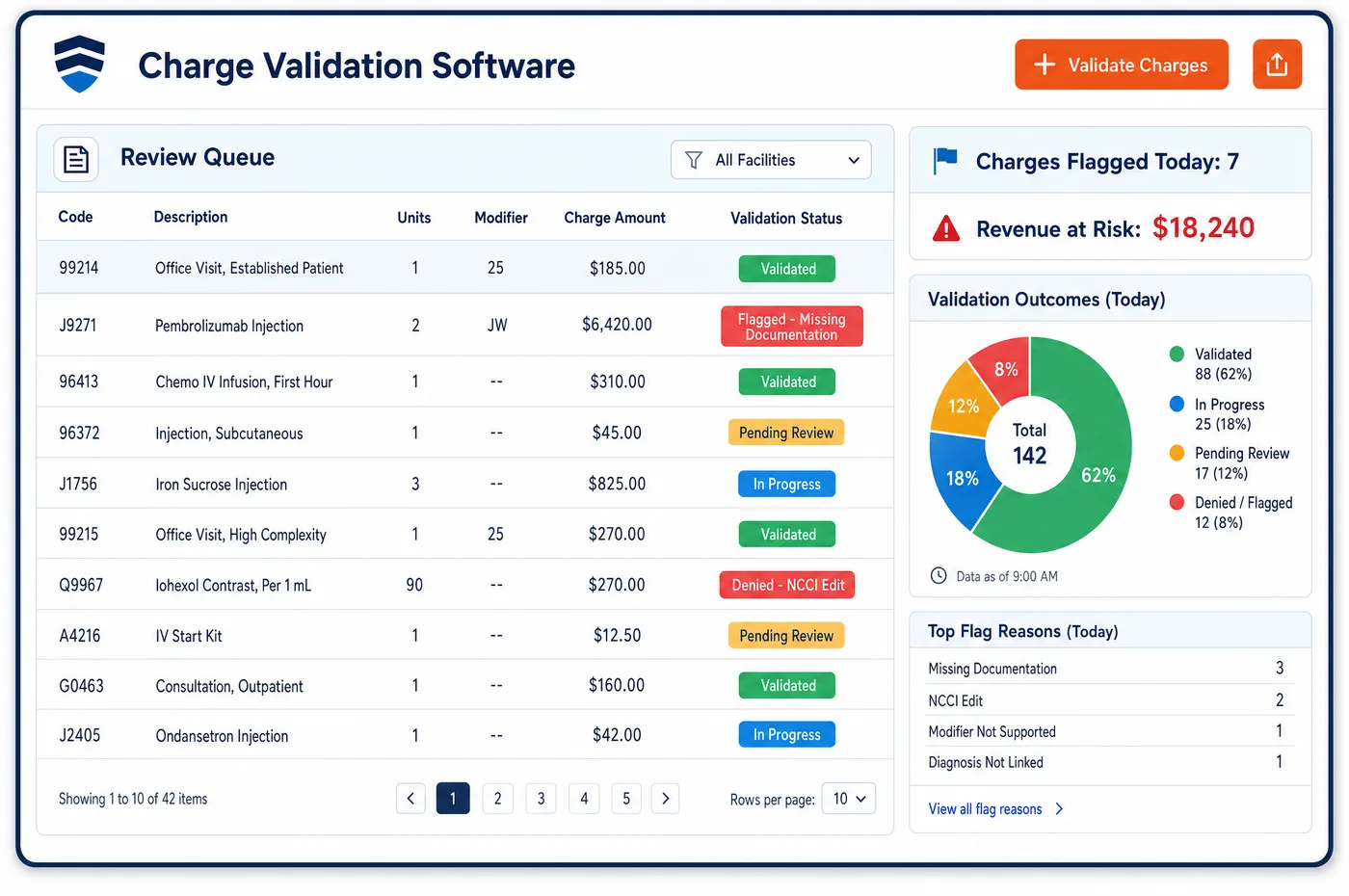
Charge Validation in a Addiction Medicine Practice
Most addiction denials start with a charge that looked fine but broke a rule. Drug testing draws the closest review. For Medicare in Novitas states, a standing order for every patient is not covered. Definitive tests must be ordered for the patient's own history and risk. A long-acting buprenorphine injection may be covered only for opioid use disorder, so the line needs an OUD diagnosis, not a pain code. OTP intake, assessments and extra counseling given by video or phone need modifier 95 or 93. A definitive test billed by a lab that holds only a certificate of waiver won't be paid. Addiction medicine charge validation software runs these checks at checkout. A line that fails is held with the reason and the rule, so staff fix the charge or add the missing note before the claim is built.
Why Is Charge Validation Different in Addiction Medicine?
Drug testing gets more scrutiny than almost any other service in the specialty. Payers watch for blanket orders, large definitive panels run on everyone, and presumptive tests billed too often. A program can test the right patients for the right reasons and still lose the claim if the order and the note don't show why each test was needed.
Medication lines carry diagnosis and product rules. Some commercial plans cover long-acting buprenorphine only for moderate to severe OUD. They treat its use for pain as not needed. Some state Medicaid programs also ask for buprenorphine to be billed by the tablet strength dispensed, not the dose taken. These details sit in policy documents, not in the code book.
Telehealth and setting rules add another layer. OTP add-ons need the modifier that matches video or audio-only care. Intensive outpatient at an OTP isn't paid when given remotely. A charge can pass coding edits and still fail on how or where care was given. Charge validation has to read the visit details, not just the codes.
What Addiction Medicine Charge Validation Software Handles
- No routine standing orders (Novitas LCD L35006)
- For Medicare under Novitas, routine standing orders for all patients in a practice are not reasonable and necessary. Charge validation holds test lines that trace back to a blanket order and asks for a patient-specific order. (CMS Medicare Coverage Database, LCD L35006: Controlled Substance Monitoring and Drugs of Abuse Testing (Novitas))
- Definitive testing rationale
- The same LCD says definitive orders should be individualized by clinical history and risk, and the clinician's reason must be documented. Definitive lines without a linked reason are held for the ordering clinician. (CMS Medicare Coverage Database, LCD L35006: Controlled Substance Monitoring and Drugs of Abuse Testing (Novitas))
- Presumptive frequency in SUD treatment
- The LCD treats more than three presumptive panels in one week as not reasonable and necessary. Validation counts each patient's presumptive tests in the week before releasing another line. (CMS Medicare Coverage Database, LCD L35006: Controlled Substance Monitoring and Drugs of Abuse Testing (Novitas))
- Lab certificate for definitive codes (G0480 to G0483)
- Definitive codes are subject to CLIA edits, and a lab with only a certificate of waiver can't be paid for them. Validation checks the certificate type on file for the performing lab. (CMS Transmittal R3439CP (CR 9502): HCPCS codes subject to CLIA edits, including G0480 to G0483)
- Telehealth modifiers on OTP add-ons (95, 93)
- For dates of service on or after May 12, 2023, CMS expects modifier 95 or 93 on G2076, G2077 and G2080 when given by video or audio-only. Validation compares the visit modality with the modifier on each line. (CMS: Opioid Treatment Program (OTP) Billing & Payment)
- OUD diagnosis on extended-release buprenorphine
- UnitedHealthcare's commercial policy covers Brixadi and Sublocade for opioid use disorder and calls use for pain management unproven and not medically necessary. Validation checks that an F11.2 diagnosis supports the injection line. (UnitedHealthcare Commercial Medical Benefit Drug Policy: Buprenorphine (Brixadi and Sublocade), effective October 1, 2026)
- Tablet strength billing (Washington Medicaid)
- Washington Apple Health asks OTPs to bill buprenorphine products by the tablet strength dispensed, not the dose given. Validation checks the NDC and quantity against that rule for Washington claims. (Washington Apple Health (Medicaid) Substance Use Disorder Billing Guide, October 2025)
How Does Addiction Medicine Charge Validation Software Work?
1. Receive assembled lines
Lines arrive from addiction medicine charge assembly with codes, units, modifiers and links to the order and note.
2. Run payer and coverage edits
NCCI edits, payer policies and local coverage rules are applied to each line. Drug testing lines are checked for order type, frequency and documented reason.
3. Check how and where care was given
The visit's modality and place of service are compared with the modifiers on the line. Remote OTP intensive outpatient lines are stopped, since Medicare won't pay them.
4. Confirm drugs and diagnoses
Injection lines are checked for a supporting OUD diagnosis, the right product code and units. State rules, such as billing by tablet strength, are applied where they exist.
5. Hold, explain and release
Failed lines are held with the rule that failed and who needs to act. Fixed lines move on, and repeat failures feed denial prevention.
Addiction Medicine Charge Validation Software vs. Generic Software
| Area | Generic approach | Unlimited Systems |
|---|---|---|
| Drug testing | Every panel billed as ordered. | Order type, frequency and reason checked per line. |
| Lab certificate | Assumed to cover every test. | Certificate type checked against the code billed. |
| Telehealth | Modifiers added from memory. | Modifier matched to the visit's modality. |
| Injection diagnosis | Any diagnosis on the claim. | OUD diagnosis required where policy says so. |
| Held lines | Rejected with no reason given. | Held with the rule and the person who must act. |
Who Uses It in a Addiction Medicine Practice
- Compliance officer: Drug testing and injection lines checked against written policy before any claim leaves, with a record of each hold.
- Ordering clinician: A short note when a test or injection line needs a reason or a diagnosis, instead of a denial weeks later.
- Lab manager: Clear flags when a test is billed above what the lab's CLIA certificate allows, so testing and CLIA status stay in step.
Addiction Medicine Charge Validation Software FAQs
Charge validation checks that each test came from an order for that patient. It checks that the count of screening tests is within policy and that each definitive test has a stated reason. It also checks the lab's CLIA certificate against the code. For Medicare under Novitas, routine standing orders for every patient are not reasonable and necessary.
A line may be held if no OUD diagnosis supports it. It may also be held if the code doesn't match the dose or the approval has lapsed. Commercial policies such as UnitedHealthcare's cover these injections for OUD and treat pain use as not medically necessary, so the diagnosis on the line matters.
For Medicare, CMS expects modifier 95 on intake, periodic assessments and extra counseling given by audio and video, and modifier 93 when they are given by audio only. This applies to G2076, G2077 and G2080. Charge validation compares the visit's recorded modality with the modifier on each line.
Definitive drug test codes G0480 to G0483 are subject to CLIA edits. A lab with only a certificate of waiver can't be paid for them; it needs a certificate of registration, compliance or accreditation. Charge validation checks the certificate type on file before the line is released.
Under Novitas LCD L35006, more than three presumptive panels in one week is not reasonable and necessary, and testing for patients with an SUD should be random. Charge validation counts each patient's presumptive tests for the week and holds any line past the limit for review.
A failed line is held with the rule it broke and the person who needs to act, such as the ordering clinician or the billing team. Once the order, note or code is fixed, the line is released to the claim. Repeat failures by rule or clinician are reported so the root cause can be fixed.
Related Addiction Medicine Software
Billing & claims
In the revenue cycle
Charge Validation for related specialties
Sources
- CMS Medicare Coverage Database, LCD L35006: Controlled Substance Monitoring and Drugs of Abuse Testing (Novitas)
- CMS Transmittal R3439CP (CR 9502): HCPCS codes subject to CLIA edits, including G0480 to G0483
- CMS: Opioid Treatment Program (OTP) Billing & Payment
- UnitedHealthcare Commercial Medical Benefit Drug Policy: Buprenorphine (Brixadi and Sublocade), effective October 1, 2026
- Washington Apple Health (Medicaid) Substance Use Disorder Billing Guide, October 2025
GET STARTED
See Unlimited Systems in Action
Whether you're actively evaluating new technology or simply preparing for your next vendor renewal, Unlimited Systems can help you understand where your current workflows may be creating avoidable revenue risk.