

Billing & claims
Addiction Medicine Medical Billing Software
Build, scrub and file each OTP, office-based and Medicaid claim in the format and with the pairing rules its payer expects.
Addiction Medicine Medical Billing Software turns documented addiction services into claims and follows them to the payer. It builds each claim on the right form, pairs add-on codes with their base bundle, applies state Medicaid modifiers, scrubs the claim at checkout and submits it electronically. Claim status then comes back to the same screen.



 6,500+ specialty providers

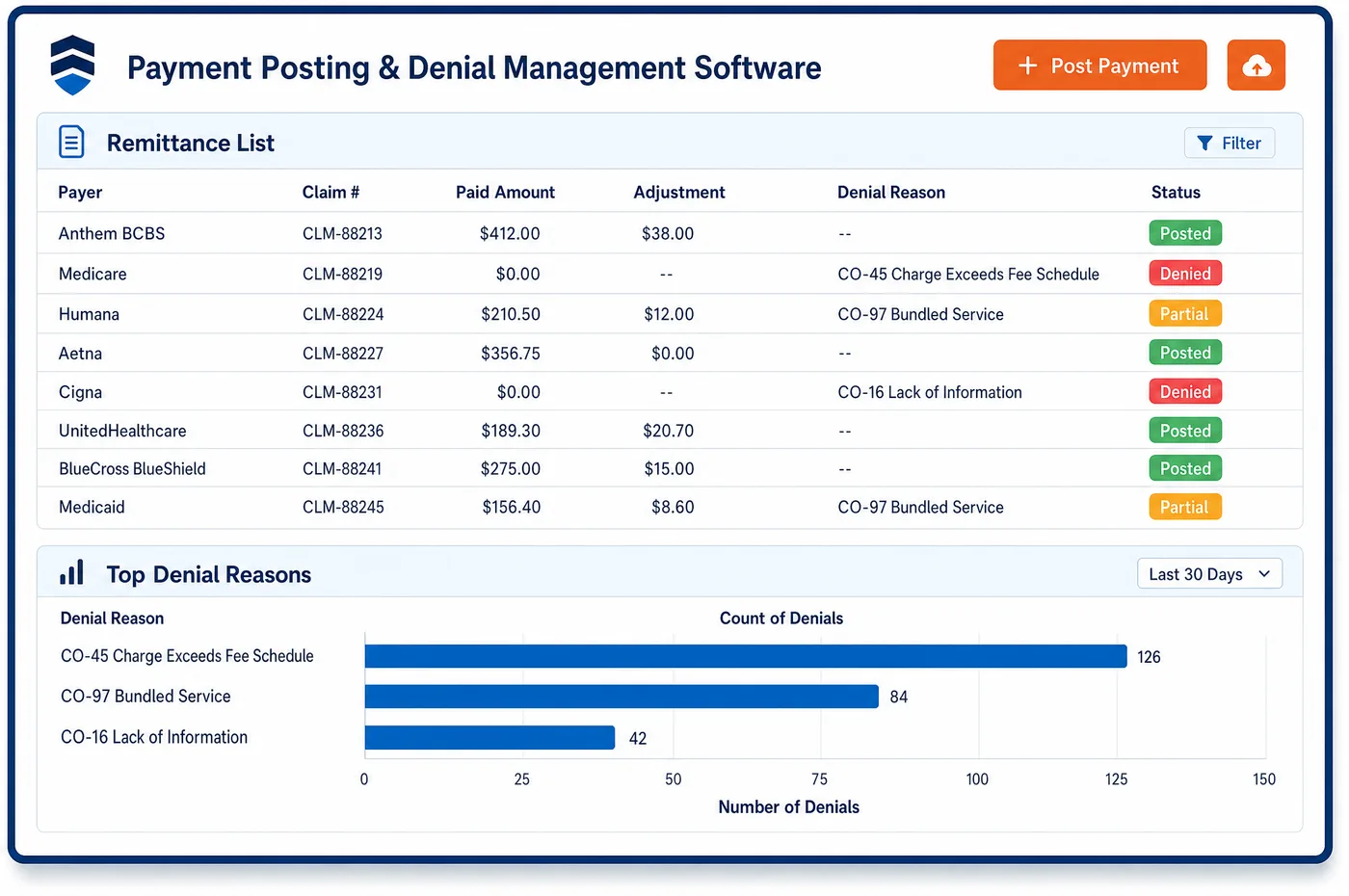
Medical Billing in a Addiction Medicine Practice
Medical billing in addiction care is full of pairing rules. An OTP's take-home methadone add-on can only go with the methadone bundle, and the oral buprenorphine take-home add-on only with its own bundle. Every OTP add-on needs a base weekly bundle on the claim. When a patient switches drugs mid-week, only one bundle is billed, chosen by the drug given for most of that week. Medicaid claims carry state rules of their own, such as a program modifier on each line or a place of service for a mobile unit. Screening codes can't be billed for the same work as an E/M or therapy visit. Addiction medicine medical billing software checks each of these as the claim is built. Clean claims go out as 837 transactions through the clearinghouse, rejections come back to a queue the same day, and staff can see where every claim stands.
Why Is Medical Billing Different in Addiction Medicine?
Claim forms differ by how the program enrolled. A Medicare OTP can bill as a professional provider on the CMS-1500 or as an institutional provider on the CMS-1450. Hospital-based and critical access hospital OTPs use their own types of bill, and a provider-based OTP adds a condition code. Getting the form or bill type wrong rejects the claim before anyone looks at the services.
The weekly bundle is a claim built from many small services. Dosing, counseling, group therapy and toxicology testing all roll into one line, and a week with no drug uses the non-drug bundle. Billing staff need to see the services that support each bundle, and the add-ons that ride on it, before the claim goes out.
Medicaid billing is state-specific in detail. Washington, for example, asks for an HF modifier on SUD program codes, a TF modifier for interim methadone maintenance and place of service 15 for services from a mobile unit. Another state may use different codes for the same care. Medical billing for addiction treatment has to carry each state's rules, not just national ones.
What Addiction Medicine Medical Billing Software Handles
- Take-home add-on pairing (G2078 with G2067, G2079 with G2068)
- CMS allows the methadone take-home add-on only with the methadone bundle, and the oral buprenorphine take-home add-on only with the oral buprenorphine bundle. Claim edits stop a mismatched pair before submission. (Medicare Claims Processing Manual, Chapter 39: Opioid Treatment Programs (Rev. 13572, 2026))
- Add-ons need a base bundle
- OTP add-ons such as G2076, G2077, G2080, G0137 and G0534 to G0536 are billed in addition to a base weekly bundle. The claim builder won't release an add-on without one. (Medicare Claims Processing Manual, Chapter 39: Opioid Treatment Programs (Rev. 13572, 2026))
- Mid-week drug switch
- When a patient switches from one drug to another, the OTP bills one weekly bundle, chosen by the drug furnished for most of the week. Billing staff see both drugs and pick the bundle by that rule. (Medicare Claims Processing Manual, Chapter 39: Opioid Treatment Programs (Rev. 13572, 2026))
- Institutional OTP claims (condition code 89, TOB 013x, 085x)
- Provider-based OTPs report condition code 89, hospital-based OTPs use type of bill 013x and critical access hospital OTPs use 085x. Claim settings follow how each site is enrolled. (CMS: Opioid Treatment Program (OTP) Billing & Payment)
- Washington Medicaid modifiers (HF, TF) and POS 15
- Washington Apple Health uses HF on SUD program codes such as H0004 and H0020, adds TF for interim methadone maintenance, and asks for place of service 15 when an OTP service comes from a mobile unit. These rules are set for that state only. (Washington Apple Health (Medicaid) Substance Use Disorder Billing Guide, October 2025)
- SBIRT with other visits (G0396, G0397)
- Under the Medicare NCCI manual, G0396 and G0397 are not reported separately with an E&M, psychiatric diagnostic or psychotherapy code for the same work or time. The scrubber flags the pair for review. (CMS NCCI Policy Manual for Medicare Services, Chapter XI (revised 1/1/2026))
How Does Addiction Medicine Medical Billing Software Work?
1. Build the claim on the right form
Each site's enrollment sets the form, bill type and place of service. Professional OTP claims use POS 58, and institutional claims use the site's type of bill.
2. Attach the base bundle and add-ons
The weekly bundle is chosen from the drug given, and add-ons are attached only where they are allowed. Units for take-home supplies are checked against the monthly limit.
3. Apply payer and state rules
Medicaid modifiers, payer-specific code sets and NCCI edits are applied at checkout. Problems are fixed before the claim reaches the clearinghouse.
4. Submit and track status
Clean claims go out electronically as 837 transactions. Rejections and status updates return to a work queue, so staff fix them while the details are fresh.
5. File secondary claims
When the primary payer pays, the secondary claim is built from the remittance. Results feed the wider addiction medicine RCM view and the next steps in payment posting.
Addiction Medicine Medical Billing Software vs. Generic Software
| Area | Generic approach | Unlimited Systems |
|---|---|---|
| Claim form | Same form for every site. | Form and bill type set by each site's enrollment. |
| Add-on codes | Added by hand and often orphaned. | Attached only to an allowed base bundle. |
| State Medicaid rules | Kept in a binder at the billing desk. | Applied as edits on each claim line. |
| Rejections | Found days later in a clearinghouse portal. | Returned to a work queue the same day. |
| Secondary claims | Filed when someone remembers. | Built from the primary remittance. |
Who Uses It in a Addiction Medicine Practice
- Billing specialist: Claims that arrive with bundles, add-ons and modifiers already checked, so the day is spent on exceptions.
- OTP administrator: Confidence that each site bills on the form and bill type it enrolled with, with no surprise rejections.
- Medicaid billing lead: State rules applied line by line, with a clear note when a state manual changes and charge validation rules need an update.
Addiction Medicine Medical Billing Software FAQs
Medical billing for an OTP attaches each add-on only to a base weekly bundle. Take-home methadone can only go with the methadone bundle, and take-home oral buprenorphine only with its bundle. Units are checked against the monthly limit. The claim isn't released until each add-on has the base code it needs, which avoids rejections and denials.
That depends on how the OTP enrolled. A professional OTP bills on the CMS-1500 or 837P with place of service 58. An institutional OTP bills on the CMS-1450 or 837I, with a type of bill that matches the site, such as 087x for a freestanding OTP. Provider-based OTPs also report condition code 89.
CMS says the OTP should bill only one weekly bundle for that week. The bundle is chosen by the drug furnished for most of the week. Billing staff see both drugs on the claim worksheet and pick the bundle by that rule, and the clinical note supports the change.
For Medicare, G0396 and G0397 are not reported separately with an E&M, psychiatric diagnostic or psychotherapy code for the same work or time. If the screening and the visit were distinct, the record has to show it. The scrubber flags the pair so staff can check the note before the claim goes out.
State Medicaid rules are set up as payer edits, so each line gets the right code, modifier and place of service. In Washington, SUD program codes carry the HF modifier and mobile unit services use place of service 15. When a state updates its manual, the edits are updated to match.
After submission, acknowledgments, rejections and status responses come back to a work queue. Staff see which claims were accepted, which need a fix and which are still pending with the payer. Rejected claims can be corrected and sent again the same day, before they age.
Related Addiction Medicine Software
Billing & claims
In the revenue cycle
Medical Billing for related specialties
Sources
- Medicare Claims Processing Manual, Chapter 39: Opioid Treatment Programs (Rev. 13572, 2026)
- CMS: Opioid Treatment Program (OTP) Billing & Payment
- Washington Apple Health (Medicaid) Substance Use Disorder Billing Guide, October 2025
- CMS NCCI Policy Manual for Medicare Services, Chapter XI (revised 1/1/2026)
- X12 Transaction Sets: 837 Claims, 276/277 Claim Status and 835 Remittance
GET STARTED
See Unlimited Systems in Action
Whether you're actively evaluating new technology or simply preparing for your next vendor renewal, Unlimited Systems can help you understand where your current workflows may be creating avoidable revenue risk.