

Billing & claims
Behavioral Health Medical Billing Software
Build, scrub, send and track claims for therapy sessions and program days, each to the payer and form it belongs on.
Behavioral Health Medical Billing Software turns sessions and program days into claims and follows each one to payment. It sends each claim to the payer that holds the mental health benefit, with the rendering clinician, taxonomy, place of service and modifiers that payer expects. Professional sessions and facility program days each go on their proper claim form.



 6,500+ specialty providers

Medical Billing in a Behavioral Health Practice
Billing in behavioral health is mostly high-volume professional claims, plus a smaller stream of program claims that follow facility rules. A therapy session becomes an 837P claim with the group as billing provider and the clinician as rendering provider. The clinician's NPI and taxonomy must match what that payer has on file. Place of service shows office, school, home or telehealth, and the payer's telehealth modifier is added when needed. Hospital and community mental health center programs bill differently, on an institutional claim with condition codes that mark partial hospitalization or intensive outpatient days. Behavioral health medical billing software scrubs each claim against payer edits before it leaves. It routes the claim to the right payer, which is often a separate behavioral health company, not the medical plan. Acknowledgments and status come back automatically, and rejections are fixed the same day. This is the claims core of the wider behavioral health RCM cycle.
Why Is Medical Billing Different in Behavioral Health?
Two NPIs sit on almost every claim. The group bills under its organization NPI while each line names the clinician who delivered the session, which is the split between Type 1 and Type 2 NPIs. If a counselor's own enrollment with a payer is missing, the claim fails even though the group is in network. Billing has to check both levels.
Routing is its own job. The same client may have a medical plan, a separate company that pays for therapy, and Medicaid behind both. Sending the claim to the plan named on the front of the card is a common and costly mistake. Each claim has to go to the payer stored for that service, with secondary claims filed after the first payer pays.
Program billing follows different rules. Partial hospitalization and intensive outpatient services from a hospital or community mental health center go on a facility claim. Medicare won't pay the therapists in those programs separately under their own benefit. A billing system that only knows professional claims can't handle a program.
What Behavioral Health Medical Billing Software Handles
- Program claims with condition codes 41 and 92
- Under Medicare, a hospital reports partial hospitalization services, and any other mental health services to that patient, on one claim with condition code 41. Intensive outpatient claims use condition code 92 the same way, so program days go out on the institutional claim with the right code. (CMS MLN Booklet: Medicare & Mental Health Coverage (MLN1986542, March 2026))
- Who bills inside a hospital or CMHC program
- Medicare does not pay clinical social workers, marriage and family therapists or mental health counselors under their own benefit for PHP or IOP services furnished by a hospital outpatient department or CMHC. Those services belong on the program's facility claim. (CMS MLN Booklet: Medicare & Mental Health Coverage (MLN1986542, March 2026))
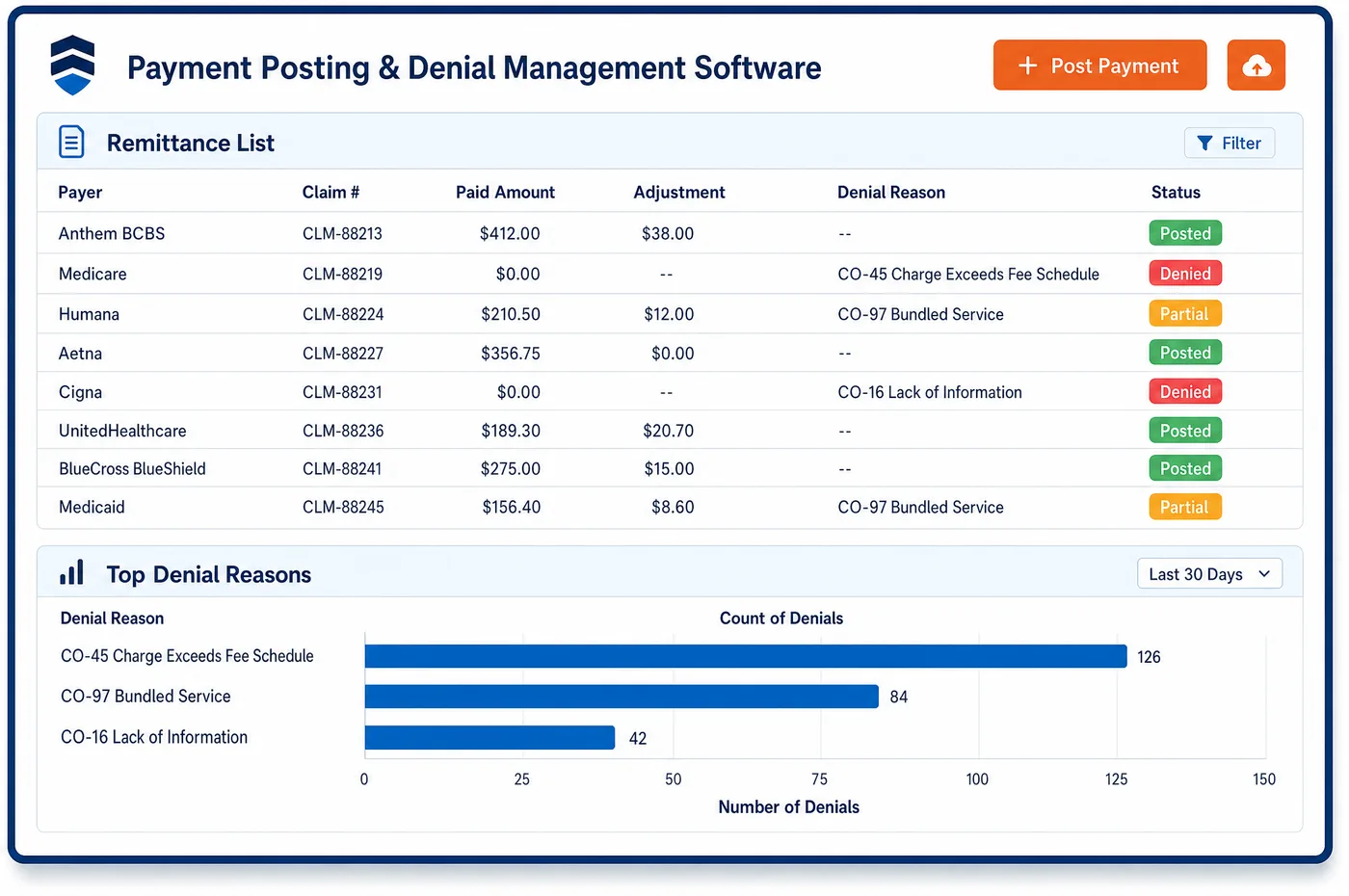
- Wrong-payer denials (CARC 109)
- CARC 109 says the claim is not covered by this payer and must go to the correct one. It often means a session went to the medical plan instead of the company that manages behavioral health benefits, so billing resends to the payer stored for therapy. (X12 Claim Adjustment Reason Codes)
- Clinician taxonomy codes
- NUCC taxonomy codes identify the rendering clinician's type, for example 106H00000X for a marriage and family therapist, 101YM0800X for a mental health counselor and 1041C0700X for a clinical social worker. Billing uses the code each payer has on file for that clinician. (NUCC Health Care Provider Taxonomy Code Set)
- Telehealth modifiers by payer
- Ohio Medicaid requires the GT modifier on services delivered by secure video or other allowed telehealth methods. Other payers ask for different modifiers, so the telehealth rule is set payer by payer. (Ohio Department of Medicaid: Behavioral Health State Plan Services Provider Requirements and Reimbursement Manual, version 1.28.1 (March 2026))
- Electronic claims and remittance (X12 837, 835)
- Professional sessions go out as 837P claims, and program days from hospitals or CMHCs go out as 837I claims. Payment comes back as an 835 remittance that posts to the ledger. (X12 Transaction Sets (270/271 eligibility, 278 authorization, 837 claims, 835 remittance))
How Does Behavioral Health Medical Billing Software Work?
1. Build the claim from checked charges
Charges that passed the charge validation step become claims with billing and rendering providers, taxonomy, place of service and modifiers. No one retypes details from the chart.
2. Choose the claim form
Office and telehealth sessions go on professional claims. Hospital or community mental health center program days go on institutional claims with the right condition code.
3. Scrub before sending
Each claim runs through claim scrubbing against payer edits, NCCI pairs and the payer's telehealth rules. Errors are fixed before submission, not after a rejection.
4. Route to the right payer
Claims go to the payer stored for that service, often a separate behavioral health company. Secondary claims to Medicaid or another plan file off the primary remittance.
5. Track status and fix rejections
Acknowledgments and claim status return electronically. Rejections land in a work queue with the reason, and staff correct and resend the same day.
Behavioral Health Medical Billing Software vs. Generic Software
| Area | Generic approach | Unlimited Systems |
|---|---|---|
| Payer routing | Claims sent to the medical plan on the card. | Claims sent to the payer stored for therapy. |
| Rendering clinician | Group NPI only, clinician missing. | Billing and rendering NPIs with the clinician's taxonomy. |
| Program days | Billed like office visits. | Institutional claims with program condition codes. |
| Telehealth | One modifier for every payer. | Telehealth modifier and place of service set per payer. |
| Secondary claims | Keyed by hand when someone remembers. | Filed automatically off the primary remittance. |
Who Uses It in a Behavioral Health Practice
- Biller: Claims built from checked charges and scrubbed before sending, with rejections back in a queue the same day.
- Program manager: IOP and partial hospitalization days billed on the facility claim with the right condition code, without a separate process.
- Group practice owner: Claims for every clinician type going to the right payer, with balances owed by Medicaid or another plan filed as secondary claims without extra work.
Behavioral Health Medical Billing Software FAQs
In a multi-clinician group, behavioral health medical billing files each session under the group as billing provider and the clinician as rendering provider. The claim carries that clinician's NPI and taxonomy, the place of service and any payer telehealth modifier. It is scrubbed, sent to the payer that holds the mental health benefit and tracked to payment.
When a hospital outpatient department or community mental health center runs the program, IOP days go on an institutional claim. For Medicare, the claim carries condition code 92 to mark intensive outpatient services, and partial hospitalization claims carry condition code 41. Office-based sessions from individual clinicians stay on professional claims.
CARC 109 means the claim isn't covered by that payer and must go to the correct one. In behavioral health it often means a session went to the medical plan when a separate company manages mental health benefits. The fix is to resend to the right payer and store it on the record for future sessions.
Under Medicare, clinical social workers, marriage and family therapists and mental health counselors are not paid under their own benefit for PHP or IOP services a hospital outpatient department or CMHC furnishes. Those services are part of the program's facility claim. Outside those programs, the same clinicians bill their own professional claims.
The taxonomy code should match the clinician's type and what the payer has on file. Common NUCC codes include 106H00000X for a marriage and family therapist, 101YM0800X for a mental health counselor and 1041C0700X for a clinical social worker. A mismatch between the claim and the enrollment record can lead to a denial.
Telehealth claims carry a place of service, such as POS 10 for the client's home or POS 02 for another location, plus any modifier the payer requires. Rules differ by payer. Ohio Medicaid, for example, requires the GT modifier on telehealth services. Billing applies each payer's rule, so the same session is coded correctly for each.
Related Behavioral Health Software
Billing & claims
In the revenue cycle
Medical Billing for related specialties
Sources
- CMS MLN Booklet: Medicare & Mental Health Coverage (MLN1986542, March 2026)
- X12 Claim Adjustment Reason Codes
- NUCC Health Care Provider Taxonomy Code Set
- Ohio Department of Medicaid: Behavioral Health State Plan Services Provider Requirements and Reimbursement Manual, version 1.28.1 (March 2026)
- X12 Transaction Sets (270/271 eligibility, 278 authorization, 837 claims, 835 remittance)
GET STARTED
See Unlimited Systems in Action
Whether you're actively evaluating new technology or simply preparing for your next vendor renewal, Unlimited Systems can help you understand where your current workflows may be creating avoidable revenue risk.