

Billing & claims
Psychiatry Medical Billing Software
Build, scrub, send and track psychiatric claims with the right payer, place of service, modifiers and code pairs.
Psychiatry Medical Billing Software turns validated psychiatric charges into clean claims and follows them to payment. It builds 837P claims with the right payer, rendering clinician, place of service and telehealth modifiers. It scrubs them against NCCI and payer rules, sends them through the clearinghouse, and tracks acknowledgments and status until each claim pays.



 6,500+ specialty providers

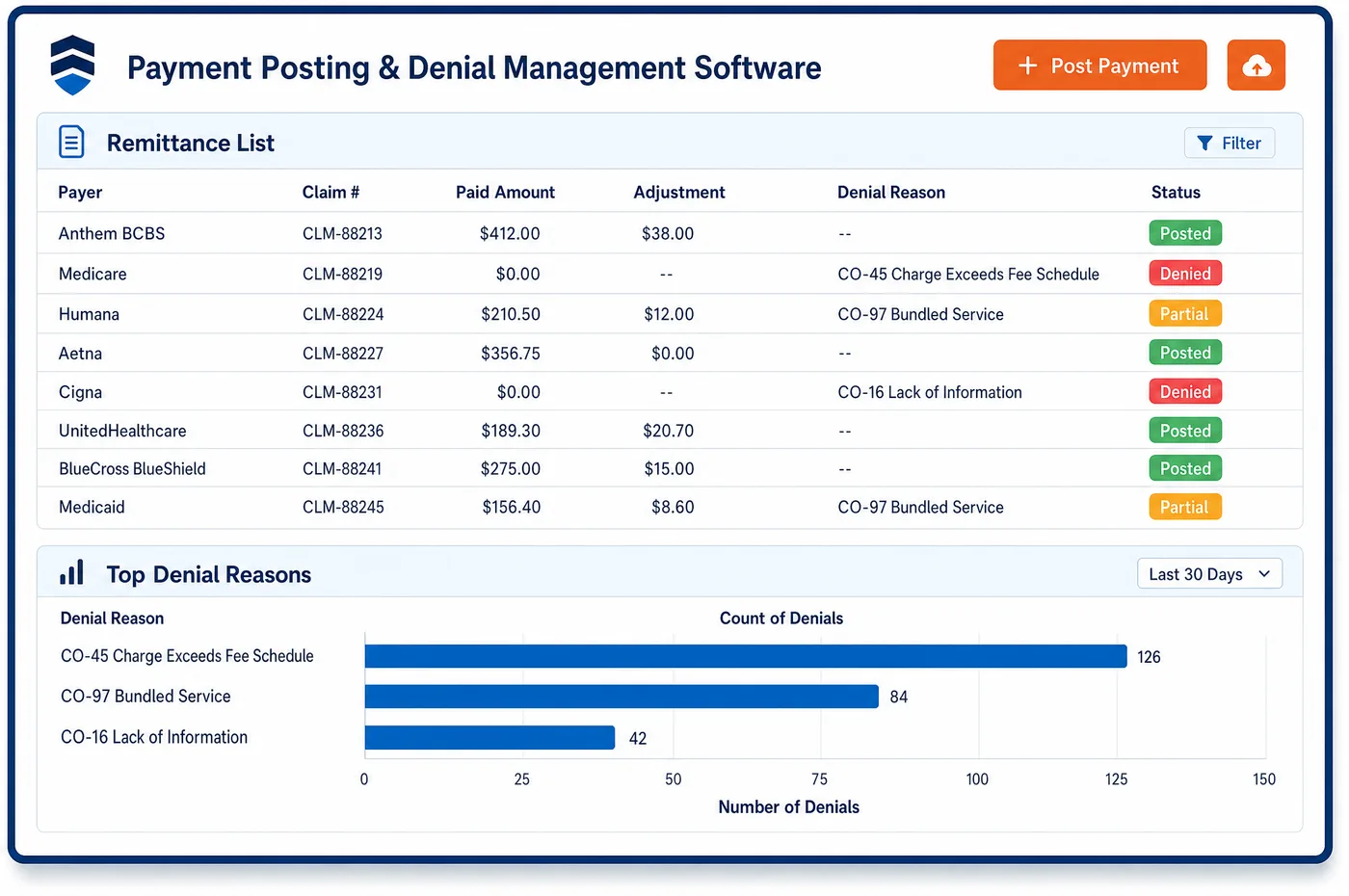
Medical Billing in a Psychiatry Practice
Billing a psychiatric visit looks simple but has traps. A medication visit with therapy carries an E/M code and a psychotherapy add-on on the same claim, and both must point to the right diagnosis. A video visit needs the place of service that matches where the patient was, and some payers also want modifier 95 or 93. The claim must go to the payer that manages the mental health benefit, which may not be the plan on the card. Psychiatry medical billing software builds the claim from the validated charges and applies each payer's format rules. The scrubber then runs NCCI and payer edits, such as the rule against an E/M on the same day as a diagnostic evaluation. Clean claims go out through the clearinghouse. Acknowledgments, rejections and status responses post back to each claim, and secondary claims are built from the primary remittance.
Why Is Medical Billing Different in Psychiatry?
Psychiatric claims are small and frequent. A practice sends many short-visit claims for each high-value procedure claim that a surgical specialty might send. That volume means a repeated error, such as the wrong place of service on every video visit, spreads fast. Medical billing for psychiatry has to catch patterns, not just single claims.
The payer on the claim is often not the plan on the card. When a behavioral health company manages the benefit, the claim needs that company's payer ID and claims address. Medicare adds its own rules for who can bill, and marriage and family therapists and mental health counselors now enroll and bill Medicare directly.
Code pairs also matter. NCCI blocks an E/M with 90791 or 90792 on the same day, and it blocks diagnostic evaluations with psychotherapy on the same day. Add-on codes need their primary code on the same claim, and telehealth rules shift by payer. A scrubber tuned for psychiatry stops these errors before the payer does, which keeps timely filing limits from running out during rework.
What Psychiatry Medical Billing Software Handles
- Professional claim (X12 837P)
- Psychiatric claims go out as 837P professional claims. Each carries the rendering clinician, the billing group and the payer ID of the company that manages the benefit, which may be a behavioral health payer rather than the medical plan. (X12 Transaction Sets: 837 Claims, 276/277 Claim Status, 277CA Acknowledgment)
- Telehealth place of service on the claim (POS 02, POS 10)
- Video and audio-only visits carry POS 10 when the patient is at home and POS 02 when they are elsewhere. The claim takes the value set at booking, so it matches the visit as it happened. (CMS Place of Service Code Set)
- Audio-only modifier 93
- CPT modifier 93 marks a service done by real-time audio only, for codes listed in CPT Appendix T. Payer rules decide when 93 or modifier 95 goes on a psychiatric claim line, and claim formatting is set per payer. (AMA: CPT Appendix T and Modifier 93 (audio-only services))
- Same-day code pairs (90791, 90792, E/M)
- NCCI does not allow an E/M code on the same day as 90791 or 90792, and it bars those evaluations with psychotherapy on the same date. The scrubber holds these pairs before the claim reaches the clearinghouse. (CMS NCCI Policy Manual for Medicare Services, Chapter XI (Medicine, including Psychiatric Services))
- Claim acknowledgment and status (277CA, 276/277)
- After submission, the 277CA shows whether the payer accepted the claim. Status checks with the 276/277 pair follow it until it pays, and rejections come back to staff with the reason. (X12 Transaction Sets: 837 Claims, 276/277 Claim Status, 277CA Acknowledgment)
- Part 2 disclosures for payment
- A claim for treatment in a Part 2 program discloses protected substance use records to the payer. The patient's Part 2 consent sits on the record, so billing staff can confirm it covers payment before the claim goes out. (eCFR: 42 CFR Part 2, Confidentiality of Substance Use Disorder Patient Records)
How Does Psychiatry Medical Billing Software Work?
1. Build the claim from validated charges
Charges that passed psychiatric charge validation become claim lines. The E/M, any psychotherapy add-on and interactive complexity sit on one claim, with diagnosis pointers set to the right F-codes.
2. Pick the payer and the format
The claim goes to the payer that covers the service, medical or behavioral health, with that payer's ID and format rules applied. Rendering and billing clinicians are set from the visit.
3. Scrub before submission
Payer edits, NCCI pairs and telehealth rules run before the claim leaves. Claims that fail are held with the reason attached, so staff fix them once.
4. Submit through the clearinghouse
Clean claims go out as 837P files over a real-time clearinghouse connection. Acknowledgments come back and post to each claim.
5. Track status and file secondaries
Claim status is checked until payment. When the primary payer remits, a secondary claim to Medicaid or a supplemental plan is built from that remittance.
Psychiatry Medical Billing Software vs. Generic Software
| Area | Generic approach | Unlimited Systems |
|---|---|---|
| Payer on the claim | The medical plan, by default. | The payer that covers the service, medical or behavioral health. |
| Telehealth fields | POS and modifiers typed by hand. | POS and modifiers carried from the booking. |
| Same-day code pairs | Found on the remittance after a denial. | Held by the scrubber before submission. |
| Rejections | Found on a weekly clearinghouse report. | Posted back to the claim with the reason. |
| Secondary claims | Filed by hand, or never. | Built from the primary remittance. |
Who Uses It in a Psychiatry Practice
- Billing specialist: Claims that arrive built and checked, with rejections posted back to the claim and a clear reason for each hold.
- Billing manager: Status for every open claim by payer, so stalled claims are worked before filing limits pass.
- Psychiatrist or group owner: Fewer rejections on telehealth and add-on claims, and a clear view of where each claim sits in the psychiatry RCM cycle.
Psychiatry Medical Billing Software FAQs
Psychiatry medical billing software turns validated charges into 837P claims, sends them to the right payer through the clearinghouse, and tracks them until they pay. It applies payer format rules, scrubs claims against NCCI and payer edits, posts acknowledgments and rejections back to each claim, and builds secondary claims from the primary remittance.
The E/M code for the medication work and the psychotherapy add-on code, such as 90833, go on the same claim for the same date. The add-on can't be billed without its primary E/M code. Both lines point to the diagnosis they treat, and the add-on time must be documented apart from the E/M time.
Medicare uses POS 10 when the patient is at home during a telehealth visit and POS 02 when the patient is somewhere else. Commercial and Medicaid payers set their own rules, and some ask for modifier 95 for video or 93 for audio-only. The claim takes these details from the booking and the payer's rules.
When a behavioral health company manages the mental health benefit, the claim goes to that company's payer ID, not to the medical plan. The payer is chosen from the coverage on the patient record. That avoids wrong-payer rejections and denials, and it keeps the claim inside the right payer's filing limit.
NCCI does not allow an E/M code with 90791 or 90792 on the same date, because 90792 already includes medical services. The scrubber holds that pair before submission so staff can correct the claim. Diagnostic evaluations also cannot be billed with psychotherapy codes on the same date of service.
After the claim is sent, the 277CA acknowledgment shows whether the payer accepted it. Status checks then follow the claim until it pays or denies. Rejections and status changes post back to the claim with the reason, so staff can fix and resend rejected claims quickly rather than finding them on a weekly report.
Related Psychiatry Software
Billing & claims
In the revenue cycle
Medical Billing for related specialties
Sources
- X12 Transaction Sets: 837 Claims, 276/277 Claim Status, 277CA Acknowledgment
- CMS Place of Service Code Set
- AMA: CPT Appendix T and Modifier 93 (audio-only services)
- CMS NCCI Policy Manual for Medicare Services, Chapter XI (Medicine, including Psychiatric Services)
- eCFR: 42 CFR Part 2, Confidentiality of Substance Use Disorder Patient Records
- CMS MLN Booklet: Medicare & Mental Health Coverage (MLN1986542)
GET STARTED
See Unlimited Systems in Action
Whether you're actively evaluating new technology or simply preparing for your next vendor renewal, Unlimited Systems can help you understand where your current workflows may be creating avoidable revenue risk.